
Translated material
Simplification of history
Orlova and Aleksandrov-actress and director, co-authors of the famous Stalinist blockbusters “Funny Guys”, “Circus”, “Volga-Volga”-the heroes of the series of Channel One, in which the melodrama prevailed over the facts
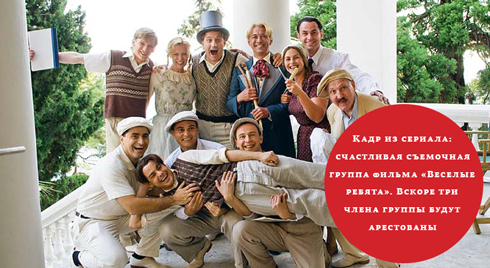
The series Vitaly Moskalenko “Orlova and Alexandrov” was announced as the history of great love. Everyone who knows the story of the cinema a little, will be surprised at the choice of characters: there were many gossip and rumors around the star couple, but their union, according to eyewitnesses, rather spoke of mutual respect and calculation than about the ardent of passion. However, the creators of the series decided to give free rein to fantasy, building a love triangle between Grigory Alexandrov, Love Orlova and Joseph Stalin. The viewers received the perfect melodrama in which, following the laws of the genre, the two impeccable lovers should threaten evil.
As in the movie, the action of the series begins in the late 1920s-the heroes are not yet familiar, but they are already starting to move to each other. Both - beginners, both work in the theater, both are ready for everything for the sake of art. Orlova (Olesya Sudzilovskaya) belongs to the traditional theater (her mentor is the head of the music theater Vladimir Nemirovich-Danchenko, the associate of Konstantin Stanislavsky in the Moscow Art Theater). Aleksandrov (Anatoly Bely) plays in the play by Sergey Eisenstein at the Moscow Working Theater of Plaletcult and already with him leaves the theater to cinema. This lengthy preamble occupies the first four episodes, but, in fact, the story begins only when the heroes connect.
Grigory Alexandrov - “Parsley”, as Comrade Stalin repeatedly calls him - “a little stupid”, “a little cunning”, but overall completely harmless. By order of Obkino and his boss, Honored Bolshevik Boris Shumyatsky, he takes off the funny jazz comedy “Funny Guys” with the fashionable singer Leonid Utesov. Need a heroine, and he finds the actress Lyubov Orlova. Everything goes according to plan, although colleagues call the "new film" vulgarity, but here is the first blow. The OGPU is arrested by the scriptwriters - Nikolai Erdman and Vladimir Mass (both survived) - and gradually digs under Alexandrov and Orlova.
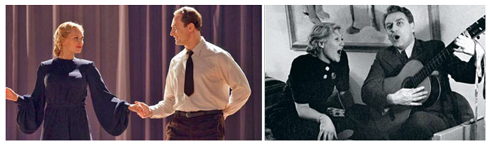
Lyubov Orlova and Grigory Alexandrov in the film (left) and in life (1937)
The main event occurs when the film is ready and Comrade Stalin (Evgeny Knyazev) approves him. Moreover, the leader of the world proletariat gently and sincerely falls in love with Lyubov Orlov and even ready to endure her obedient husband. Although Comrade Gorky honestly warns in a conversation with Alexandrov: they will “not shoot, they will poison anyone, not poison, so with an ax. In the state of workers and peasants, all means are good, ”the proletarian writer reports to the film director in a trusting conversation.
But Alexandrov did not heed an insider. He continued to make films, and the same story happened with each next: at the stage of filming, the Chekists arrested someone from the film group, colleagues-kinematographers together scolded the future masterpiece, but at the last stage, Comrade Stalin’s support helped the next picture to release and gain folk love and international recognition. For this, the director and actress were awarded an apartment, a car, a cottage, an open account in Sberbank. “So, it means that you are, a golden cage,” Aleksandrov guesses.
And terrible things were happening around: during the filming of the film “Volga-Volga”, they arrested the young, talented operator Nikolai Nielsen, with whom Alexandrov already shot two paintings, and after that Shumyatsky, the “father” and the inspirer of Soviet cinema. They were shot, but Erdman (Alexei Vertkov) was lucky - he was arrested to the “Great Terror” of 1937 and therefore received “minus six” (that is, a restriction for living in large cities), Eisenstein (Vitaly Haev), by order of Stalin, closed the shooting of the second part of the painting “Ivan the Terrible” (during the first Dali, he died from which he died from infarction in its room in a communal apartment. Osip Mandelstam (he died in the camp), whose poems “we live by without sensing the country”, for no reason, begins to recite (by the way - to the extremely pathos and mediocre) Orlova in the forest, in the territory of their chic country house - this is from despair that life in the golden cage is so difficult. All this time, the heroes suffer terribly, hate Stalin, call him an earthen worm, worry about friends. Aleksandrov enters into a binge, Beria is trying to poison Orlov, but both still live in luxurious houses, go on cars with a driver for a cottage, sew dresses and costumes at the very expensive dressmaker of Moscow, eat in expensive restaurants and set the table on expensive dishes, as in the days of a long-deceased NEP-in general, they use all the blessings given from above. And most importantly - they continue to make a movie in which they are famous for the happy life of ordinary citizens of a great country, led by the great comrade Stalin. The leader of the peoples himself even once pulls Alexandrov after watching the “bright path” - they say, people must be entertained, and not to be promoted before the authorities. But this is so, an episode. As they say, that we have everything, but we have nothing for us.
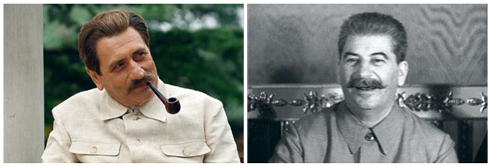
Joseph Stalin performed by Evgeny Knyazev (left) and in life
As in life , it is clear that when you get on the screens of the current Russian TV, reality must certainly turn into popular pictures. Thanks to the creators of the series and that they, for example, did not blame the head of the NKVD of Lavrenty Beria in everything, leaving the image of the leader noblely wrapped, as it is now fashionable. However, the lusting Kremlin recluse, from idleness sings with screen songs and hiding a portrait of his beloved Orlova in the box, is as far from reality as any other stamp.
We do not know what Orlova had with Stalin. In addition to unreliable stories from third -handed, there is no evidence of their non -public communication. We do not even know in what relations there were Orlova and Alexandrov - they lived is closed, always on “you”, had separate bedrooms. We went abroad a lot, visited America and Europe, met with Charlie Chaplin and other Hollywood stars. Orlov was dressed once in the newspaper Pravda - the star diva took very large fees for concerts, but this had no consequences. The cottage was built like Chaplin - a spacious one, with a fireplace hall, with a movie screen, but there were almost no guests there.
After the leader of the leader in Aleksandrov’s films, bills were made-from the Volga-Volga, for example, the name of the ship “Joseph Stalin” was cut out, but Alexandrov never spoke badly about him. However, without Stalin, the spouses did not go to the spouses. Old age was not happy. The son of Alexandrov from his first wife Douglas was of little interest to the father - in childhood he lived in an orphanage, and after the war he was arrested and released a year later. Orlova refused him from home because of her unequal marriage with a housekeeper, but after her death, Alexandrov made up with his son's family, and when her son died, he married his widow, which caused abundant gossip. However, by the end of his life, he, obviously, was not quite in a clear mind.
The history of Aleksandrov’s relationship with Eisenstein is also vague. They spent three years together abroad - they made a movie, met with filmmakers. But by returning to Moscow, the teacher and the student turned almost into competitors. Rumors about the intimate connection between them were very stubborn, but they have no confirmation. However, in the series this topic was simply ignored, except for the pairs of phrases - the hints of Eisenstein himself (whose homosexuality was not a secret for anyone), in the final of the series, which cannot be understood without context.
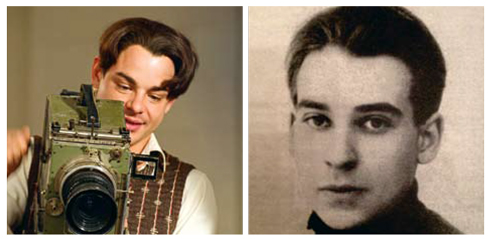
Vladimir Nilsen was arrested during the filming of the film "Volga-Volga" and shot at the Butovo training ground. On the left is Nielsen in the film, on the right - in the life of the victims of historical illiteracy , unfortunately, in modern Russian culture there is no general understanding of the historical past. And the series "Orlova and Alexandrov" is a victim of this mass historical illiteracy, discreteness of perception.
The same films of Alexandrov are part of the Great Stalinist plan to create folk art. And Eisenstein, and Meyerhold, and Mayakovsky - left artists who, having adopted the revolution, are actively looking for forms that are understandable to the masses. How Erdman joked in the forbidden play “Suicide” (1928), under socialism there will be no person - “there will be masses, huge masses of the masses”.
But while the left ideologists and artists discussed and made plans, Stalin began to build new elites: he carried out a massive set to rabfaks, began the replacement of old personnel in party bodies, in the OGPU/NKVD, and then in other areas. The beginning of the thirties - the time of the creation of "funny guys" - was accompanied by the first processes over entire groups of the old intelligentsia. Academic business, Shakhty business, the process of industrial Party, the case of Chayanov (by the way, the first husband of Orlova Andrei Berzin went through it) ... At that time, unique specialists were destroyed, but a precedent was created when an uneducated, wild part of the people began to influence questions in which she did not understand anything. The avant -garde art turned out to be the least understandable to the masses who were so sung by the left enthusiasts. But the musical-cold aesthetics of Alexandrov was perfect for these purposes. This was the true reason for the strong attachment of the leader to Orlova and Alexandrov, in them he saw “Soviet Hollywood”.
The series shown now on the Channel One, in which historical and vital truth, is easily sacrificed to melodramatic stamps, common places and stilting schemes, indicates that the Russian mass culture inherits the Stalin trend for simplification. But if Aleksandrov, the student of the ingenious Eisenstein, in his first paintings, still managed to find a compromise between the unpretentious tastes of the proletariat and the professional brilliance of execution, then the current masters of entertainment spectacles, alas, cannot even boast of formal quality. Their involuntary, but inescapable hack - it is also from there: the Stalinist heritage that we still consume and cannot refuse it in any way.
Photo: ruskino.ru, Anatoly Garanin, ITAR-TASS, Wikipedia.ru