
Translated material
Religion is a kind
Sect
During the last festival of Mediaart, Transmedile in Berlin, I happened to talk with the artist, with whom, as it turned out later, we have a bunch of common acquaintances. At some point, the conversation began to clarify the attitude towards and this kind of willow, which took their stable position in cultural life.
- And what are you working with?
- I generate the video, I never shoot anything myself, only generate. But (pointing with a scooter towards the festival) I am not an adept of this ... a kind of religion.
- Do you mean mediaart?
- Yes.
- That is, you consider it as a religion.
- Absolutely! You know, unlike them, I still draw.
- And they - no?
- No. This is a dogmatic religion that recognizes exclusively digital information.
It is clear that he had in mind not specific participants in an individual exhibition (this year it was called Capture All under the curator of Daphne Dragoon and Robert Sakrovsky) and not random passers -by, but the closed world of Mediaart, which remains separate, despite many years of attempts to go beyond the ghetto of digital art. Is it really so? Having adopted a hypothetical symptom, it becomes easier to navigate in the field of diagnosis.
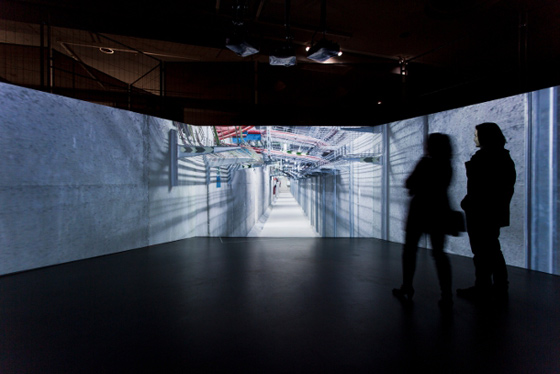 © Julian Paul Transmediale 2015. Internet Machine by Timo Arnall
In contemporary art, a narrow professional division into workshops, characteristic of traditional art, region with their pioneers and heroes, is possible. From this position it is easy to create an assessment, as it meets the technical parameters of its medium. And if desired, we could consider Andy Warhol as an outstanding master of silkography, and the historical exhibition of video art will not do without us June Pike. But quality is a very unreliable and dubious thing, which is under permanent pressure from the art world. And more and more new forms of art replace this unsteady concept, turning art into a dynamic search for meanings.
The relationship between the mediaart, art created with the help of new technologies, is difficult - with all modern art. On the one hand, this area invites us to apply the criteria that are similar only with a scientific discovery. We know that technology is constantly changing, offering the artist more and more production tools that determine the aesthetics of art, etc.
Somewhere there are interdisciplinary intersections. Peter Webel - a conceptual artist - made a bet on the mediaart. He is one of those artists who constantly violate the boundaries. A striking example of this is the Moscow Biennale , which has turned the secret territory of the creation of meanings into an incendiary attraction ( funny excursion of Catherine Lear ).
This is a dogmatic religion that recognizes exclusively digital information.
For the vast majority of Mediaart, it has become a form of contemporary art due to the emergence of the Internet and the whole generation of artists-dilents, who as soon as possible gained the fame of network artists, and some of them even managed to make a transition to the world of adult art.
In the second half of the 1990s, Natalie Kurdchin and Alexei Shulgin wrote “Introduction to Net Art” -in fact, a software manifesto, ironic and realistic at the same time. Many of the postulates cited in it are clearly according to the points, it is quite possible to count for the foundations of the religion that my interlocutor was talking about regarding the media art as a whole. Efficiency, intangible, communication, gratuitous cooperation, etc.
“Introduction to Net-ART” is a utopian, maximalist view of the newly born practice. Today's Shulgin (as a member of the Electroboutique group) is the direct opposite of those software installations that they and Natalie and Natalie described from 1994 to 1997. Actually, the text of 2010 , written in co -authorship with Aristarchus Chernyshev, is their ( Electroboutique - Shulgin, Chernyshev) with a new stitcher: it is necessary to make art cool, attacked, understandable, bright, calculated for sale (material benefit) and serves as long as possible (not ephemeral).
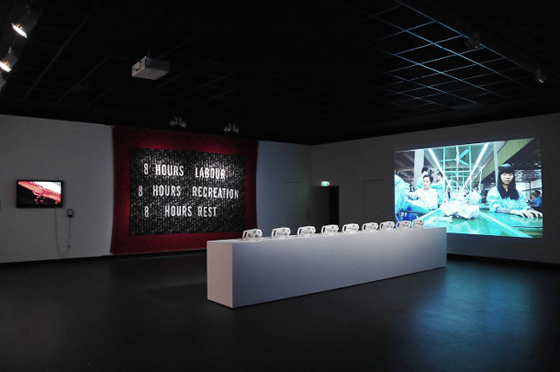 © PACCO Neumann Transmediale 2015. Guest Exchination "Time and Motion: Redefining Working Life"
"Transmediala"
Now you can return in time at the Capture ALL - the main exhibition of the 2015 Transmediale, which took place in late January - early February, and to state the fact that, to one degree or another, a similar story occurred with the entire “religion”.
The curators rightly notice that we live in a world determined by a global competitive movement to optimization. To optimize reading books, especially such as “five languages of love” or “how to acquire friends and influence people”, certainly it is high time. The artists Silvio Lurusso and Zebastian Schmig collected data on the highlights (emphasizing certain offers/paragraphs) made by Rider Kindle users during reading. And they printed with appropriate covers and the initial number of pages only what most users identified (the work is called Networked Optimization ). It was printed, that is, you can’t put it back in Kindle (at least they didn’t do it), but the line was built to “look through”, some even laughed.
Artist Jennifer Lin Moron is tired of the arbitrariness of corporations using users and personally her data for their own purposes, and decided to turn her own life into a corporation - now you can purchase any data about Jennifer (body temperature, interests, videos, photos, etc.), and she calls the viewer to think about information slavery - behind the incorporated personalities, in her opinion, in her opinion There is a bright future, free from extreme capitalism. The installation of Moron consists of promoted certificates, a site and a paper catalog with a price list.
What happened is not good and not bad - the prevailing artistic system sucked mediaart into itself and corrected in its image and likeness.
Probably, the most intangible work at the exhibition was the installation of Jonas Lund “collected for you”: the author’s algorithm selected work from all previous “transmediles”, which passed in the house of the culture of the peoples of the world, and at the current exhibition under the feet of the audience were numbered and outlined by white rectangles of the zone - if you picked up a special tube and press the corresponding figure on it, then a fan A male voice will tell you about the work that was once here and more (most likely) will never be.
The same optimization, which curators carefully talk about, covered the mediaart as a whole, which led to banal mutations: the desire for materiality, institutionalization, production of the object, museumification - in the manifesto of the Kurdchin/Shulgin, this went under the item "Materials and crash":
“What you need to know:
A) current status
1) No art undergoes huge transformations as a result of newly acquired status and institutional recognition
2) So no art is transformed into autonomous discipline with all the ensuing: theorists, curators, museum departments, specialists and board of directors
B) materialization and collapse
1) movement from inconsistency, intangible and immediacy to materialization
a) production of objects, show in galleries
b) archiving and museumification
2) Interaction with institutions: The Cultural Loop
a) work outside the institution
b) declare that institutions are evil
c) throw a challenge
d) undermine institutions
E) Introduce yourself into an institution
f) attract institutional attention
g) rethink institutions
h) work within the institution
3) interaction with corporations: improvement
a) the need to join the stream of corporate production in order to remain on the crest of relevance and visibility
b) the use of radical art strategies to promote products. ”
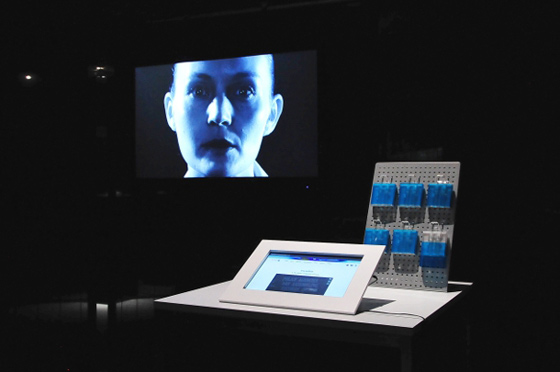 © PACCO Neumann Transmediale 2015. Invisible by Heather Dewey-Hagborg
***
What happened is not good and not bad - the prevailing artistic system sucked mediaart into itself and corrected in its image and likeness. And the only question that remained unresolved-why is it still somehow specially allocated? It seems that you can already remove the strip from the shoulder and not invent a non -existent ghetto. This privilege of the novelty and avant-garde maximalism will remain with someone else.
Nation
If you still consider art as a religious sect or, for example, a nation, then I would like not to go through the division into “ethnic groups” (mediaart, painting, sculpture), but on the contrary, imagine what modern art as a whole is. This is, of course, an international transnational art community. And, unlike nations, it is not imaginary. Benedict Anderson, who described his concept of the theory of the nation in the book “Imaginal Communities” , noted that the nation is imagined , “since the members of even the smallest nation will never know most of their brothers-to-the-ones, meet them or even hear about them, while in the minds of each of them there are the image of their community.” The artists, on the contrary, perfectly imagine their “brothers”, but there is often no image of community. The nation always implies the presence of other nations and a comparison (and more often - contrast) with others. The world art community, paradoxically, is one. And his phenomenon is unimaginally (amazing).
Art is a non-imaginary community (it is not imagined, and it is unimaginably).
I tried to express this plastic in the form of an intangible, network object.
Neither Imagined Nor Imaginable Community
You Might Need Flash Player 10The author expresses gratitude to Roman Minaev for help in creating work