
Translated material
I came, I'm not talking
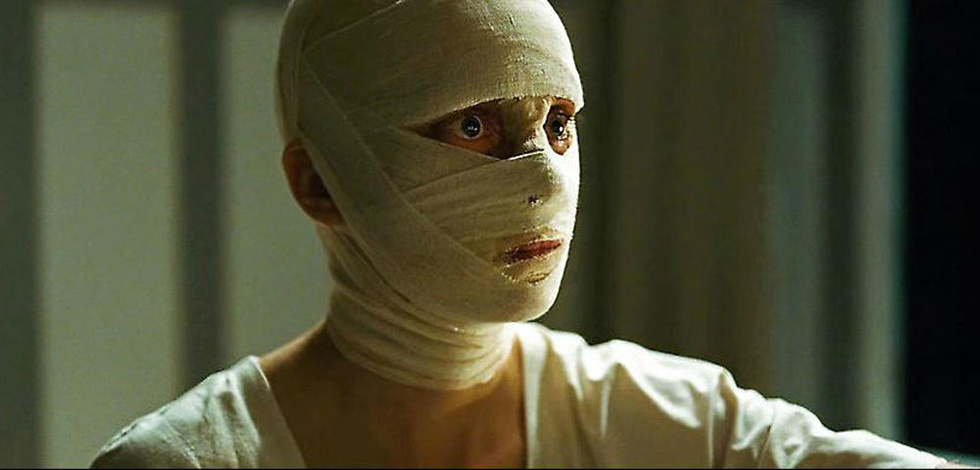
No, this is not a character of a zombie chorror. This is just a woman after plastic surgery. Nelly Lenz, a pop singer, unknown why (was Kurt Vile needed to bureaucrats of the Third Reich?) Returning to Germany in the 34th, just between the destruction of the attack aircraft and the adoption of racial laws. She hid until the 44th in the boat house, was arrested two days after the arrest and interrogation of her husband-pianist, safely released right away. Auschwitz (here we know little, except for the second flashback “Beautiful Sunny Day in the Camp”). Apparently - the mass execution, the wound in the face, miraculously survived, was saved by her sister (sister?), And remained the only heiress of the condition. One, without a face, without a voice (“no one wants to speak with those who returned“ from the east ””), without a place. In a desperate desire to return to himself, Nelly lies on the table of a plastic surgeon, demanding to return the old face. “It will not work in the same way,” the doctor gently warns. And it does not work.
A quiet, frightened shadow, a real nose, Nelly sneaks along the night streets, is looking for her husband, who calls Johnny’s stage name, is looking for American clubs. In this sector of Berlin, every pimp responds to Johnny, but Nelly finds him. Johnny is probably still a traitor, and he does not recognize his wife. But he offers a deal: a little rehearsals - and Nelly the current one will turn into Nelly the present, receive his Jewish inheritance, and then they will share it. She agrees.
The criminal novel by Yuber Montayei “Return from the ashes”, which is beyond recognition, was prepared by Christian Petzold and his teacher and constant co-author Harun Faroki (only the theme of camps, duality and inheritance remained), it seems as wrong as possible-and at the same time impossible-the material for Petzold-resident. The resulting “Phoenix” is the film, who was caught on the hook of his own idea-idefix, bravely stepping into the trap of his favorite topic, which leads him to the source of the eternal elusive, but so disturbing his modernity, to the place where his entire apparatus is difficult to receive. The instrumentation and technique of Petzold, in particular, and the “Berlin school” were generally always imprisoned for macro -filming of poststoric being, immovable, slowly looking around in a half -shaped attempt to understand where it is generally located. Politics and other “large narratives” in these films expressed themselves through a chain of household little things, through poses, habits, interiors and landscapes, Small Talk and exploding its attacks of despair.
In the “Phoenix” optics, designed for microscopy of frustration of a small person, is visible to the world, where not only a small one - a person as such grinding into the dust of the Holocaust machine. The directory in which the main roles were assigned not only to actors, but also to their dresses and trousers, material fragments of feelings and memory, collides with an environment where there is nothing but ruins. In this world of ash and ashes, the problem of identity, always tormenting the characters of Petzold, is articulated extremely clearly, even explicitly, on the verge of a grotesque, a horror film: a good half of Phoenix Nina Hoss goes in the guise of an ominous dead man. A woman without a face playing something convulsive, in the spirit of the horror of Georges Franju-is she not an ideal, visible metaphor for all the searches of the German identity that Berliners led the “Berliners” for the past twenty years?
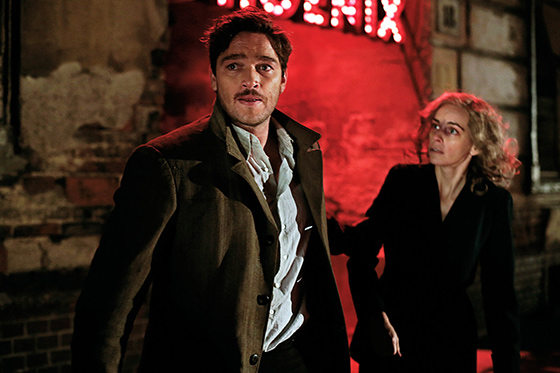 © Schramm Film Koerner & Weber
But a bright metaphor is poorly compatible with the fact that we are used to calling a “Berlin school” - an ellipsis school, lack of core, and indifference between valid and apparent. And in the “Phoenix” metaphors are everywhere, they circle their heads, turning the laconic, compact, in some ways even the utilitarian cinema of Petzold into their seemingly French opposite. A surreal night scene, in which the patients of beauty clinic hidden behind the bandages secretly creep into the doctor’s office and in a somnambulic either in enjoyment, or longing in grave silence, look at the photographs pinned to the wall (one - their future face, the second - rather, this is too much, too bright, too magical for that minimalist for that minimalist Petzold, whom we knew before.
However, can we talk about injury without showing the symptom? And the burned, fragmented and blocked face of the heroine of Nina Hoss is not just a beautiful symbol, but a visible symptom, like dark Berlin streets covered with piles of bricks. Aushwitz destroyed not only Nelly Lenz's appearance - he burned the entire pre -war subjectivity of Germany. For myself, Nelli is no longer a German (“I can’t bear German songs anymore”), but not a Jewish (she never counted herself and is not going to go to Haifa to work out inheritance, building a Jewish state), not a singer and, it seems, is not even a woman anymore. She passed the countdown (“This is from the German film“ Woman on the Moon ”,” the doctor-erudite suggests) not on the surgeon’s table, but in the camp hut, and now she is at the Zero point. To collect herself again, she needs a foundation. What-only Johnny knows about this, a man who once loved her, who examined in her something invisible and elusive, which made her himself.
It is the search for this of his only real line that Nelli is busy in Johnny’s basement apartment, trying on his old shoes, dresses, walking and turning either an enpas, then into a profile. But neither a voice, nor a gait, nor a look - nothing helps the ex -husband find the lost object of his love in the figure of a new friend. Of course, in the finale, following the inexorable logic of costume-historical stylization, Petzold is trying to give out for this elusive quality something equally elusive and difficult: a poetic grimace dejauu appears on Johnny's face when Nelly sings “ Speak Low” in front of petrified friends. The camera at this time will persistently show a completely different, quite material line - a strip of a camp number on Nelly's hand, for lifelong, forever cutting it off from the rest of Germany. It is difficult to call this as a resurrection from the ashes, and “Phoenix” here is just the name of the dirty bar in the American sector.