
Translated material
One of the seventeen
Another 4-8 thousand years ago, only one man of 17 born actively multiplied. This turned out during the fundamental study of paleogenetics, the results of which are published in the respected Genome magazine Research . More than a hundred scientists involved in the work completely deciphered 456 samples of Y -chromosomes 456 men from around the world.
Actually, initially the goal of such work was not to establish how many women were fertilized by the average man, even in the Middle East during the Babylonian kingdom: four thousand years ago - this, of course, is no longer “primitive people”, but the era of Tsar Hammurabi or the Egyptian Middle Kingdom. They studied the evolution of a person in general, the speed and time of his resettlement on the planet, related ties between various groups. This is a solid section of science at the junction of anthropology, population genetics and paleogenetics. Together, they are engaged in the history of man as a biological species.
Y -chromosome, as you know, is a standard object for this science. Why? Because it is only in men and is transmitted only from father to son. Now imagine: you want to find out who was your great-great-great-grandfather- (and so on) grandfather. You just compare your Y -chromosome and chromosomes of alleged ancestors. As you find the same - count, found their own. Of course, what I just wrote is wrong. In the vast majority of cases, they do not do this. For the simple reason that getting the genetic material of long -dead people is somewhat problematic. Scientists go by a bypass: they compare the chromosomes of now living people with each other and thus find relatives, close and distant: this man from Estonia, for example, is almost a brother, but that Chinese is at best a second cousin.
Everything would be easier (and much more boring) if these chromosomes did not change in generations. But they mutate. Very slowly, but with a known speed - a little less than one point mutation per year per billion nucleotide couples (chromosomes DNA consists of nucleotides, as everyone knows from the school course of biology). Then this mutation can remain with the descendants, or maybe not: it depends on how successfully the person has multiplied. That is, the more people, the more likely it is that someone will have a mutation that will remain. During the existence of mankind, many such mutations have accumulated; According to them, they determine how close a relative is one person to another. And by the distribution of these mutations among humanity, a lot can be calculated.
In the work that is now being discussed, for example, it was found that the genetic Adam -a person who had not yet mutated the Y -chromosome, the ancestor of all the Y -chromosomes of all men of the Earth, lived 254 thousand years ago in Africa. His descendants went to other continents about 47-52 thousand years ago. So we are all a little relatives.
Humanity ceased to live as before. Changed traditional values - so much for millennia lived with a coefficient of 4 to 1, one man for four women.
But this does not mean that we do not have genes of other ancient people. On the contrary, we have some genes even from Neanderthals. However, it is much more difficult to calculate according to the genome of ordinary chromosomes, who handed over to which genes than the Y -chromosome. Because ordinary chromosomes always mix their genes obtained from both parents. And the y -chromosome is transmitted to the sons as a whole and always unchanged (excluding the mentioned mutations, of course). That's what they think when and from whom someone came. There is, however, another person like a genome - the mitochondria genome. On the contrary, it is transmitted only from the mother, but to everyone - both boys and girls.
The most interesting thing began when the data on the mitochondrial genome with the latest data on Y -chromosome was compared. It turned out that about eight thousand years ago, suddenly one woman became much fewer men than before. The ratio fell repeatedly - up to one man into seventeen women. This does not mean that the strong half of humanity suddenly ceased to be half overnight, but turned out to be one seventeenth. This means that the offspring of only one of the seventeen men have reached our times. The rest were either completely excluded from reproduction, or their share is so small that then completely disappeared against the background of the triumphal procession of the heirs of that one -seventeenth.
What's happened? The authors of the work asked this question. The general meaning of the answer is this: humanity has ceased to live as before. Changed to traditional values (and after all, millennia lived with a coefficient of one man for four women). Because that period - 4-8 thousand years ago - the time of the first cities, the transition from stone to bronze, the origin of civilizations, constant skirmishes between the clans. The horse was already domesticated, and the mammoth was exterminated (however, the last mammoths lived on Wrangel Island even during the pyramids and died out only to Tutankhamun’s rule; they were in small tall, about the cow).
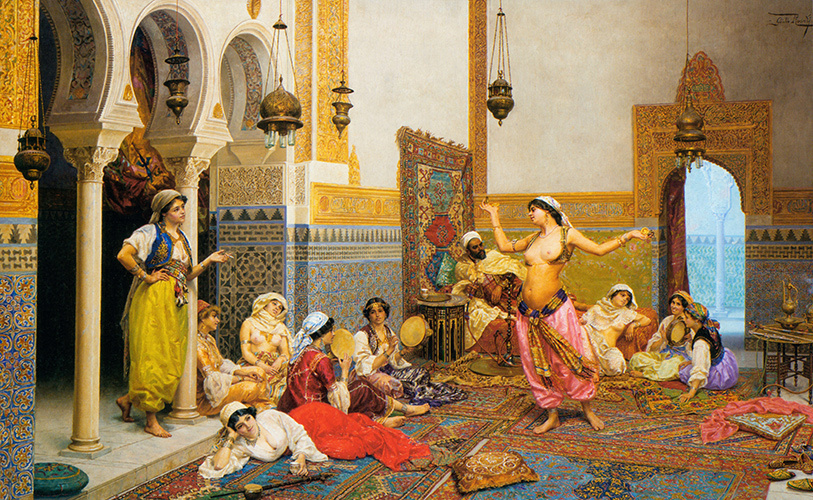
There was a real, no longer primitive culture, and social relations have changed. This is the main thing that happened. Technically, such an egregious violation of the right to offspring a huge number of men could have several reasons. The simplest: the neighboring clan comes to the village, takes men and concubines of women into slavery. Or like this: I have more funds (cows, slaves, lands) - well, there are more women. That is a harem.
The change of social structure went, as they would say in Soviet times, with excesses. This is always the case with revolutions-someone is lucky for someone, someone is not at all lucky. There was not a single region of the inhabited world that would not go through this Y -chromosomal bottleneck. Then the situation began to be rapidly aligned - apparently, civilization allowed many to have children. Already 2.5 thousand years ago, nothing remained of the former imbalance, the leveling of women and men continued in the reproduction of women and men, quickly slipped the “One to four” good good Neolithic and approached the current “one to one”. Not without local excesses, of course, connected, as a rule, with conquests.
Could there be a different story? We will never recognize this. Because globalization goes through the Western model with conditional monogamy, and local cultures with polygamy and multiply, most likely, in a historical perspective, cannot survive.