
Translated material
Iranian oil and American slate
On April 2, in Lausanne (Switzerland), Tehran agreed with the “six” of international intermediaries* on the gradual folding of his nuclear program in exchange for the lifting of sanctions - in the banking and oil spheres. Oil exchanges almost did not respond to this event 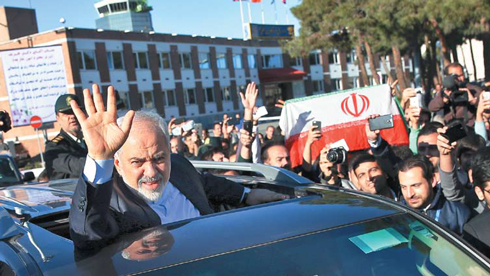
US President Barack Obama called Lausanne agreements “historical”. Optimism is also full in Tehran. “Decisions are found. We are ready to start writing a draft of the contract immediately, ”wrote on his Twitter the head of the Iranian Foreign Ministry, Javad Zarif, referring to the general mood to finalize and sign the agreement no later than June 30. The essence of the transaction: Iran uses its achievements in the nuclear region purely for commercial purposes. Iranian enriched uranium will be sold in the global nuclear fuel market. In this case, the only object to enrich Uranus will remain a plant in Natanze. The reactor in Arak will also be rebuilt for peaceful purposes - the Islamic Republic refuses the production of weapons of weapons of Plutonium. Magate inspectors will gain full access to Iranian nuclear facilities. “Six” in response loses sanctions against the oil and banking sectors of the Iranian economy. We are talking about taking a ban on the purchase of oil and gas from Tehran, for export to Iran of some metals, as well as technologies for the oil and gas industry. Iranian banks disconnected from the SWIFT international calculation system will be connected to it again.
So, one of the world's largest oil and gas producers returns to the global hydrocarbon market. It seems that the trend for reducing the price cannot be avoided. After all, the removal of restrictions on the purchase of Iranian oil means in the near future the receipt of additional volumes of “black gold” on the world market. “This threatens to increase the excess of raw materials in the market and extend the period of relatively low prices,” said Stanislav Kleschev, chief analyst of the VTB investment department. It seems that you can’t argue here. Meanwhile, oil almost did not react to the course of negotiations in Lausanne, and when they announced their results, the barrel of the brand of Brent, although at first, fell from $ 57 to $ 54.11, but then grew to $ 55.
Why does the oil so sluggishly reacting to the lifting of sanctions from Iran, which occupies the 6th place in the world for the production of "black gold"?
Firstly, in Lausanne, only a framework agreement has been reached by it, without details and specific numbers. The final text of the contract, as already mentioned, promises to be finalized by June 30. Secondly, even if Iran is allowed to fully resume oil exports, it will take “two or three years to make it an increase in the supply in the market,” Mikhail Krutikhin, partner of the consulting agency of Rusenergy, noted in a conversation with NT.
But the “modest” market reaction to Lausanne agreements has a deep reason. And in order to understand it, you need to look at another event of an international scale - a civil war in Yemen. It began in July 2014, and by the spring of 2015, the Shiite rebers-Hussites have already controlled the most part of the country. On March 26, the Saudi Arabian Air Force included in the conflict, dropping bombs in the positions of rebels, which, according to rumors, helps Iran (see NT No. 10 of March 30, 2015 ).
Yemen himself as a raw material power is somewhere in the third ten world ratings-both in oil export, production, and in proven reserves. The whole question is in his geographical position. The one who controls Yemen also controls the Bab-El-Mandebi Strait through which tanker oil supply is coming. In addition, the republic borders on Saudi Arabia, which, on the contrary, is steadily included in the three leading oil countries according to the parameters listed above.
However, the oil market seemed to not feel the conflict in the most important-as always it seemed-the oil region of the world: Brent Brent fell since June 2014, when it cost about $ 115, to $ 47 in January 2015, despite the war, and in recent months will range within $ 50–65 per barrel. Partly the reason is that the conflict in Yemen has not yet led to a serious violation of supplies. Partly, in the fact that the market in recent months has completely stopped reacting to military operations in the Middle East. “The military operations also continue in Libya, there are two centers of government, mining in March (2015) fell, but, in fact, there was no reaction (market.- NT ),” Marcel Salikhov, head of the Economic Department of Energy and Finance, noted in a conversation with NT . The expert sees the reason that the attention of the world market is focused on the US oil industry, and not in the Middle East. In other words, the market now primarily reacts to what is happening in the American oil industry, to the US oil in the dynamics of production, total reserves, the number of drilling rigs, and the ratio of demand. This is an absolutely rational and justified approach: thanks to the mass production of shales of the United States, back in 2010, in 2010, they reached the first place in the world for the production of this type of raw materials (according to the International Energy Agency) and hold it to now, ahead of Russia and Saudi Arabia. Irrational here is more likely that until 2014 the market “did not notice” the shale revolution in the United States, although the growth rate of shale oil over the ocean was well known to all players for at least 3 years.
* Great Britain, Germany, China, the USA, Russia, France. Photo: Ebrahim Noroozi/AP