
Translated material
The effect of deja vu
How censorship mechanisms in the USSR worked
I, like many people who remember Soviet life, recently have a strong effect of deja vu - familiar technologies have been tested, the previous rhetoric is returned, public opinion is processed, and personnel are recruited. Although it seems to me that those who are trying to return to Soviet forms of control over the repertoire and the performances themselves do not have enough imagination, what costs this will require. It will not be possible to repeat what was in Soviet times under a carbon copy. I treat this with a sense of sad humor and recall the message of A.K. Tolstoy to the head of the censorship committee (in connection with the horror of the latter before the discovery of Darwinism): “A way, as the Creator did, / what he considered more by the way - / The chairman / committee on the press cannot know.”
In the history of the control of Soviet censorship, everything that moved and breathed, it’s not even interesting how they learned to hold and not let go, but completely different: how could not protect the system, how the meaning was breaking through the asphalt. They kept the artists on a long or short leash, awarded orders and ranks, threatened with kales, deprived of citizenship, sent outside the country, but nothing helped. Has the modern plays crippled? Yes, but in response a prose Theater arose. Can't change the text of the classics? Yes, but in old texts, without changing a single letters, they counted modernity, all our lives and burned the audience with their discoveries. In “Boris Godunov” on Taganka, in “Horse States” and “philistines” Georgy Tovstonogov, in the “Three Sisters” Anatoly Efros, in the “Death of Tarelkin” by Petra Fomenko, in the “profitable place” Mark Zakharov opened a deafening content.
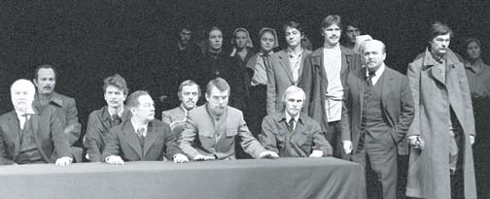
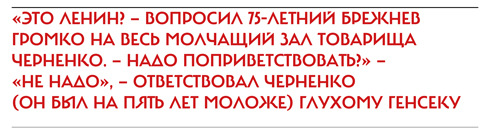
The performance of the Moscow Art Theater based on the play by Mikhail Shatrov "So we will win!" At first it was banned, but then received the State Prize, Moscow, 1981 learned to protect signs on paper, but failed to censor the air of the performance, its pauses, its rhythms, light, impressions, the breath of the actor, its intonation. I will give only one example, as they say, from my own life. In the early 1980s, a performance prohibited in the Art Theater arose about Lenin "So we will win!" A year after the ban, the performance nevertheless goes to the public. And what happened? The will of Oleg Efremov? Yes, of course, but also many other things that the system could not overcome. They fought not with the play on paper, but with the finished performance, in which there was everything that the theater was alive as art. We rearranged the phrases, gave something, but the meaning of the performance did not change. He was no longer dependent on words. When in March 1982 they brought to the performance of the 75-year-old Leonid Ilyich, there was a clash of what could be called the audience’s spectator with the element of the living theater not subject to him. The effect of the Shakespearean mousetrap in Gamlet. He knew that he was brought to a meeting with Vladimir Ilyich. He was not warned only about one thing: that Lenin would come out, but there will be no applause, as it should be according to the Soviet ritual. Director Oleg Efremov created such stage circumstances that put the Secretary General in a dead end. “Is this Lenin? - he asked loudly to the whole silent hall of Comrade Chernenko (he became the Secretary General after Brezhnev and Andropov. - NT ), his well -known semi -paralyzed voice. "We need to greet?" “No need,” Chernenko answered (he was five years younger) to the deaf secretage, without turning his head to the owner. They sat in sight of the entire hall, each of their commentary caused a murmur or laughter. The hall lived at once with two performances: on the stage and in the government bed. Then, after the premiere, they called Efremov to the Minister of Culture, asked to change some phrases. Efremov easily agreed. The performance already lived according to its own laws, and nothing could be changed by any small text lugs.
There were two types of censorship. First, the text was allowed for execution, and then, at the exit, and the performance created according to this text. In the role of censors, a repertoire collegium acted. It was in every republic of the country, and the structure of the main repertoire collegium of union significance was married. People of different professional dignity worked there. There were comrades specially trained for the subtext, who, in the event of a hidden text threat (“mines”), could confidentially inform the author: “Something is pressing me here.” There were other specialists who tried to compare the danger coming from the director, with a danger coming from the text itself, including the classic one. Comrade Goldobin, who led the Union repertoire collegium, trying to influence Peter Fomenko-at that moment he staged a performance in the Mayakovsky Theater,-read the at home carefully the play of Sukhovo-Kobylin “The Death of Tarelkin”. After reading, he was deeply saddened and informed the director: yes there (that is, in the play) worse than yours.
In the case of the play about Lenin in the Moscow Art Theater, the Institute of Marxism-Leninism acted as the censors of the text. But the performance was prepared-contrary to the rules-without the permission of Glavlite and the Institute of Marxism-Leninism: this was Efremov’s special insolence. Officials who spoke on behalf of the state did not have the means to censor theatrical text. The theater turned the almost children's request to the very top: to allow "to improve our Leninist performance." Well, how can it be forbidden to improve? They allowed to improve the text, but could not censor the finished performance. There was no qualification. The performance came to the public, and it was necessary to deactivate its meaning by the award of the USSR State Prize. The prize prize, and Sasha Kalyagin continued to do what was laid down by the director. “No one in the world will be able to prevent the victory of the Communists, if the Communists themselves do not interfere with her, no one in the world will be able to compromise the Communists if the Communists themselves do not compromise themselves.” Thus ended the performance about the next fork of our history, about the real threat of returning to Stalinism. And the hall exploded by a standing ovation, which I would now call an ovation of understanding.
To the collapse of the entire system of life, in which there was a double protection against the impact of the theater, it was a stone's throw.
* Anatoly Smelyansky - the historian of the theater, doctor of art history, in 1980-1987 - the head of the literary part of the Moscow Art Theater. Photo: Sergey Karpov/ITAR-TASS, Vasily Egorov/Photokhronika TASS