
Translated material
With whom are you, masters of culture?
The story with the Wagnerian Tangaiser once again revealed fundamental value discrepancies between today's authorities in Russia and civil society.
For the Kremlin, she became the reason for raising the question of “preliminary views” of performances. For theater figures - it seems to be a chance to unite and hit the alarm: the country in full pairs rolled back to the censorship of Soviet model 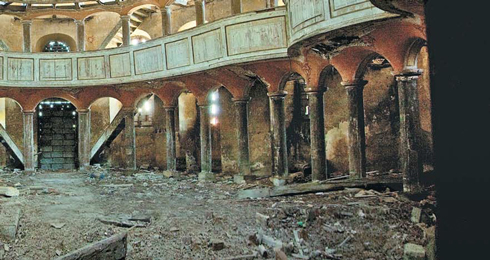
In this story, almost all people in the theatrical world, Alexander Kalyagin, Lev Dodin, Galina Volchek, Oleg Tabakov, Evgeny Mironov, Valery Fokin, Mark Zakharov, Mikhail Shvydka, Dmitry Chernyakov, Andrei Mogelinnikov, Kirill Borodin, Dmitry Bertman and many others, got to the side of the Kulyabin side in this story. However, their letters in defense of the director did not have any effect.
Suicide policy on March 29 The Director of the theater Boris Mezdrich ( interview with him - on page 24) was dismissed, and Vladimir Kekhman was appointed in his place (see p. 26), who previously called on Madzrich to resign and simultaneously declared: “I, as a person who is a believer, baptized, Orthodox, as a Jew I perceive it (the performance“ Tangamer ”. - NT ) as a Jew. Insult. " On March 30, the Kremlin’s reaction was followed: the deputy head of the presidential administration Magomedsalam Magomedov announced that it would be good - in order to avoid such scandals - to organize “preliminary viewing” of performances from state structures: “It will be necessary to track further so that there are works that work on the unity of our country on the sites of such important all -Russian theaters. Let such works put, and not those that split society. ” At the beginning, the presidential press secretary Dmitry Peskov, and then the First Deputy Minister of Culture Vladimir Aristarkhov, agreed with him. “We are not obliged and we will not support everything in a row,” said Aristarkhov. And he emphasized that art is not an end in itself, "the itself is the well -being of our people, our culture, our society, spiritual and physical."
The scandal around the Tangazer suddenly became an incentive for expert verification and performances of other theaters for compliance with the originals. March 31 at the Institute of Cultural and Natural Heritage named after D.S. Likhacheva passed a seminar entitled “The Right to Classics”, following which new performances were put on the works of Alexander Pushkin - “Evgeny Onegin” by Rimas Tuminas, “Onegin” by Timofei Kulyabin, “Boris Godunov” Konstantin Bogomolov, “Ruslan and Lyudmila” Dmitry Chernyakov. According to the experts of the institute, the state, financing such productions, is conducting a “suicidal cultural policy”.
Open questions what next? Representatives of the authorities in every possible way emphasize that we are not talking about the introduction of censorship. But many saw in the events around the Tangazer just an attempt by the state to again establish control of theatrical art ( on censorship mechanisms in the USSR - on page 30). “This is Pasquilus and the muck that we have already passed,” the actress of the Contemporary Theater “Contemporary” Liya Akhedzhakova, actresses in state theaters, appreciated in a conversation with NT with a bureau. “When officials want to lead the culture, not having an appropriate education and a sufficient understanding of the theater, cinema, literature, this is a terrible story.”
However, the reaction of the theater community to a “terrible story” is not at all clear. For example, the chairman of the Union of Theater Workers (STD) of the Russian Federation Alexander Kalyagin published a strange open letter on the STD website-for some reason it was sent to TASS-in which he shared his philosophical and very vague discussions about the essence of creative freedom: “Only in the conditions of freedom can the artist realize his creative potential, fulfill his mission, his mission. But I also understand that freedom is not absolute anywhere. Where are the limits of freedom? This is the question that torments me. "
The torment of Alexander Kalyagin is quite understandable: financing of STD largely depends on the Ministry of Culture. But how will other actors and directors behave, if censorship restrictions are now extended not only to television and cinema, but also to the theater sphere? And this threat is quite real, according to the artistic director of the Alexandrinsky Theater Valery Fokin: "This is the introduction of censorship, no matter what they call it." The director says that he has repeatedly passed all this in Soviet times: “Then the commissions consisted of people who were not too knowledgeable in the theater. They made decisions, not being, of course, by experts, and for the theater this had incredibly destructive consequences. ”
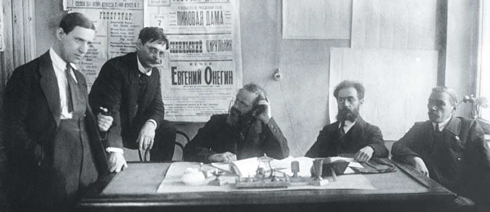
A meeting of the Hud Council of the Siberian State Theater of Opera and Musical Drama, Novo-Nicolaevsk (now Novosibirsk), 1923-1924 The initiative of the presidential administration, if it is realized, will not only insult the feelings of believers, Fokin is sure: if a preliminary viewing of the performances will be put into practice, then it will be possible to prohibit any performance-for example, to find some kind of insult in it Or something else that does not correspond to state ideology. The main thing is to want. ”
Fokin agrees with Lenkoma, Lenkoma, Mark Zakharov: “Forbidden is a dangerous path that will reduce the number of truly interesting innovative works.” Zakharov is sure: “If a preliminary viewing of productions in state theaters was fulfilled, the performance of Konstantin Bogomolov“ Boris Godunov ”would not have appeared in the Lenkom repertoire. Many other Moscow performances would not have come out. ”
Judging by the general tone of the public statements of theatrical figures, they are seriously scared by the possible tightening of the cultural policy of the authorities. But for now, everything is limited to careful and prudent speeches. The leaders of the theater are in no hurry to unite against new censorship. And if the members of the Kinoil in a collective letter demanded the resignation of the Minister of Culture Vladimir Medinsky, then the theater community has not yet decided even on such a gesture. “The intelligentsia is always very poorly united in the fight against injustice. But the Nazis or bandits are able to unite in flocks well, ”says Leah Akhedzhakova. She herself is sure that "now all theatrical people do not need to write letters, but simply rebel, otherwise it will be thrown again to our culture." Will her colleagues only hear her?
Photo: Shutterstock, bsk.nios.ru