
Translated material
Dinosaurs media

The newspaper Pionerskaya Pravda recently turned 90 years old. But she is not going to retire yet. Like other Soviet fossils.
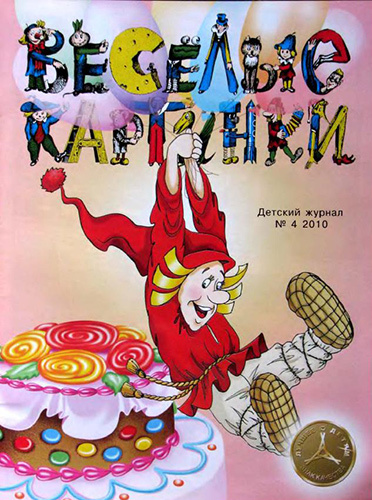 "Funny pictures"
“Funny Pictures” was invented by the cartoonist of the journal Crocodile Ivan Semenov. The first issue was released in 1956, the publication was conceived as a humorous educational journal for young children. However, the creators of “funny pictures” not only raised Soviet children, but also encouraged them to work: in the poem that Samuel Marshak wrote for the first number, it was said that the magazine could be learned to draw. The best artists-illustrators collaborated with the publication: Konstantin Rotov (author of illustrations for the books “Adventures of Captain Vrungel”, “Old Hottabych”, “Uncle Stepa”), Viktor Chizhikov (author of the Olympic Mishka), Aminadav Kanevsky (illustrated “Moidodyr” by K. Chukovsky, “Golden Key” A. Tolstoy, A. Tolstoy. I came up with the image of Murzilka), Alexey Laptev (author of the image of Dunno).
In the 70s, conceptual artists Ilya Kabakov, Eduard Gorokhovsky, Viktor Pivovarov came to the magazine. The latter in 1979 came up with the famous logo of “Funny Pictures”, consisting of human letters. The magazine published Korney Chukovsky, Agnia Barto, Sergey Mikhalkov, Eduard Uspensky. “Funny Pictures” were the most popular magazine of the country-by the 1980s the edition reached 9.5 million copies.
In the 90s, difficult times came for “funny pictures”: competition from Western children's publications and new Russian brands, the lack of resources that large publishing houses possess, problems with tenants and judicial laws with counterparties led to the magazine had interruptions with the release of numbers.
Nevertheless, “funny pictures” continue to go out. Now the circulation is about 50 thousand copies. True, the magazine cannot be found in retail networks, it is distributed mainly by subscription. Now the publication is trying to find a balance between modern children's literature and classic like the stories of Leo Tolstoy, although it still gravitates to tradition. Therefore, meeting the signs of postmodernism on his pages - for example, a story in which Kolobok is given to read a fairy tale about Kolobok so that he does not run away - you rejoice and surprise at the same time. But in general, it seems that the creators of the magazine are not so much focused on children as their nostalgiars, inserting references pleasant to their hearts - like a homeless cat from another story, quoting a song from Lev Leshchenko’s repertoire “Parental House - Beginning began”.
One generation replaces another, and on the pages of “funny pictures” all the same resourceful rabbits, musical mice, mischievous frogs, grandparents, good -naturedly ridicurating grandchildren for laziness and sloppiness - they were here and twenty and fifty years ago. In the magazine, signs of our time are almost invisible: if in Soviet times his heroes went to BAM and flew to the moon, then in the current “funny pictures” there are practically no intersections with the present. Including visual ones - for nothing that it exists in the same space with Angry Birds , Disney blockbusters, Marvilov comics or computer games. It seems that in the 80s the magazine was more open: then “Funny Pictures” could release an American number, on the cover of which Mickey Mouse shook his hand to the pencil, and inside there were stories and drawings of American authors (the texts were even duplicated in English!), Including the famous work of Maurice Sendak “Where the Monsters live”. A comic book publishes to the zero magazine, where a caricature, in the spirit of the Kukryniks, has come to a fabulous country inhabited by the heroes of Russian folklore, who has “one fairy tale - make money”. He is trying to teach heroes to entrepreneurship, but with shame is expelled to the back.
There is a regular section in the journal, where the picture replaces individual words in the story - the child is invited to guess the word on it. Outwardly, this is very reminiscent of Emoji's modern messengers familiar to us, but it seems that the magazine did it unconsciously. In general, in “funny pictures”, digital culture is treated with a clear prejudice: in one of the rooms, one can read that the books are developing the imagination, and “no three -dimensional animations will be compared”. The magazine website resembles amateur pages on the Narod.ru platform of the Web 1.0 times. The latest updates on it date back to 2014, archival numbers of magazines are represented only by covers. And the publication simply ignores the social networks.