
Translated material
Grach-Grachevsky, aka V.I. Lenin
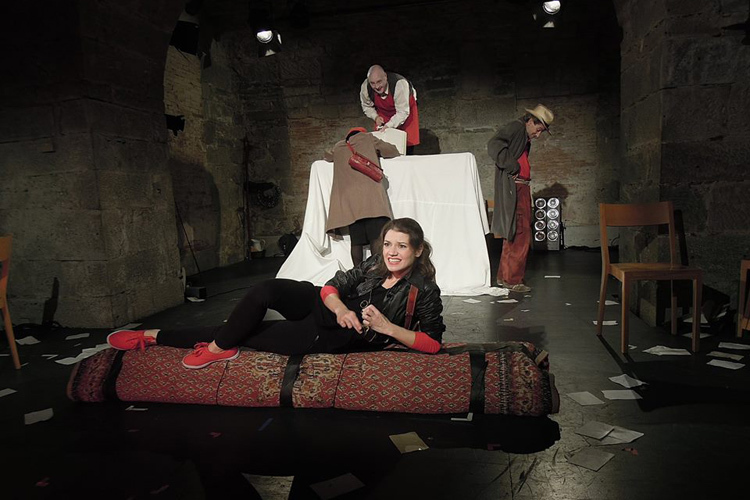
The Theater of Generations - the brainchild of the great director and teacher Zinovy Korogodsky - was created in the wake of the studio movement, which covered the St. Petersburg undergrand at the beginning of perestroika. Many groups of those years, unable to withstand the natural selection of the 90s, have sunk into oblivion, others-for example, “formal theater” or ahe, managed to earn international recognition, gradually joined in large state and festival projects, actually becoming part of the theater mainstream. Finally, others settled in attics, in attic and basements and continued to create for a narrow audience, jealously guarding their identity. After a quarter of a century, it cannot be said that they all won the race over time, but in the theater of generations the “young winds” of the era are definitely blowing. Perhaps the secret is that the theater always sought to be one step ahead, to speak with new generations of the audience in their language. Fresh European and American drama, installation and alteration of the classics (at a time when large scenes could not even dream of this), the participation of non -professionals, a mix of languages and genres, experiments with Sight Specific , the emphasis on the process, parallel to work with adolescents-all these quite post-dramatic rules of the game gave the unique atmosphere of freedom and studio co-creation, which made up the original physiognomy of generations.
 © Generation Theater
It is all the more indicative that this team programmed to talk about the future created a performance, the main theme of which was a desperate, derogatory absurd chase over the past.
“The rooks flew in, or an emergency in Zimmervald” - the work of directors Danila Korogodsky and Eberhard Köhler (Germany) last season, created jointly by the Generation Theater and its Swiss friends. The poster has been listed as many as three Switzerland Theater, but the performance, apparently, was shown to the larger number of sites, significantly redesigned compared to the original version and came to us already as a new edition, and not the premiere.
In the hotel documents, a meeting of socialists was listed as an ornithological conference. The sincer of Mazhmam was distinguished by the story itself - the playwrights only have to inflate the fire.
The plot of the play by the Swiss Arian von Graffenrid and Matto Campfa, taken as the basis of the performance, is built around the famous historical event - the International Conference of the Left Socialist, held in the Bucolic Alpine village of Tsimmerwald in September 1915. Representatives of the left radicals from 11 countries gathered in a small hotel to discuss the future of the labor movement in the conditions of the imperialist war. The largest Russian delegation included Zinoviev, Trotsky and Lenin-illegally crossed in a sealing car through the Russian-German front. The “highlight” of the whole gathering, which, apparently, inspired the authors of the play and the performance, was the fact that in the documents of the hotel this political assembly was listed as an ornithological conference. The very story of the sincer of Mazhmam - the playwrights only had to inflate the fire that they made with all their hearts.
 © Generation Theater
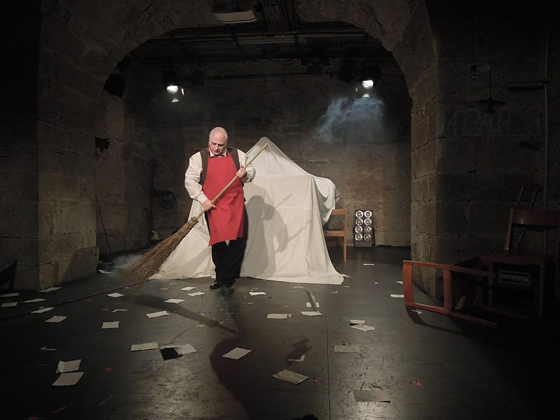
So, about a hundred years later (judging by the appearance of an iPhone in the hands of Lenin) to the very village of Zimmerwald, the Beau Séjour hotel, which is held by a certain dad Yaggi, a strange society gathers: fans-revolutionaries, carrying the corpse of Lenin, and eco-wrapped in the carpet, they are, they are also eco-wrapped in the carpet. "Communists-Nostalgiki", putting on the costumes of Lenin and Trotsky. This strange company declares that it intends to hold an ornithological conference, which arouses the suspicion of the Swiss half of the guests in the person of the regulars of Bar Hugo, the bus driver and the local teacher. The latter involves the whole society in work on the search for new theatrical forms - that is, the production of the performance. Stiring sandwiches with manifestos and socialist realism with Banksy, the team inevitably approaches the revolution in art and life, which is a manifest of a hundred years ago and the opera about Holy Helvetia, respectively. However, it is not so important who turns out to be there: dad Yaggi, for example, turns into a woman-yaga, which Marx planted to protect the “portal”, connecting his ideas with descendants, from the invasion of the Russians. He himself declares this, rebelled in the final from the grave, as expected, under the clock of the clock. Turning to his friend Engels, the poor man complains: “Friedrich, I repeat: in Russia you can’t try. Briefly and clearly wrote. This will lead to a Slavic disaster, but never and for nothing to socialist democracy, never for anything. ” Under the very curtain of Yaggi-Yaga, he still fulfills his mission, first resurrecting Lenin stolen from the mausoleum, and then he buried him under a cheerful song about “O Mother, Materialism. Dialectical".
Genius, in the words of Merab Mamardashvili, endless repetitions of Russian history, bad to nausea, came his nest in this performance.
The play, written with an eye on specific actors (possibly with their participation) and taking into account the bilingual environment, is shed with satire not only for the habits of the Russians to worship the past, but also for the Swiss provincial “culture”. Here, the Soviet version of communism, and the Swiss version of democracy, equally “stinks”. The theater multiplies the already numerous chimeras, turning the satire into an absurd gignol.
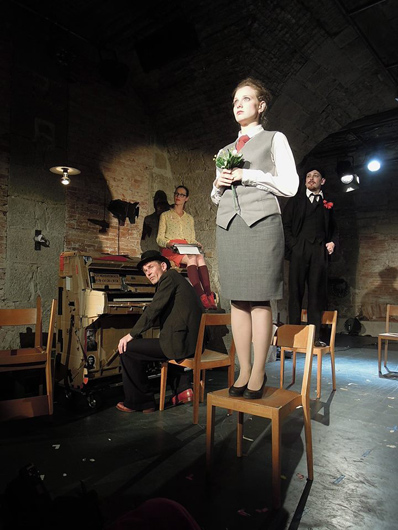
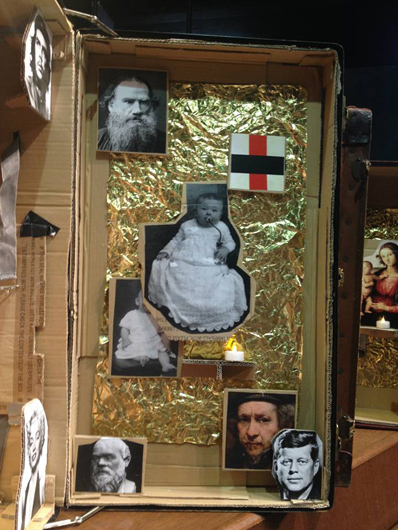
The leitmotif of the play are characters with suitcases, the same passengers of Zimmerwald - Petrograd who came to make a story: to turn the imperialist war into a civil war. In the whirlpool of scenes, skeletons, grotesque masks replace one another. It’s no longer to understand where Lenin himself is, and where “Igor Grach-Grachevsky, a radical eco-activist, pretending to be a nostalgic socialist-director, he is V.I. Lenin. " “Frida Vogelson, pretending to be an ornithologist, is Frida Kalo,” and “Stella Utkin, secretary I.N. Swan, she is a sickle ”, and I.N. Swan, “an ornithologist, a full member of the Academy of Sciences, he is a hammer”, and the embalmed mummy of Lenin, and another woman-yaga is his wife. With so many characters, the already loose architectonics of the play threatens to completely collapse under the onslaught of acting studies, musical numbers and jokes on the anger of the day. There must be a “pedagogical” orientation of the directing of Korogodsky (both Zinovia, and Danila Zinovievich) implies the moment of freedom: each of the participants gets the opportunity to speak out - in a monologue, sketch or visual sketch. So, for example, Mona Petri and Svetlana Smirnova (Annaeli's local historian and radical Masha Chizh) play a chic insert number with a cigarette, and Maria Slavic and Artem Tomilov is a sketch dedicated to the “relations” of a sickle and a hammer, which seemed to come from the workshop of the KUKOLAND actors.
 © Generation Theater
All this sometimes more, sometimes less charming studio covers, however, does not reduce the level of statement. Genius, in the words of Merab Mamardashvili, endless repetitions of Russian history, bad to nausea, came his nest in this performance. “... with a strong hail / soil is oxidized, / and nothing grows on it for a long time ...”-the Yaggi song “On the Berne Dialect with an Accent”, which begins and ends the performance, as if collecting a spreading action in a vice. In the interpretation of the theater, Baba Yaga not only buries Lenin, but at the same time kills all pseudo- (and not pseudo-) ornithologists. But the soil has already been oxidized-new sickles and hammers crawl out in their place, new altars with Soviet “icons” and leaders. No wonder Marx performed by Marco Morelli is lamented.
I would like to say separate words about this with a wonderful Swiss artist. The clown-mim, the trouser-cup and acrobat, his French charm fills the heavy air of the performance with oxygen. Along with Sergey Mardar, in the role of Yaga, whose grotesque existence allows the performance to balance on the verge of the drama of the absurdity and the field action, Morelli with his poetic old people make up the emotional core of this intricate, frivolous studio and at the same time serious work.