
Translated material
White Garden
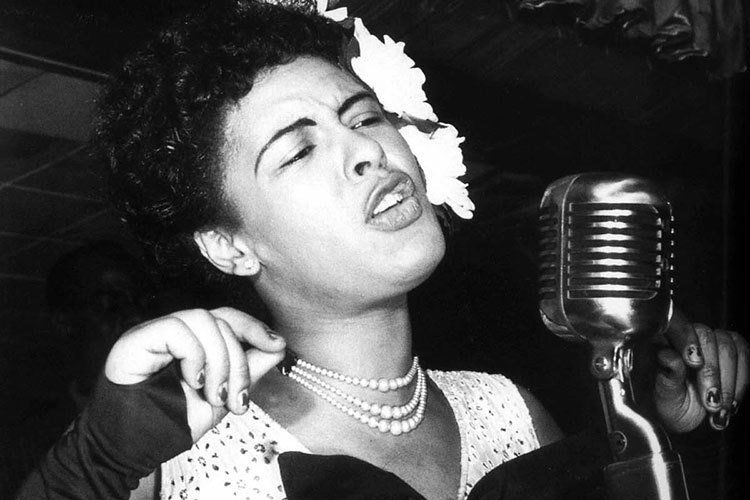
April 7 marks the 100th anniversary of the birth of Billy Holide.
Many young jazz singers are still copying Billy Holide, literally every second. Some manage to make a name on this. But still it is clear that another will not happen. Why was Kholidei secretly recognized as the best, most worthy of imitation, over the eyelids of jazz, who gave many outstanding singers? And God knows. She did not have a powerful voice - a narrow range, a kind, somewhat “creaky” timbre: if you turn on the record of Billy Holide in one room, go to another and listen through the wall, it seems that it sounds not a female voice, but a pipe.
Perhaps the heavy, “rock and roll” fate is attracted: incomplete family, alcohol, drugs. According to legend, in her youth she worked in a brothel. According to classic photo portraits, you will not guess about this: a gentle smile, clean, like a warden in her wavy hair. Angel, a real angel - by the way, in 1988, the U2 group dedicated her the song “Angel of Harlem” .
She had nothing to become a superstar. On April 7, 1915, a girl named Eleanor Feigan was born in Baltimore. The daughter of a minor and the nightclubs of the teenager-guitarist who disappeared into the smoke. Poor, uneducated, black in racist America of the 1930s.
“Why are all black women,” Holydia was angry, “they play roles in the cinema either some“ ordinary girls ”or whores?”
For all the difficulty of the life circumstances of Eleanor Feigan (the pseudonym “Billy Holide” arose by adding the name of his beloved actress and the surname of his own father; while colleagues for grace called her Lady dex) turned into an absolutely amazing beauty: sensual lips, expressive almond-shaped eyes, an amazing figure, an amazing singer. And male musicians admired the talent and professionalism of the young self-taught. By the way, it was talent that made her a professional singer almost out of the blue. This is how Billy Holide herself told about the turning point in her life: “We [with my mother] lived then in New York, on the 145th Street, near the seventh Avenue. Once we were so hungry that we could barely breathe. I gathered my strength and went out into the street. It was damn cold, but I wandered from the 145th street to the 133rd on seventh Avenue, going into every beer with the hope of finding at least some work. Finally, I came in full despair and went to the Log Cabin club, led by Jerry Preston. I told him that I would like to warm up and drink, although he did not have a cent in his pocket. Nevertheless, I ordered Gene - my first drink: I used to differ from wine before - and drank in one gulp. It immediately became warm, I asked the throne to give me some work, a dancer, for example. He asked to dance. I tried, he did not like it. Then I said that I could sing. He replied: "Well, sing." In the corner, some old man screamed at the piano. He began to play the melody “ Travlin '” , and I sang. Visitors in the bar stopped drinking, turned and began to observe me. Then the pianist - it turned out that it was Dick Wilson - switched to Body and Soul . God, you would have seen these people: everyone began to scream and cry to one! It was a very simple audience. Preston came up to me, nodded and said: “Baby, you won.” That's how I started singing. ”
The singer passed away at the age of 44 as a sick and completely broken man. Health blew alcohol and drugs. She was addicted to opium by her first husband named Johnny Monroe, and the second husband, trumpeter and drug dealer Joe Gai “planted” her “planted” on heroin. When a few close people do the hell with what is difficult to resist this. Mom could not help her, the father, whom the singer was already in a conscious age - even more so. Colleagues saw what was happening (“I myself was sick,” wrote in the Miles Davis autobiography), but could not intervene. Fatal for Billy Holidea was 1945. In this year, she agreed with her unfortunate Joe Gai, then mother died - the only native person, and Billy finally flew off the coils. She was even arrested "for storage"; After liberation, they were forbidden to perform in clubs, a casino, in general, wherever alcohol is sold. Nevertheless, there was enough for almost one and a half years of fruitful work for almost one and a half years. In these years, there was everything: notes with the best jazzmen and orchestras, full houses in large halls, European tour, hits and high fees.
Two times, in 1948 and 1956, she gave sensational full-time concerts at the prestigious Carnegie Hall-a serious achievement for any jazzman, especially black. There is no Hentoff about the second concert, the observer of the magazine of the magazine (the author of several textbook books on the history of jazz and countless Liner notes for the records that we copied in Soviet times) as a miracle: “The audience was her from the first to the last minute. There was one moment when even musicians applauded her. Billy was in the highest form. Undoubtedly, all over the world she is the best and most honest jazz singer! ”
Shortly before the death of Holide, she managed to put an end to the discography of the Lady in Satin album with a symphony orchestra. It is customary to scold the album: the voice is no longer the same, everything is recorded at the limit and capabilities. But she, the most honest, does not hide it, does not hide flaws and is not ashamed.
She was not tired of experimenting and was not afraid to take on any creative work. Although in the 1930s there was still a division into authors and performers, many of her hits Billy Holide composed herself: “ Fine and Mellow” , “ God Blas The Child” , “ Don ' T Explain” and “ Lady Sings The Blues” .
“ Lady Sings The Blues” (“Lady Sings the Blues”)-this name-oxymoron became cliche. The biography of Billy, which the writer William Dfti, a great friend of the singer and the husband of her best friend wrote, is also called. The childless, Billy Kholidei - twice a godfather: the son of Dfti and daughter Critic Leonard Fezer, the borough of American jazz journalism.
In the cinema, Billy Kholidia starred little, mainly in episodes of music films. Participated in television shows. The actress, perhaps, could become: photogenic, lively, convincing. In the New Orleans of 1947, she was entrusted with a rather large role next to the great Louis Armstrong, whom she idolized as a musician. Billy biased to the result. On the set, it turned out that she was playing not “jazz singer Billy Holide”, that is, herself, but a maid. “Why are all black women,” she was angry, “they play roles in the cinema either some“ ordinary girls ”or whores?”
At that time, jazz from the entertaining genre quickly evolved into high art. And in Dzhazova - Negritian, mostly - anti -racist sentiments were sighted. At a certain historical moment, jazzmen-neigers were in an absurd position. On the one hand, many were stars both in their homeland and in Europe, on the other-in America, any white could still humiliate them. In the southern states at that time, the Lynch courts were arranged: the executions of blacks without trial and investigation.
The unfavorable racial situation and the tragedies accompanying it, oddly enough, played a positive role in Billy Holide's career. Back in 1938, she attracted tremendous attention, becoming the soloist of the orchestra of the artist, the famous team, in which only white musicians played. The white orchestra plus a black singer - it was a new product. So in the novelty that not everyone understood. True, she had to leave the orchestra, but soon she began to perform in a new club called Café Society , where her “meeting” with the song “ Strange Fruit” , which became her visiting card, occurred.
Poems were written by a teacher from Bronx named Abel Miropol - a Jew and a communist who, just in case, signed by the pseudonym Lewis Alan. Billy Holide, having heard this poem in the aforementioned Café Society , proposed her melody. The text is perfectly “lay down” on her voice and manner of performance: the combination was produced by a strong effect. Billy, as a large artist, also “switched” the atmosphere: at any of her concert “ Strange Fruit” was performed by the very last one. Having finished singing, the singer immediately went out of the stage.
And never returned to bow.