
Translated material
Tests on the history of Russia for migrants have complicated: now they need to know about the accession of Crimea, Hermitage and Stalin's Board
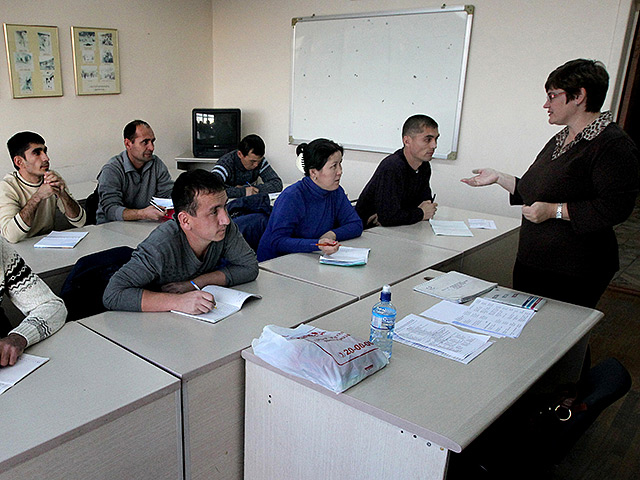
In Russia, they will complicate a comprehensive test in the Russian language, the history and foundations of law, which must be handed over to migrants who want to get a residence permit, temporary registration or employment in the Russian Federation. Now, five new open questions will appear in it, the answers to which foreigners will need to be entered by themselves. The lexical minimum for visitors will also be increased - up to 1250 Russian words. This was told by Izvestia by the vice -rector for working with foreign students of the Russian University of Friendship of the Peoples of Angela Dolzhikov.
According to her, one of the problems today is that the conditions for obtaining a patent for work, permission for temporary residence and a residence permit in the Russian Federation are almost equal to foreigners.
“You can’t equalize these categories, because foreigners come to Russia, and therefore the level of adaptation in the country, the knowledge of the language should vary. Now the differentiation of migrant testing is associated only with the percentage of the exam: for those who want to get a patent or temporary residence permit, at least 60%, for those who want to get a residence permit, the threshold is 75%,” said Dolzhikova.
The first sample of the complicated exam on the history of Russia for foreigners, which has already been at the disposal of the newspaper, will consist of two parts: a test of 20 questions with answers (for all categories of migrants) and additional from five questions without options (for those who are going to receive a residence permit in the Russian Federation).
So, in the test part, foreigners will have to find answers to questions at which ruler the adoption of Christianity in Rus', who was the initiator of the perestroika, where the Hermitage Museum was located and when the day of spring and labor is celebrated in the Russian Federation.
In an additional part, foreigners will have to write the dates of the First Russian Revolution themselves, to remember who was the head of the USSR during the Great Patriotic War, to determine which monument is a symbol of St. Petersburg, to name the document adopted in Russia on June 12, 1990, and guess which republic became part of the Russian Federation in March 2014.
"We also added the question of one holiday - May 1. It is possible that there will be questions in the test and the creation of the Eurasian Economic Union: visitors should know that there is integration in the post -Soviet space between the CIS countries," said Marina Moseikina, professor at the Russian Department of History,.
She also noted that due to the complication of test issues, the time for migrants will be increased. "90 minutes will be allocated for the Russian language test, the modules" History of Russia "and" Fundamentals of the Legislation of the Russian Federation " - half an hour," she said.
For labor migrants, the lexical minimum of Russian words will remain within 950. However, for those who want to stay in Russia, it will be increased to 1250.
According to the source, since the beginning of the year, 440 thousand migrants have already passed a comprehensive exam throughout Russia, 95% of them received relevant certificates. The full cost of the exam is 4900 rubles if the visiting claims to work permit, and 5300 rubles, if a foreigner is going to get a residence permit or temporary residence permit. Nevertheless, in some regions, migrants have to pay several times more. So, in Norilsk, the price of a complex test reaches about 25 thousand rubles due to costs for the flight of teachers from Krasnoyarsk and delivery of certificates. At the same time, it is noted that citizens of the Donetsk and Lugansk People's Republics will pay much less than the rest - 2500 rubles for the exam.
The law obliging labor migrants to take exams for knowledge of the Russian language was signed by Russian President Vladimir Putin at the end of April last year. According to the law, to obtain a work permit, temporary residence, patent or a residence permit, the labor migrant must pass an exam and receive a certificate confirming its knowledge of the Russian language, knowledge of the history and fundamentals of the legislation of Russia. The law entered into force on January 1, 2015. The Kommersant newspaper, reporting the presentation of tests for migrants, wrote that the experts considered the tests too complicated, and human rights activists warned that instead of passing exams, migrant workers would buy certificates for bribes.