
Translated material
New York Almanac
“Sleeping beauty” of Ratmansky. War around Wagner. Tolstoy, Putin and America
Alexander Genis: Solomon, I propose to start the spring release of our Almanac with a pleasant news - from the premiere of Ratmansky: "Sleeping Beauty" in America.
Solomon Volkov: This is not entirely accurate, this is not the premiere of Ratmansky, Ratmansky presented his version of the classical setting of the “sleeping beauty” by Pyotr Ilyich Tchaikovsky in the production of Marius Petep.
Alexander Genis: This is a difficult question that we will discuss now: how much is Petipa and how much Ratman is. Explain what is the matter.
Solomon Volkov : This problem has a lot of aspects. We are big fans of Ratmansky. I, without abundance, call him a genius, he, of course, in my opinion, I always emphasize that I am not a ballet will, but in my opinion a person who loves music and is interested in ballet, he is the most significant modern choreographer, the most significant creator of dancing. Ballet, new ballet, new ballet performances in a certain sense are experiencing a crisis. This is not my observation-this is such a friendly voice of ballet historians who say that there are no new bright names. I always point out in response to the figure of Ratmansky. Almost every ballet for me is a joyful event. And this, of course, is also an event.
Ratmansky has recently become interested in the reconstruction of old ballets - this is a very interesting direction. Let's say he put a “bright stream” to Shostakovich’s music, by the way, my acquaintance with Ratmansky began with this ballet. It was a new ballet-it was not a reconstruction of the ballet Fedor Lopukhov, who, as you know, at one time was crushed by the Pravda newspaper as a ballet falsity, but the “bright stream” was a new ballet of Ratmansky, and the “sleeping beauty” is still a reconstruction.
Alexander Genis: A very peculiar reconstruction. And what does reconstruction mean in ballet in general? Critics write that Ratmansky used materials to unsubscribe this ballet, using Stepanov’s notation. which allows you to reproduce the ballet. What is Stepanov’s notation, explain to us?
Solomon Volkov: There was such a man Vladimir Stepanov, he was born in 1866 and died in 1896, that is, he lived only 30 years, a very short life. During this time, he managed a lot, he was not very remarkable, but had a great historiographical talent, archaeographic. He was interested in the problem of ballet recording. Ballet is the most fragile, most ephemeral art, it disappears. Now you can still record the ballet on the video.
Although I must tell you that there are also big problems with the video recording of the ballet. I know this from conversations with people who put old ballets. Relatively recently, the Mikhailovsky Theater brought to New York the reconstruction of the Flame of Paris Vionen. 20 minutes of ballet in the film, shot back in Stalin, were preserved, a fragment from the Flame of Paris, everything else was modern choreographer. And these 20 minutes - this is all filmed from one specific point of view, it is extremely problematic.
Here the question arises: what is before us, is it really a reproduction, reconstruction of a petrel of 1890, a legendary production, which in its genuine original form has long disappeared or is it still a certain artifact of the wonderful choreographer Alexei Ratmansky?
Alexander Genis: That is, reconstruction or stylization?
Solomon Volkov: You are breeding this in the poles, but I would say that the word “reconstruction” itself already implies some stylization. Moreover, the prisoners of the performance themselves say that this is a mixture, a certain connection of the production of Petip 1890 and the production of 1921 by Diaghilev in London, where the artist was Lev Bakst. And this already in itself suggests that this is not a genuine, the original production of a pet, since the Diaghilev production of 1921 did not reproduce and could not reproduce the production of Petipa.
Alexander Genis: A curious incident is associated with Diaghilev’s production. The fact is that this production burned out, costumes were arrested for debts, thanks to which they were preserved in the museums of Australia and England. And now these costumes served as a model for new costumes, in any case, they were used by artists.
Solomon Volkov: What you say, and I say, this nevertheless indicates that this is the result of a certain new work of Ratmansky, one way or another based on these two legendary previous productions.
You mentioned the name of Vladimir Stepanov, yes, he came up with a system of recording ballet performances, and it remains unique in this sense to this day. There are strange badges, squiggles, in which it is impossible to understand an outsider. Ratmansky plunged into all this, he carefully studied this business. His wife Tatyana, she was an assistant in this performance, was a great assistant to him. Ratmansky has a tendency to such an immersion in the old days, in tradition, the desire to study them, delve into them and reproduce in a new way at the present stage. And it always turns out to be interesting.
Alexander Genis: It seems to me that in this case it is especially valuable. Because the “sleeping beauty” is the quintessence of the classic ballet.
After all, the ballet is the last form of art that the spirit of old France conveys to us, the spirit of the art of Rococo. Well, what is Rococo for us? Busha, fragonar, furniture for spider legs, fairy tales Charles Perrault, those that served as the basis of the libretto of the “sleeping beauty”. But - these are all museum values. But there is no ballet, the ballet is alive. If we want to look at the present Rococo, because this is the end of the 18th century, it is pre -revolutionary France. Remember how they said: who did not live before the revolution in France, he did not live at all. To see this frivolous luxury that we love so much in the architecture or in the paintings of the same Fragonar, we can only dream about it. But the ballet allows you to move to that era, because it is a conservative, old -fashioned art. I think that such a “time machine” is fascinated by Ratmansky.
Solomon Volkov: I agree with you and disagree at the same time. Yes, it definitely attracts Ratmansky and it is definitely, apparently nourishes his imagination at this stage. But he is developing all the time. After all, what is wonderful in Ramansky - he is always looking for a new one, he changes all the time.
Alexander Genis: The main thing for the artist: do not write the same novel twice.
Solomon Volkov: This is his phenomenal trait, before which you can only bow. People who discuss this performance, they contradict themselves. Ratmansky studied everything - and Stepanov’s notes, and old photographs, and drawings. But after all, we, too, can look at some in any case from these photographs and drawings, and what do we see there? We see a completely different type of dancers and dancers there than the one we have today. Surprise is caused by photographs of the dancers: they are all low, thick, with short legs. Sometimes, when you look at these photos, they make a somewhat comic impression. Now the dancers are increasingly thin, higher, longer -legged. So it is no longer possible to reproduce the performance of a pet.
Alexander Genis: They say that if we saw Sarah Bernard on stage now, we would laugh at her. The general problem is not only associated with art. I was told by one winemaker, whom I recently met that none of us would drink the famous illustrious wines, say, the 18th century, because they would be disgusting to our taste. The same with spirits. The perfumes that the French fashionistas were strangled in the 19th century seemed repulsive to us. You can’t return to the past, you can’t enter the same river anywhere - neither in art, nor in cooking, nor in ballet.
Solomon Volkov: And here we are in New York with impatience in May.
Alexander Genis: I think it will be a grandiose gift for New York, because the performance demanded incredible costs and efforts. I will give a few digits. 160 dancers are employed in the play in order to dress them up, 300 costumes that were made specifically in Milan were required, and sent from there.
Solomon Volkov: Yes, this is a joint production with La Scala.
Alexander Genis: This already suggests that this holiday will stay with us for a long time.
Solomon Volkov: We will wait for him, we will enjoy this performance, that stunning music - and this is the top of Tchaikovsky’s ballet work - created for the “sleeping beauty”.
(Music)
Alexander Genis: Solomon, I want to discuss with you an article that recently appeared at New York Times, this is what is called “profile” in America. In my opinion, there is no such word in Russian, but it would not have prevented us.
Solomon Volkov: My eternal walls about this, that such a non-fiction genre as a profile has not been mastered.
Alexander Genis: You can say the “Portrait”.
Solomon Volkov: No, the portrait is not that profile.
Alexander Genis: This is a rather thin thing that plays an extremely important role in American journalism. In this case, the “New York Times” printed the profile of Tolstoy, the great-great-grandson of Leo Tolstoy Vladimir Ilyich Tolstoy, who was in charge of the Museum of Yasnaya Polyana. He was the director, and now he is Putin's adviser in culture.
Solomon Volkov: Preserving, in my opinion, his functions of the director.
Alexander Genis: No, he handed over his functions of the director to his wife, one way or another, everything in the family. The article is neutral in character, but nevertheless, quite sarcastic. It is about the fact that Putin is trying to use the resources of Russian classics for his own purposes. Speaking simply, with the help of a descendant of Tolstoy, the Russian authorities are trying to turn Leo Nikolaevich Tolstoy into a “Crimean -player”, that is, to him, the Minor! - They attribute the views that Putin shares today. Vladimir Tolstoy argues like this: yes, Leo Tolstoy was an officer, he fought in the Crimean war, so he would undoubtedly welcome the capture of Crimea.
Thus, the authorities, as it were, included Tolstoy in the community of the "Crimean". How do you like the tactics of introducing Russian classics to the Putin Guard?
Solomon Volkov: You know, I have dual considerations about this. Firstly, I read the statements of Vladimir Tolstoy about how his famous ancestor reacted to the current situation. I am rather inclined to agree with him, imagining the views of Lev Nikolaevich in this matter, which is very important, because everything looks a little more complicated. On the issue of Crimea, it can be assumed that Lev Nikolayevich would take a “Crimean” position. But Lev Nikolaevich, as we recall, belongs to a certain number of statements by a certain number of topics.
Alexander Genis: Lev Nikolaevich lived a long life.
Solomon Volkov: In particular, we must remember that he was anathematized by the Russian Orthodox Church.
Alexander Genis: And as excommunicated from the Church, the Orthodox values that Vladimir Tolstoy are preaching with Putin can not defend today.
Solomon Volkov: And then one of the favorite quotes of Lev Nikolayevich was that patriotism was the last refuge of villains. This quote would not be very popular today.
Alexander Genis: Yes, and Hadji Murat is not a very imperial book.
Solomon Volkov: When I encounter such a grandiose figure as Lev Nikolaevich Tolstoy, I always recall the statements of another grandiose personality of Walter Whitman that “I am great, I contain a multiple” b. A great person contains a lot, he is disorderly, if you like. At any moment, especially considering that a person is no longer with us, they are trying to present any one side of this “diverse” as a decisive for this figure.
Alexander Genis: This, of course, is simply demagogy, let's call a spade a spade. I even know a little Vladimir Tolstoy, he came to New York to the Congress of compatriots. Remember, after all, you and I have recently been compatriots, and not the “fifth column”, so I was also invited to this congress. I saw how Tolstoy performs, he has a wonderful blush, a healthy, very pleasant, courteous and charming person. I am friends with Yasnaya Polyana, they constantly invite me to speak, even recently asked for advice on the culinary book that they publish, the books of Sofia Andreevna Tolstoy, which conducted its culinary book, they are now preparing food in the buffet of this museum. So we have any contacts.
But the main thing, of course, is that along with oil, Russian classics became resources, which they try to redo and introduce to the current government. This is not the first time. We will find out how the Narodnik began to make from Pushkin in Soviet times, we know that Pushkin was a Decembrist, now Pushkin is an Orthodox PIIT. This is a common thing to adapt the classics to the dominant ideology.
Solomon Volkov: But agree that in Pushkin, as in Lenin, you can find anything you want.
Alexander Genis: In Lenin, I can’t find anything, I can’t, but in Pushkin I can.
Solomon Volkov: In Lenin, you can find absolutely opposite statements on any of the given topics. He changed his view, I assure you like gloves.
Alexander Genis: Excuse me, but I will not read Lenin. I have already read the work “how do we reorganize Rabkrin” and I will not return to Lenin anymore.
As for Leo Tolstoy, this is an important figure for America. Therefore, it is strange for the Americans to hear that Tolstoy was for Putin. The attempt itself so suggests that the Putin regime looks around the west. Indeed, of all Russian classics, moreover, of all Russian people, Leo Tolstoy is generally the most important. There is such subtlety, for us, say, the most important is Pushkin, but Pushkin is unequerful. Dostoevsky? But Dostoevsky is too Russian - this is an exotic writer. Chekhov? Chekhov is simply his own, he is not a foreigner, he is the same as Shakespeare, with a bread-boy of the theater. But Tolstoy is a block. Bush, not the youngest, but the eldest, Bush the father, said that at the age of 17 he read a thick and complex “war and peace” to prove to himself that he has a will.
And remember, when we gave our Liberty Award to James Billington.
Solomon Volkov: The librarian of the congress.
Alexander Genis: He is not just a librarian, but a librarian of Congress.
Solomon Volkov: This is such an important position so that people do not think that he walks with the overshielders and distributes books.
Alexander Genis: But besides this, he is the author of the completely ingenious, in my opinion, work “Icon and the ax” of the best book about Russia, which I know. At the table, we asked him: what are you reading to understand what is happening in today's Russia? He said "war and peace."
Solomon Volkov: If you remember, relatively recently, Yasnaya Polyana organized such a wonderful event as Anna Karenina Life, here in New York a certain number of people joined this action. In my opinion, 700 people were read around the world "Anna Karenina." This is an action in which I had a chance to participate, I recall with enormous pleasure a stay in Google’s building here in New York. This project is listed in the Guinness Book of Records, as the largest Life event on Google, ever what happened. So, you see, they do very good things in Yasnaya Polyana.
Alexander Genis: Do you think they can make Putin’s Tolstoy ally in the eyes of the world community?
Solomon Volkov: I will express another consideration. You said that now many people belonging to Russian culture, who live abroad, are ranked to the “fifth column”. “The Fifth Column” is okay, but a new expression appeared, I don’t know if you heard the “sixth column”.
Alexander Genis: No, I don't know. So we are the “sixth column” or “fifth”?
Solomon Volkov: The Sixth Column is the disguised, lubricated liberals within Russia, which now skillfully hide their rotten essence, but soon their real patriots will take into pure water. So the situation in this sense in Russia is not developing by days, but by the hour. I see that, unfortunately, people of scale and rank, relatively speaking, the significance of Vladimir Tolstoy becomes less and less in leading positions. You are talking about how he interprets his ancestor, and when I read such interviews, I think that someone is already sitting and enlisting such Vladimir Tolstoy in the “sixth column”.
Alexander Genis: Because he considers himself moderate.
Solomon Volkov: That's the point, he is actually a person with whom you can talk. But already on such people, subjects poke their fingers with whom it is impossible to talk with, because they are, as it were, from another planet.
Let's complete this slightly sad conversation on a lighter note and listen to the music from Prokofiev’s opera “War and Peace”. This is the book and the opera by which it is possible and necessary to study the Russian character.
(Music)
Alexander Genis: Solomon, we cannot leave without comment the scandal that occurred with the production of Wagner's opera in Russia.
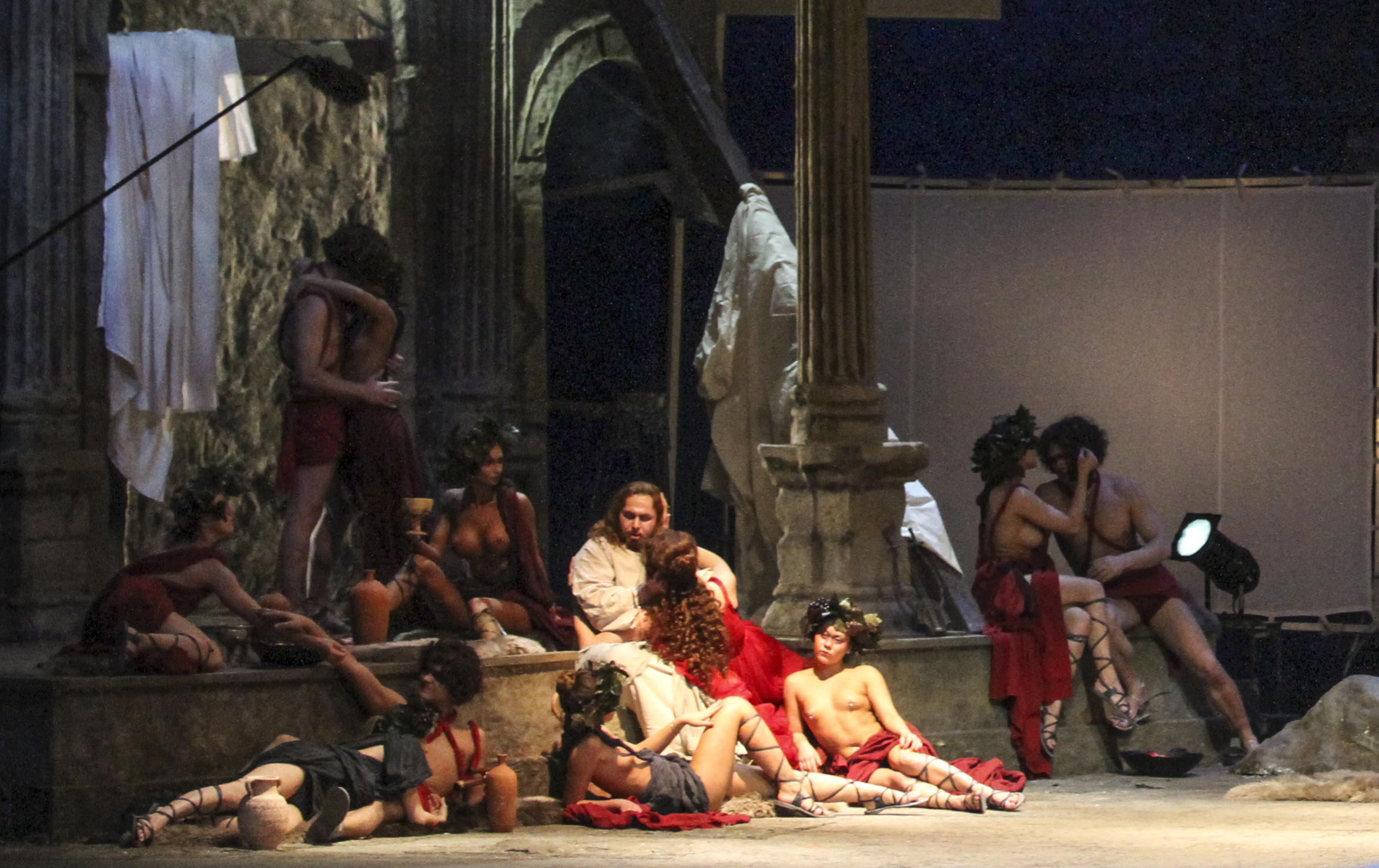
Соломон Волков: Разгорелась история, которая, между прочим, напрямую связана с нашей темой, которую мы только что обсуили - о «шестой колонне» и о том, кто на сегодняшний момент может вообще говорить от имени русской культуры и что вообще возможно в поле дискурса культурного, который на сегодняшний момент разворачивается в России. Мне, к сожалению, все тревожнее и тревожнее в этом смысле становится, потому что я вижу, как напряженнее и напряженнее становится выяснение отношений на культурном поле.
Выясняют отношение три силы, если мне будет позволено так сформулировать: общество, государство и православная церковь, которая является в России доминирующей. Разберем это на примере того конфликта, который вы упомянули. В Новосибирске поставили оперу «Тангейзер» Вагнера, режиссер придумал, на мой взгляд, не самый лучший ход для свежего прочтения этого произведения. Генрих Тангейзер в его трактовке — это немецкий кинорежиссер, который снял фильм про грот Венеры, в котором повествуется о том, что якобы в этом гроте Венеры свою юность провел Иисус Христос. К этому был выпущен соответствующий театральный плакат, афиша, на которой изображение распятия помещалось между ног обнаженной женщины. И про одно, и про другое я могу так сказать: про плакат, что в любом случае, на мой взгляд, это не есть проявление самого лучшего вкуса. Идея диковатая, потому что вполне можно было бы поставить «Тангейзер» в том плане, в каком он был задуман Вагнером. Я не думаю, что сам Вагнер, например, так шибко бы обрадовался, увидев такой спектакль.
С другой стороны я могу сказать, что, говоря об оперном спектакле, а это можно распространить и на драматический спектакль, как для меня определяется величие «Гамлета», или «Кармен», или «Тоски»? Тем, что можно действие этого произведения перенести в любую другую эру, в любое другое время, сделать героями кого угодно, если это только не бездарно и не отвратительно сделано. Перенесение, временные рамки, их изменение, изменение функций главных героев не мешают, а наоборот высвечивают очень часто какие-то неожиданные стороны шедевра. И в этом их величие: они выдерживают любые адаптации. Поэтому в принципе возражать против такого подхода нельзя, хотя здесь часто переходят границы вкуса просто-напросто. Мне кажется, что ответ на такие нарушения вкуса должен быть очень простой: не ходи на такие спектакли, если тебе о нем рассказали. Тебе это не нравится, не покупай билеты и таким образом не спонсируй из своего кошелька это произведение. Но почему-то на сегодняшний момент все чаще и чаще в современной России такого рода взаимные неудовольствия разрешаются юридическим путем, путем запретов. Вот это, мне кажется, ошибка.
Так и случилось в Новосибирске. Местные иерархи православной церкви подали в суд за оскорбление чувств верующих на режиссера Тимофея Кулябина и директора театра. Суд не принял этих претензий, дело было приостановлено за отсутствием состава преступления, но сейчас это решение суда уже апеллируется. А директора театра уволили.
Все это, мне кажется, заблуждение, потому что с помощью судебных акций такие вещи не нужно и бессмысленно вытеснять. Вытеснять такие вещи можно только с помощью кошелька.
Александр Генис: Соломон, как историк русской культуры, скажите мне: а как в старой России, дореволюционной России решались конфликты подобного рода с участием православной церкви?
Соломон Волков: Это очень интересная и сложная история. Потому что любая институция — это такой физический закон имени Волкова, если вам угодно, любая институтция стремится к расширению своего влияния неминуемым образом. Церковь будет всегда стремиться к тому, чтобы завоевать все большее и большее место в структуре государства. Государство будет в свою очередь стремиться к тому, чтобы расширять свои функции и сферу своего контроля. Бывают ситуации, когда интересы государства и интересы церкви сталкиваются, государство не заинтересовано в том, чтобы предоставить церкви большие права. То же самое с церковью. Бывают ситуации, когда общество не заинтересовано в том, чтобы вмешивались в его личные дела и в то, что общество хочет и может смотреть, ни государство и ни церковь. Это, мне кажется, совершенно естественное право, потому что в том случае, если платит государство, оно имеет право в той или иной степени ограничивать и контролировать заказанный продукт.
Александр Генис: Но у государства нет своих денег - оно тратит мои деньги, которые я плачу как налогоплательщик.
Соломон Волков: Но поскольку оно распределяет, оно имеет право на определенный контроль. Общество, человек имеет тоже право контролировать свои личные расходы именно таким образом, одобряя или не одобряя конкретный спектакль, фильм, картину, выставку и так далее. Церковь в ситуации, в которой она отделена от государства, как это имеет место быть в современной России и в европейских демократических странах, мне кажется, не должна и не может пытаться влиять с помощью юридических каких-то форм на развитие культуры. Это большое заблуждение иерархов современной православной церкви, что таким образом они принимают участие в формировании общества.
Александр Генис: А в XIX веке принимали?
Соломон Волков: Там опять-таки была очень сложная ситуация. На самом деле влияние православной церкви было резко ограничено никем иным, как Петром Первым и с тех пор до самой революции православная церковь в России никогда не оправилась от этого. Она пыталась так или иначе воздействовать на состояние умов общества, но иногда, я вам доложу, самые шокирующие идеи высказывались на заседаниях так называемого религиозно-философского общества в Петербурге, куда могли придти и церковные иерархи, и современные философы типа Розанова. Можете представить, когда Розанов открывал рот, что слышала аудитория.
Александр Генис: Мне очень понравилось замечание нашего коллеги Бориса Парамонова, который сказал, что в романе «Война и мир», о котором мы сегодня столько говорили, мы можем себе легко представить французского аббата в салоне Анны Павловны Шерер, но мы не можем себе представить православного священника в этом салоне. И это говорит о том, какую роль играла церковь в высшем русском обществе.
Соломон Волков: Сейчас я вижу только одно: культурное поле в современной России оказалось чрезвычайно диффузным, границы его не распределены, правила дискурса не определены, кто может первый схватить и кто первый заявит свои права, тот и хозяин. Сейчас именно это и происходит: каждая сторона пытается расширить сферу своего влияния, и это приводит, мне кажется, не к укреплению культурных и духовных настроений в обществе, а наоборот к созданию излишней и ненужной напряженности.
А мы завершим наш разговор, вспомнив музыку Вагнера и подумав о том, одобрил бы Вагнер такую постановку или нет, и мог бы он прибегать к помощи судебных и правительственных инстанций, чтобы запретить такой спектакль.
(Music)