
Translated material
Flafacio wars
What is behind the conflict of the Ukrainian state and Ukrainian oligarchs
With the light hand of President Poroshenko, who took to establish “unified rules for all citizens”, a new term appeared in the Ukrainian political discourse - “deoligarchization”. In recent weeks, the term has managed to become one of the main ones. 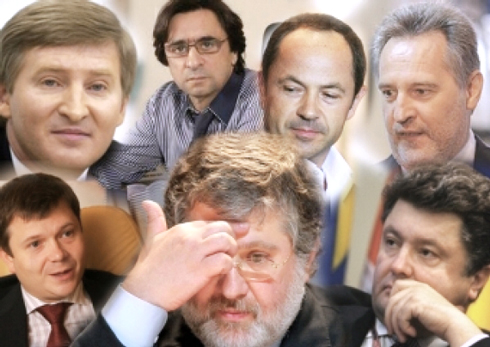
Resignation with guarantees and compliments
The dismissal of Igor Kolomoisky was preceded by a scandal around Ukrneft and Ukrtransneft. De Jure, these enterprises belong to the state, but de facto has been controlled by Kolomoisky for many years. However, the receipt of dividends from the work of state-owned enterprises is not to the country's budget, but in a private pocket, indignant that it is indicative, not so much Ukrainian power as its Western partners-creditors. And if Igor Kolomoisky had not demonstrated - so openly - his involvement in the state’s oil business, then probably would have remained in office. The transition of the conflict to a public plane is the main reason for the disgrace.
A few hours before Petro Poroshenko signed a decree on the resignation of Igor Kolomoisky, the latter met with the US ambassador to Ukraine Jeffrey Payette. According to the diplomat, he explained to Igor Valerievich that “the laws of the jungle of the times of Viktor Yanukovych in Ukraine no longer work,” and he “heard it”. Other details of the meeting were not reported, but according to the sources, in exchange for consent to support the arrival of state-owned enterprises, where he is a minority shareholder, the new management, which will finally ensure the payment of dividends, Kolomoisky received guarantees of non-confidence from Ukrainian power structures, as well as the lack of problems in the West, in particular in Geneva, where he lived most of his time a year ago.
Thus, in the political plane, the conflict was exhausted, but in the side of the business there is no: the state has to withstand more than one fight for its oil assets.
It is significant that after the resignation, Kolomoisky did not say a word of criticism addressed to Poroshenko. On the contrary, exclusively compliments. Moreover, the younger partner of Igor Valerievich, Igor Palitsa retained the post of governor of the Odessa region. According to the sources, the club was trying to leave after Kolomoisky, but Bankovi convincingly asked him to stay at least - until the end of the May holidays: the situation in the region was too unstable. All this suggests that the dismissal of Kolomoisky was not the beginning of the mass “dispossession” of Ukrainian thicknesses. Rather, it was the usual "agreement of the parties."
Weapons of the television
A similar situation forms around the conflict of Dmitry Firtash and the government Arseniy Yatsenyuk. The conflict has been going on for a year, from time to time flashing with renewed vigor. There are several objects of dispute. The main ones are the billionth debts of Firtash's structures to the state "Neftegaz" and his "daughters", also - the possibility of managing several GOKI. The parties permanently exchange public attacks, as well as court claims. The courts make decisions in favor of one or the other side and all starts again. A certain situational advantage is preserved for Yatsenyuk and Ko - as owners of key administrative resources. Firtash himself, as you know, has been under house arrest in Vienna for more than a year - on April 30, the court should consider the issue of its possible US extradition, where he has been accused of financial fraud. However, geographical removal does not prevent Dmitry Vasilievich from using his main weapon in the struggle against the Ukrainian government - the television channel “Inter”, which is the largest in the country.
It is important, by the way, to note that Firtash is fighting with the prime minister, not with the president. Poroshenko is still kept neutral. Indeed, it was in Vienna last spring that the historical political union was concluded: Petro Poroshenko and Vitaly Klitschko, who had the largest ratings in the democratic camp, agreed on mutual support in the elections. So Poroshenko got the head of state already in the first round, and Vitaly Klitschko became the mayor of Kyiv. By a strange coincidence, on the eve of Klitschko and Poroshenko, they saw in Vienna with Firtash. By accident, apparently.
As for Rinat Akhmetov, he gradually loses the privileges in the electricity market, in particular - on its export. Bankova, as already mentioned, wants to force the businessman to sell part of the assets that turn him into a monopolist. Of course, you can sell something, ”Akhmetov’s managers answer in absentia,“ but so that it doesn’t work out that the buyer will be, say, Russian banks. ” It is clear that in the current situation for Ukraine this is unacceptable. However, this polemic unfolds along the line “Managers of Akhmetov-Bankova’s leadership”, while along the line of Akhmetov-Poroshenko more than calm, and even benevolent. Which, again, indicates: the widely announced “deoligarchization” is a beautiful packaging, but not a real political line.
Resources - ready
Each of the Ukrainian oligarchs has at their disposal formidable resources - both defensive and offensive.
Firstly, the media. Dmitry Firtash, as well as his junior partner Sergey Levochkin, control, as noted, the Inter TV channel. Igor Kolomoisky - the 1+1 TV channel, Rinat Akhmetov - the Ukraine channel and the newspaper Today. Two weeks of their coordinated work are enough for the rating of any of the representatives of the current government to scatter into Tartarara.
Secondly-the Verkhovna Rada. In total, large capital controls about half of the deputies of the Ukrainian parliament. Thus, both the work of the Rada as a whole and the cohesion of the pro -presidential coalition directly depends on it. Already in the fall in Ukraine - the adoption of a new constitution and local elections (October 25). The key rate is precisely on local elections. Initially, it was assumed that by this moment a new basic law will be adopted and, accordingly, local councils would be elected to new powers. But today it is already clear that this is almost impossible - there are no three hundred votes necessary for the innovations in the Ukrainian parliament. They must be urgently searching. And it is clear - with whose help.
If the authorities suddenly untie the real, and not a fake war with the oligarchs, by the fall, the pro -government camp in the Rada can even lose what he has. In the sense - 226 (necessary to become a coalition) of deputy mandates.
The result is obvious. In Russia, as we recall, there was also deoligarchization. The fundamental difference between deoligarchization in Russian and in Ukrainian is that in the first case, the state machine really fought with the attempts of large capital, and fought systematically. In the second, the “old” oligarchs are involved in situational skirmishes with individual representatives of the authorities, hoping to recoup in the nearest elections.