
Translated material
Freedom as a condition for healing
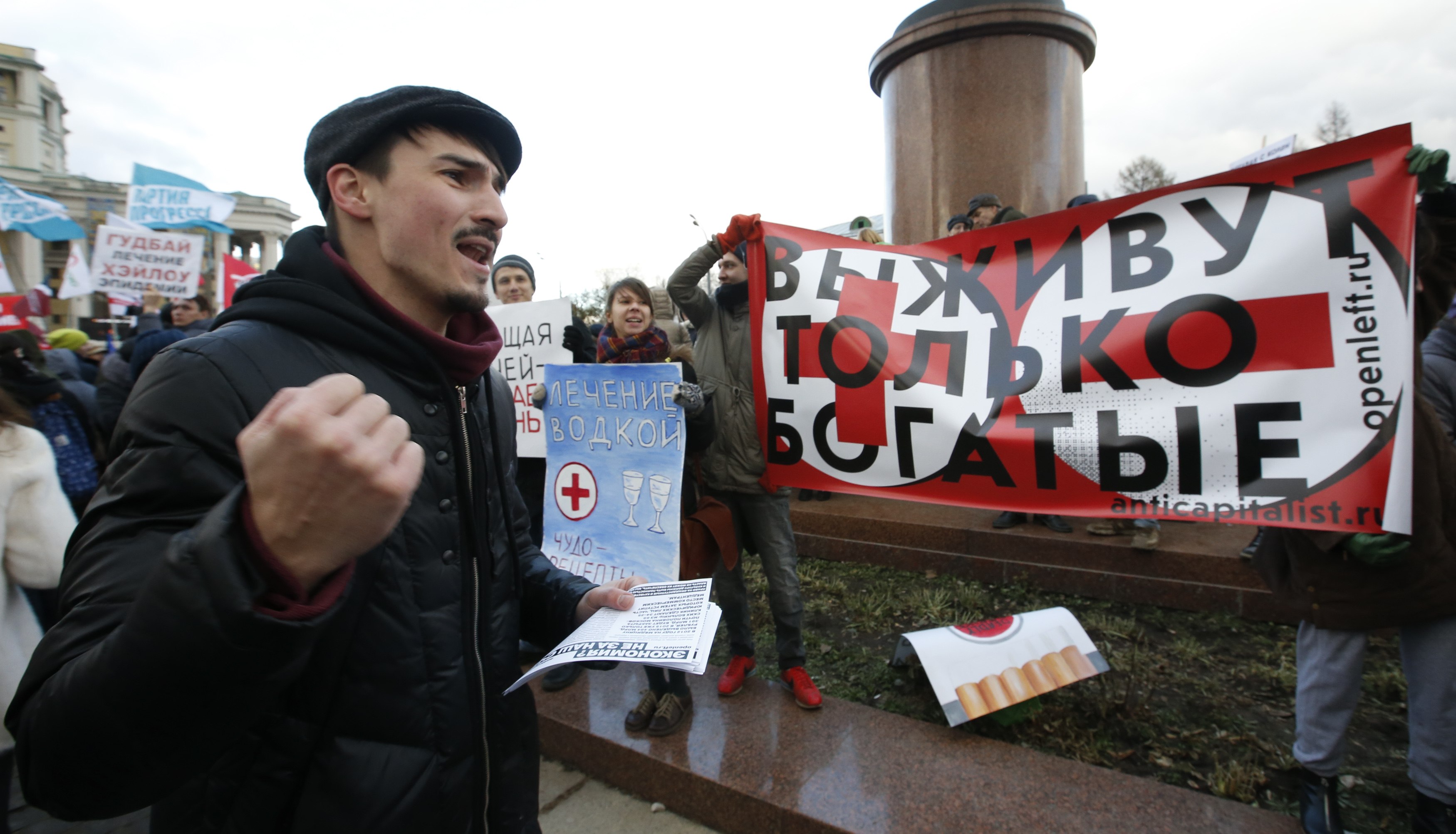
Cardiologist Maxim Osipov from the Tarus hospital is skeptical of both health care reform and the strikes of doctors
In Ufa, protests of medical workers are continuing with the arbitrariness of the administration of medical institutions. They, including radical methods - with the help of a hunger strike, achieve "compliance with their labor rights and termination of discrimination", as well as the resignation of the chief physician of the local ambulance station.
The situation in Ufa is only a fragment of the general picture of health problems in Russia, which in recent months have been actively discussed, in particular, in connection with the Moscow health care reform. Since the end of March, several dozens of metropolitan doctors have been conducting an “Italian strike” , achieving from the administration to improve working conditions, reduce load and improve financing. The reform of the healthcare system, in particular, provides for a reduction in the number of doctors and medical staff and the closure of ineffective medical facilities, including hospitals.
If there are people who are accustomed to obey, resigned to the fact that their profession has turned into a service sphere, well, well, God is a judge
A special position regarding the reform of healthcare and protest actions of medical workers is occupied by a cardiologist of the Central District Hospital from the city of Tarus, the Kaluga Region, the founder and president of the Maxim Osipov Tarusa Hospital Charitable Fund. In 2005, he, having an extensive practice of working in metropolitan and foreign clinics, left for 140 kilometers from Moscow to try to build a new type of medical institution for Russia there. Osipov is also known outside the medical community: he is a writer, author of four collections of prose and laureate of two literary awards, a public figure, active on social networks and does not shy away from public statements on socio -political issues.
“My sympathies a priori should be on the side of the doctors, because they are my colleagues and because they are not from a good life, obviously, are striking and starving,” said Maxim Osipov in an interview with Radio Liberty. - Another thing is that I have not yet seen such protest actions that I would personally have to join. I am afraid to incur the wrath of the medical community, but I have not yet noticed speeches or stocks of this, for example, such as: let us treat in accordance with the principles of scientific, Western medicine or something like that. Here we see a rally in Novosibirsk, about the opera theater : people do not go to the square to demand an increase in salaries to artists (which in itself, of course, would be nice to do), but they go out to fight for the freedom of creativity, for themselves and for others. I have not observed some serious struggle for freedom of healing, if you like. It is true, however, it is impossible to say that I am very carefully behind the strike movement of doctors.
Cardiologist Maxim Osipov from the Tarus hospital is skeptical of both health care reform and the strikes of doctors
- And what are you investing in the concept of "freedom of healing"? In your particular case, here you have - enough freedom of healing?
- Freedom is never enough, but in general, yes, we work freely. To a large extent because we are outside Moscow, in a very small town. If our hospital was not in the city, then, with some exaggeration, there would be no medicine in Tarus at all.
- Do you really have enough money?
- Of course, we do not have enough money. That is why for 10 years now the Society for Assisting the Tarus Hospital has been working. Without it, we could not exist at all. Not even because we are collecting a lot of money - unfortunately, we did not learn to find serious money on the side. But, at least, we find the money that is enough to buy supplies, which, generally speaking, is impossible to do without. True, unfortunately, without this, most Russian hospitals are dispensed with - without electrodes, catheter, all sorts of little things.
- The innovations in the reform of healthcare have not yet been affected?
-They affect, but for now, thank God, somehow to work, without applying for many.
- Do you agree with the main main directions of this reform? Are you ready to support colleagues who strike just because they consider the direction of this reform wrong?
Those clinics that we have in Moscow to date, for the most part, I think, just should be closed
- You see, one thing is to declare, another thing is how to act. The very idea of transferring the main streams of medical care from the clinic to hospitals is reasonable. However, those clinics that we have now have in Moscow, for example, for the most part, I think, should simply be closed. Just because the best doctors always went to work in hospitals. It would be reasonable to make those doctors who treat patients in a hospital, and then treat them outpatiently. But all this is not done! Therefore, I agree with something, with the declarations and statements of some. But with many of what is being done, I do not agree. And, among other things, the ministry expects virtually instant results from the reform, within six months. The authorities are clearly counting on: it came for a long time, just forever, but she wants results immediately. And in medicine it is impossible to get an immediate result. It’s like teaching a child to teach: you can buy an expensive instrument for him, but the baby will not learn how to play after six months, nor in a year, or after three. This just needs a lot of time.
- Doctors who work in clinics say that they do not have the opportunity to cope with a huge influx of patients and that this is precisely what reduces the quality of medical care. Are they right?
Now in medicine and in general in society the situation is such that all the moves that are made are bad
- Well, what does it mean - are they right or wrong? And what do they know how to do something that requires a more time from a doctor to take patients? They themselves are ready to use the term "medical care", although medicine is not a service sphere. The service that patients now receive in polyclinics, in my opinion, can be made quite in the now allotted time. But here one thing clings to the other-and it is completely impossible to say "yes-yes-no-yes." Everything is complicated here ...
- Let me deliberately exacerbate the conversation: "There are too many bad doctors and bad clinics in Russia, so nothing will change due to the number of them." I understand you correctly?
- Yes. A pathological situation has developed. The chess players have such a saying: in a bad position, all the moves are bad. Now in medicine and in general in society the situation is such that all the moves that are made are bad. For example, the task is to be set: to increase the average salary of medical workers. And what happens in our same Tarus, how is this task growing? All orderlies are transferred to cleaners, thereby there are fewer medical workers, since the nurse received the least, and the average salary rises. Well, what is it?
- How do you manage to fight for freedom of healing if you work in such terrible conditions?
- No, why in the terrible? We create some conditions for ourselves. Firstly, we have wonderful doctors, including young doctors who came from Moscow. Secondly, there is a creative atmosphere. How did the Soviet Union manage to have some foci in a certain extent truly free creativity within individual theaters, editorial offices? In this way, somehow we manage to survive.
- Your critics will say: Tarusa was lucky, a creative person appeared in the hospital. Maxim Osipov - a good doctor, a Muscovite, a writer, knows how to competently work with the public, knows how to organize a fundraising for a hospital and so on. But everyone cannot be like that! When it comes to the reform of such a complex area as healthcare, you always mean the average concepts, ordinary doctors. They might want to be creative, but they can’t all be like yours in a Tarus hospital!
-Well, firstly, we do not do any special things. In the West, even with very successful hospitals, there are assistance funds, a lot of money is collecting money. On the other hand, if there is no initiative and dedication, then nothing will come of it.
- Do you recommend colleagues who are now unhappy with their situation, to show creative energy?
“Well, I can’t advise them, they themselves know what to do.” If people are brought to the point that they are announcing hunger strikes, they probably have reason to do this. But in general, I would say: yes, the organization of medicine is a creative business, and you can’t do without increased dedication.
- Last Sunday, the Society for Assistance to the Tarusian Hospital held a charity concert in the oval hall of the foreign literature library. How did you organize all this, how do you manage to do this at all?
- I have friends - musicians, very good, just a world level: Maxim Rysanov, an altist, suggested arranging this concert; Violinist Boris Brovtsyn, pianist Yakov Katsnelson, cellist Boris Andrianov. My daughter Maryana, the violinist, also took part in the concert, she is a graduate student of the Moscow Conservatory. The first four musician I have named - among the most noticeable figures among the musicians of their generation. So I am friends with them, and Ekaterina Yuryevna Genieva, the director of the library of foreign literature, provided us with the hall, and then we gathered the people, mainly through Facebook, just called, convened people. 140 people probably came to the concert, and the concert was very good in creative terms.
Charity concert in support of the Tarusian Hospital
-Did you manage to raise some funds?
-Yes, yes, we raised 177 thousand rubles. Not God God, but they collected something. And I am grateful to all our sponsors. We will spend money on consumables: catheters, electrodes, test strips and other little things, without which the normal work of the hospital is impossible. Music, of course, is far from the most profitable thing ... But if you do not have friends-musicians, you can organize a football match or an exhibition of flowers in favor of the hospital ... Yes, anything, even dog running, you can always come up with something.
- You can, probably, but rather in another country, do not you think? Still, Russia is a country of paternalist consciousness. Doctors are mainly “sovereigns”, budget workers, everyone is used to doing, as the authorities will tell them, to go to rallies in support of the accession of Crimea, if they give a rabble for this ... Within the framework of the whole country, charitable concerts - although they themselves are very important - you are unlikely to change the situation.
- Well, I do not solve the situation inside a huge country. A piece of the world is open to me, and I act in this piece of the world. I have no recipes for the whole country. And if there are people who are accustomed to obey, reconciled with the fact that their profession has turned into a service sector - well, God, God is a judge. I, in general, do not feel much sympathy for such. I myself never went to such events for the Running, ” Maxim Osipov, a cardiologist of the Tarusa Central District Hospital, told Radio Liberty.
By February 2015, more than 8 thousand doctors remained without work in Moscow. Civil activists and employees of medical institutions repeatedly opposed the reform, at the end of last year they held three quite crowded protests in Moscow.
Fragment of the final issue of the Freedom Time program
-

Andrey Shary
I.O. Regional Director of Radio Free Europe/Radio Liberty for Russian -Sound Content
Andrey Shary on Facebook
Sharya@rferl.org