
Translated material
Putin's amnesty for political
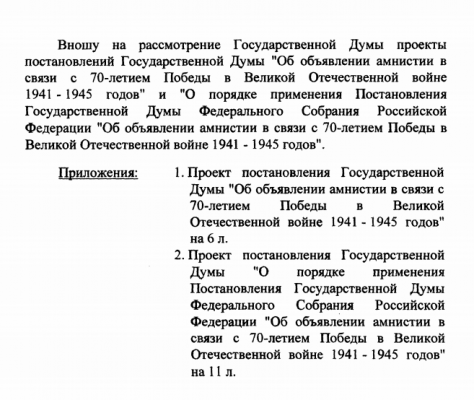
On April 9, Putin introduced draft decisions to the Duma on the announcement and application of amnesty in connection with the 70th anniversary of the Victory in the Great Patriotic War.
The alternative project of the amnesty was preparing before this in the bowels of the Presidential Council for Human Rights and suggested quite wide coverage. In particular, in accordance with this project, people convicted for the first time and sentenced to three years in prison, as well as those sentenced to a period of three to five years, but have already served at least a third of the due, were supposed to be released. In addition to the termination of the persecution, the project involved a reduction in the sentences for different categories of people, other types of mitigation of punishment were also proposed. Of those who, at the duration of the decision, would be under investigation or under court, it was provided for the release from punishment to people who, by law, could receive no more than three years of imprisonment or not more than five if the crime was committed for the first time.
In the project prepared by members of the HRC, there was also a list of crimes for which amnesty was not expected (it was only about people who were already convicted of “completed crimes”, that is, committed, and not for preparing for a crime): these are serious crimes - murder, deliberate infliction of serious harm to health, torture, and rape of a minor. Banditism, the creation of a criminal community, and so on. A number of articles by which people who were recognized by a number of organizations were condemned or are currently accused by political reasons were accused of amnesty. In particular, articles on mass riots and the application of violence to a representative of the authorities, by which the accused were convicted in the framework of the “swamp business”: many of them could immediately be released.
In the Putin draft amnesty, the list of articles of the Criminal Code, which does not apply to its effect, turned out to be significantly larger. It included Article 212 (mass riots), and Article 318 (the application of violence to a representative of the authorities), and the second part of Article 213 (hooliganism committed by a group of persons by prior conspiracy). In addition, the list of exceptions includes the economic crimes that were absent in the list of refinery - fraud in different types, bribery, extortion. The “human rights” list did not include the so -called “extremist articles” - 280 (calls for extremist activity), 280.1 (calls for violation of the territorial integrity of the Russian Federation), 282 (excitement of hatred or enmity), 282.1 (organization of the extremist community), 282.2 (organization of extremist organization). In the Putin project, the amnesty does not apply to accused and convicted under Articles 282, 282.1 and 282.2. In addition, the project does not stipulate that it is only about “completed crimes”.
Thus, neither accused and convicted in the “swamp case”, nor activists of Oleg Savvin, Mikhail Fieldman and Dmitry Fonarev, accused of group hooliganism for hanging the German flag on the Garage of the Federal Penitentiary Service of the Federal Penitentiary Service, nor the antifacist Alexei Sutuga under the same article for the same that he allegedly beat the nationalists in A homemade hammer, nor Oleg and Alexei Navalny, convicted, in particular, for fraud in the field of entrepreneurial activity, nor ally of Navalny - Konstantin Yankauskas, Nikolai Lyaskin, Vladimir Ashurkov, accused under the same article, not many, unlawfully accused or convicted under some “extremist” articles, amnesty will not affect.
As for the rest of the "political", then they have a little chance of an amnesty. So, the accused under Articles 280 and 280.1 (in particular, the Kuban activist Daria Polyudova) can count on an amnesty only if the court decides to give them a conditional term. The same applies to the ally of Navalny Georgy Alburov, accused of theft, - however, the respected organizations were recognized as “political”. (The process in the scandalous case of the theft of the picture from the Vladimir fence is approaching the stage of the debate.)
The amnesty may fall into the accused under the recently appeared article 212.1 of the Criminal Code on repeated violation of the rules of mass events. However, out of the first three accused, the amnesty with a high degree of probability will affect only Vladimir Ionov as a “man over 55 years old”. For the other two - the brand of Halperin and Ildar Dadin - amnesty is possible only in case of a conditional sentence.
Those of the political prisoners who have already been convicted of “intentional crimes of small and medium gravity”, in fact, have nothing to hope: theoretically, they could count on an amnesty, if at the time when the operation of the decision expires (six months after entering into force) they remained to sit for less than a year. However, neither the Kuban ecologist Yevgeny Vitishko, sent to the colony-settlement for damage to property, nor Rostov journalist Sergei Reznik, who received two consecutive terms for false denunciations and insults of government officials, do not comply with these conditions.
The Putin draft decree on amnesty and generally implies much less opportunities for people to release or get rid of a shorter term. Nobody is supposed to reduce the term half, as in the project of the HRC. Of those who were first sentenced to a period of up to three years for intentional crimes of small and moderate crimes, only representatives of the most vulnerable categories of citizens-minors, disabled, men over 55 years old, women over 50 years old, women with minor children or children with disabilities, pregnant women who have some kind of deserts like participation in the combat operations can count on exemption. forces or internal affairs bodies, participation in the elimination of the consequences of the accident in Chernobyl. There are no other messages in the Putin project, which are in the “human rights”-no reduction in the term, after which convicts can ask for conditional release, nor the removal of criminal record for those who can not get Russian citizenship otherwise.
In addition, the project made by Putin does not affect the people undergoing administrative persecution , while in the Special Project, they are given a separate point: in it, in particular, it is proposed to free people from fines and arrests for administrative offenses.
The Duma promises to consider and accept the project before the May holidays.