
Translated material
Fleet from the car
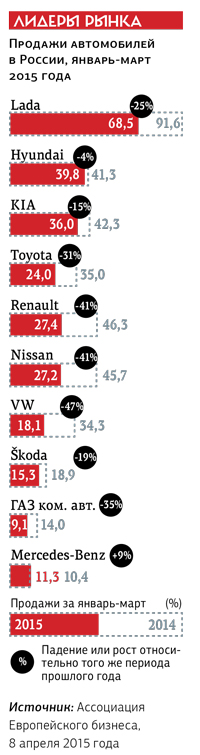
In March 2015, the market of cars fell by 42.5 % compared to March last year.
It was worse only in the crisis of 2009, when sales decreased by 58 %. What is happening - The New Times found out from the founder of the Rolf group of companies (the largest car seller in Russia), State Duma deputy Sergei Petrov 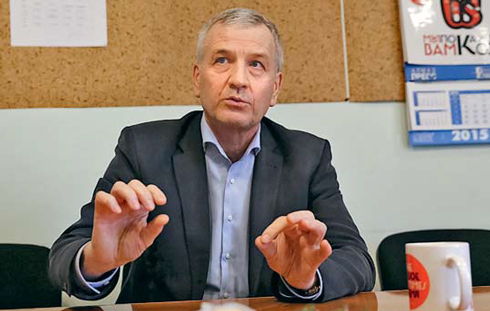
 |
| increase |

The numbers are stunned: sales of Honda fell by almost 11 times - compared to last March, Suzuki - by 80 %, Peugeot - by 79 %, Opel - by 78 %, etc. What is happening? In all crisis situations, approximately the same scenario is repeated. Immediately after the devaluation - a psychological shock: yesterday, the car was worth, relatively speaking, 1 million, and today - 2 million - we are observing now. Then, after six months-this is a plus or minus, of course, getting used to it-after all, you need to change the car, buy a wife/son. Unless, of course, there is no further devaluation or some additional problems do not appear. Plus, these factors for the first time recorded a decrease in income, salaries by almost 10 % - people lose confidence in the future, and therefore spend money only on the most necessary - the car is not included in this list. Dear loans also do not help in demand: in the United States, 90 % of cars are sold on credit or leasing. Since April 1, the government launched a program for subsidizing a loan rate for cars at a price of up to 1 million rubles. “Maybe this will revive the market somewhat.”
But Porsche sales - grew by almost a third, by 27 %. And Mercedes is still growing, and Lexus.
So it was during all our crises - premium brands either did not react to the crisis as goods in the middle price category, or continued to grow. Those who had money - have them and continue to buy expensive cars.
GM VS Lada Granta then why did General Motors leave the Russian market? This is a separate story. Of course, GM invested $ 300 million in the St. Petersburg plant, but, strictly speaking, they came to Russia primarily in order to sell their cars, bypassing customs duties. And the Russian government wants - and correctly wants - so that foreign manufacturers establish production here, that is, engaged in localization. And of course, if you have a part in Russia, you will not depend on the foreign exchange rate and you have a lot of stability as the manufacturer - therefore, the same Russian Lada Granta today is in sales leaders. That is, the idea is correct. But there are still such concepts as a business climate as the presence of qualified managers, staff, as the presence of adjacent people who can produce, for example, metal of the necessary quality for your parts.
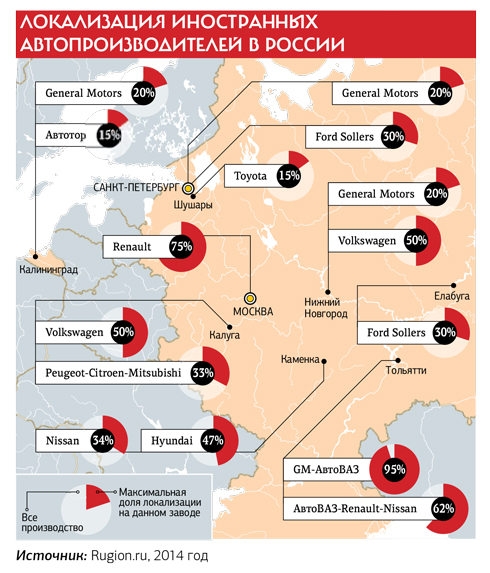
Experts indicate that GM was not enough localized in Russia (see card): say, Renault has 75 %localization, and GM has 20. Honestly, no one knows how much their localization they have. Ask - everyone will answer you: 12 %, 36 %, 62 %. How did you calculate it? Answer: Suppliers said that this knot is Russian production, which means that this unit is 100 % localization. And then it turns out: the part in this node is small, but there is important, but it is imported, it is for the currency - and the price immediately jumped up. Despite the declared localization. This is the first. Second: localization of localization is discord. The first stage - the first 20 % localization - it is relatively simple: all sorts of rugs there, glass. But the government says: no, now make engines, increase the localization - say, to 50 %, then the spare parts can be imported without customs duties. And the government says correctly. In theory. But in practice - they are not businessmen there - local problems arise.
Now the duty is 25 % plus utilization tax-there is one that in fact plus minus covers another 5 %-total 30 % load on imported machines, which should compete with manufacturers operating on the terms of industrial equipment. In other words, it should be profitable to assemble cars in local production, they should be competitors at a price with imported. In these 30 %, you must put all your production costs in Russia. To do this, you should be super -efficient, and it would be nice to have the market in 5 million (cars sold a year), and not 2.5 million, as it was last year.
Increase what problems for manufacturers in Russia are the most acute? All. For example, in the price of a car, human labor is less than 5 % - at a good factory. But the problem that we always have in Russia: 20, or even 30 % of workers may not go to work. Why didn't you go out? Because. Someone washed down, someone just did not want to work today. Therefore, manufacturers need to keep more staff - so as not to disrupt production and delivery. You will say, why not fire those who do not go to work? Not to fire. Because labor legislation - we have a socialist one. So, your costs as manufacturers grow. Labor productivity in Russia is generally a separate topic: studies show that its growth is half the lags behind.

Or - taxes, they seem to be European. In the West, income tax can be 20–25 % - we have 18 %, but in the West you enter a bunch of things into the costs, but we can’t, and to return VAT, we need additional costs for lawyers, you need to wait six months - this percentage is laid down on capital. Plus, now there are still obligations on the WTO, to which the government has gone back to the fact that in the country every year the conditions for business will become better and better. But it turned out - you see for yourself. And this is a mass, everything gets excessive stress, what you save at customs, you give with excess in other places. In short - our country is not for business, it is not good for production. And foreigners understand these risks and, apparently, prefer to have a plant in the Czech Republic or in Slovakia and from there to add cars. When someone, like GM, says: “I am leaving”, our ministry begins to think how to not miss you. But this is the same as if you fall from the 20th floor, and somewhere on the 10th floor you are asked: "How are you?" And you say: “So far, it’s good, blowing it ...” And you are going to close the factories. But someone got into a lot, someone invested more than a billion-Volkswagen, Renault-Nissan, and Solaris Hyundai is selected for this-in case of deterioration of the conjuncture, they will leave our market the last.
But GM said that leaving the Russian market will cost it $ 600 million, that is, the company will bear tremendous costs. And still - leaves. Are you sure this is not a policy? Yes, I am convinced that this is not a policy, because there are shareholders who at the meeting will ask: where are our dividends? And if you answer them something about politics, then they will instantly throw you out into the street!
Once again: Russia is a country that is poorly suitable for business. We have in power - guards, they, seeing a foreign investor, begin to scribble the papers: de, these Frenchmen came to expel our manufacturers from the market. To think with your head that these French or Germans have already invested billions, and for every frank they need to report to the shareholders - this does not come to mind. Our officials have a geopolitics before our eyes, the war between the continents, tectonic clashes, and they reign with a saber in the middle of this.
With the departure from the GM market, what will happen to the maintenance of already sold cars, with spare parts for them? Each manufacturer most expensive values its reputation. Therefore, they will never abandon their customers - they will fulfill, I am sure, all their obligations. And of course, there will be no deficiency with spare parts. First of all, they did not completely leave, they leave expensive models. Secondly, of course, the entire service structure will work. Moreover, they can return in the foreseeable future.
In general, we do not really understand that auto industry is a difficult business, the competition is very tough to survive - you need to have a constantly working group of developers who think about the future. After the war, the Japanese took 25 years to reach the international level, the Koreans reached this level much faster, in 15 years, the Chinese are now in a catch -in -catch position, but they will probably come out if they go the same with quality. They just have their own market so large that they have something to do. But this is a long process - the civilized entrance of a new country in the world auto industry.
And what will happen in Kaluga, where is a bunch of automobile plants - and Volkswagen, and Volvo, and the plant that produces Peugeot, Citroen, Mitsubishi? In Kaluga, everything is fine, although, of course, everyone has risks. They made a statement that remain in Russia. Volkswagen has invested quite a lot, so they will do everything possible to continue to produce cars. As for Citroen, then, in my opinion, last year they released almost 7 times less cars than before. And the fixed bones all remain, you have to pay for the light, for electricity ... If they even make a decision on evacuation, then maybe the Chinese will buy it, now different negotiations are underway. Maybe some other model will produce-for example, Mitsubishi additionally, there are options. The whole question is what the market will be: now we do not know whether this year there will be sales in the region of 1.5 million cars-this is a pessimistic forecast, or a little more-1 million 700 thousand, while 2.7 million cars were sold in the country in 2014. In Russia, only 28 % of the population own cars, and almost half of the park accounts for cars over ten years. We have 1000 inhabitants-about 283 cars, in the USA about 800, in Europe somewhere around 500–700-in short, our market has where to develop.
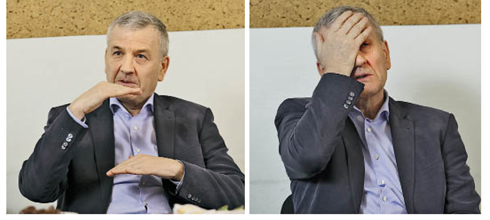
Sergey Petrov in the editor of NT, April 8, 2015 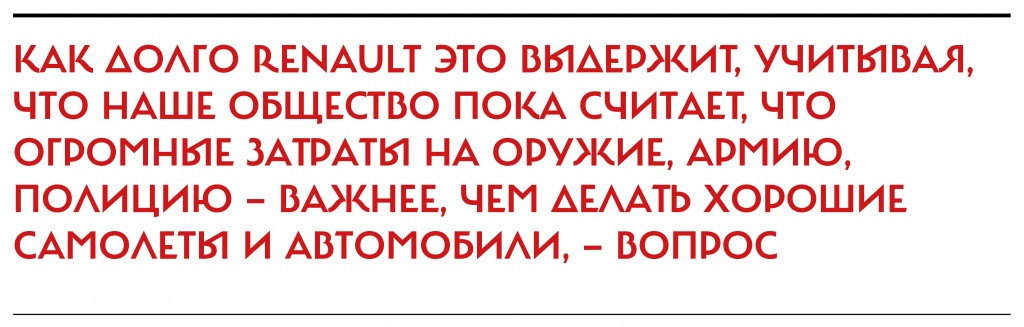
But the Chinese learned? The Chinese do not bend their fingers, they say: teach, we want to study. Ours say that Renault wants to buy us to close a competitor, bearing in mind that we know better how it works: we have been flying into space for more than 50 years. This is very bothering us. Therefore, we are not used to studying especially, we are used to looking a little, quite superficially, and say: what is there to do? Now let's take from the same “Opel” - and we will do everything. They take it, but - it does not work. In principle, everyone knows how to produce the same Toyota. You can disassemble and copy the screws. But so far we are all the time "Lada".
That is, in Bu Andersson * * Bu Andersson-Since November 2013-President of AvtoVAZ OJSC, before that for 20 years-one of the GM top managers. and Steve Mattina * ** Steve Mattin - Since October 2011, the chief designer of AvtoVAZ, before that - designer Daimlerchrysler and Volvo. who are now trying to do something on AvtoVAZ, do not really believe? * They are now on the intermediate path-of course, they will bring technologies with Renault-Nissan and put business processes. The problem is that it is very difficult to earn profit and create a new car. Imagine: we take the old "Zhiguli" and begin to make a new modern car. We insert a new, modern node - and the price of the car immediately takes off to the foreign exchange part of the node. And the car was good that it was cheap, that it was done poorly, but cheap. Everything, cognitive dissonance has gone, the same thing does not work. Please note: all over the world there is a struggle for the cost of a car. Say, in Japan, engines are made for Pajero: for Europe - at an average speed of 150 km per hour, because there are autobahns, on which 130 km per hour are allowed, and for America they make engines at an average speed of 100 km per hour. The difference seems to be small - 50 km per hour, but when there are many thousands of such engines, another casting, the metal is slightly cheaper, a lot of savings are obtained.
And therefore, in the USA, cars are cheaper than in Europe? Not only therefore: in the USA meager customs duties - in the region of 1.5 %, not counting pickups. In the United States, people do not want to pay the government, it is not clear why. Therefore, in the USA you buy Toyota Camry in terms of our money for 600 thousand rubles, and we pay more than a million. But let's get back to AvtoVAZ and Bu Andersson: one, even the most ingenious top manager, cannot do anything. Renault, if he seriously undertakes, will be able to. If a business climate will not deteriorate, if the guards who are everywhere trying to control the business and who are looking for spies and make sure that no one knows how many airfields ... how long Renault will stand this, taking into account this, will not yet interfere, taking into account that our society still believes that huge weapons, army, and police costs are more important than making good aircraft and cars, a question.
Photo: Alexey Antonenko