
Translated material
"I need a moon"
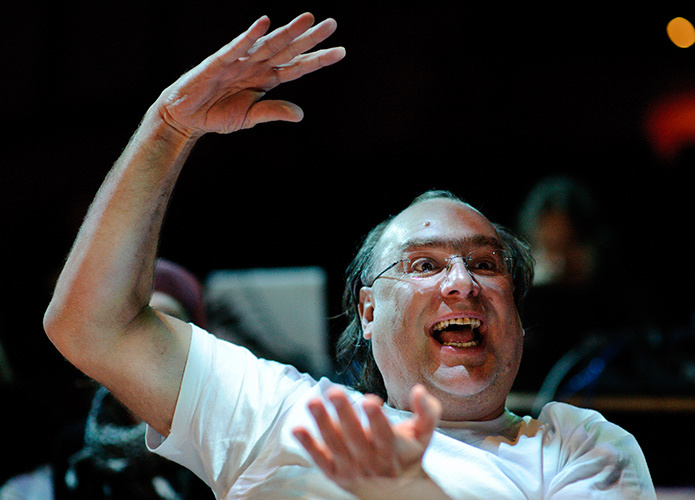
The Petersburg BDT is preparing to complete the season with two important premieres one louder than the other: in early May, the Chudruk of the Bolshoi Dramatic Andrei Mighty will present his version of the “drunk” Ivan Vyrypaev on the main stage of the theater, and on April 29 and 30 on the second scene of the BDT, in the Kamennostrovsky Theater, Ukrainian director Andr I Zholdak releases the play “Servant of the Two Lord” according The motives of the play by Carlo Goldoni. Interview with Andrei Mighty about today's agenda of the BDT read on COLTA . Ru in the coming days, but for now we publish an emotional conversation Andr I, I Zholdak with Dmitry Renansky.
- When about ten years ago at the St. Petersburg Theater Academy we were read a management course, one of the mandatory tasks was the development of a utopian project from the category of those that never, under any circumstances could not be implemented. About every second classmate of my classmate in the Wish liner of unrealistic dreams, the project “Housing puts in the BDT” was the first number -at that time nothing more blasphemous -unprofitable could not be invented. How did it happen that in two weeks you release the premiere in a large dramatic?
-Actually, this spring I had to put the “three sisters” in the Alexandrinsky Theater. But when the artist Tatyana Parfyonova and I painted the story of the performance - literally from the first to the last scene - it turned out that the project was very expensive, and as a result, Fokin (artistic director of Alexandrinka Valery Fokin. - Ed. ) Suggested that I transfer the premiere for 2016, so I had several free months. With Andrei (the artistic director of the BDT Andrei is powerful.- Ed. ) We wanted to work for a long time, and then everything somehow coincided: I had time, he had a desire, we hit hands, and the work instantly started. It is important that the mighty gave me the opportunity to rehearse with youth, with a group of BDT interns who were scored at the beginning of the season. This is so unexpected for me! At the casting, four young guys raised their hands and say: you are our first director in life! Can you imagine what is the responsibility for the director? I began to rehearse at the end of February, then left for a month - and now we have a very quick release. Everything is very rapidly: when young energy poured at me at the first rehearsals, I somehow squeezed a button that was responsible for self-control inside me, and began to rehearse very obscenely. It’s obscene for myself, and for St. Petersburg, and for the BDT - as if I rehearse in Amsterdam, in a completely free country and an uncontrolled theatrical space.
- It seems that this is exactly what today's BDT needs, to open the gateways, to lower all the musty water.
- So, I correctly felt that it was necessary to rehearse without any look.
-Tovstonogov, the apotheosis and the standard of the Russian psychological theater,-did it all have some meaning for you at the moment when you crossed the threshold of the great dramatic? After all, you probably had some kind of formed stereotype of what is the BDT.
- Rather, it is not precisely the BDT, but in general the like large repertoire theaters - and not only in Russia, but also abroad. A year ago, I conducted a casting in Bucharest, in the National Theater - a huge building built during the time of Chausko, the main scene of Romania with government and presidential lodges, with very good funding. Actresses from all over Romania gathered on one of the female roles - two hundred people, I don’t exaggerate, the whole Bucharest underground, people from the cinema ... Do you know what one girl told me? If not for you, we would never have crossed the threshold of the National Theater - for us this is a giant tomb, the kingdom of the dead. This, it seems to me, is a very accurate metaphor for large repertoire theaters with history. There are such mounds in all large cities - before they were commanded by the Scythians, who made their secret rituals there, the secret of which is not allowed to solve. All this was buried, and today, digging the mounds, we find ancient thick books in leather bindings describing these rituals - but we do not know the language in which these books are written. The language of the old theater is lost. Of course, the old leaders of the tribe survived, but they do not read books, they just remember the stories about how their ancestors lived ...
- The old theater exists only in oral tradition ...
- Yes, but art is accurate knowledge, it is mathematics: if we deciphered ancient books, we could read the basic formulas. But the key to the past is lost forever. All that remains for us is to go forward. Returning to the answer to your question: the BDT was such a mound for me - which is dangerous to pass by at night, because there are perfumes that are dissatisfied with the fact that they have forgotten ... Of course, you won’t envy them: remember what the British who opened the ancient Egyptian tombs? This is a huge risk: to agree to lead such a theater is to agree to survive what the astronauts experienced during the first landing on the moon. In this sense, it is already much simpler for me: wandering now with my flashlight on the labyrinths of the BDT, I am walking along the routes that Andrei has already cleared-although I still have the feeling that it is better not to meddle in some corridors. I have already told Andrei that now he needs to invite large directors - not even to create a name for his theater, not for promotion, but in order to help him clear the space. Today's BDT needs directors who can pour the gravity of actors.
I am an alien, driven by the only task: to break through a hole in the human skull.
- Since you were forced to leave the post of Kharkov drama, and you moved to Berlin, ten years have passed. During this time you didn’t put it where in Germany, Finland, Sweden, Russia ... Sometimes you returned to the production of theaters, but constant obligations did not associate yourself with any troupe. Is this a conscious decision or a combination of circumstances? Did you never visit you sooner or later in the minds of every director the desire to get your own theater, theater-house?
- Just yesterday I thought about it. In one day we somehow managed to do a lot of suddenly, I have long been so productive, I did not work with a grand scale. And now, watching how the young BDT actors work, I began to ask myself questions: here are beautiful young actors, I like them terribly - do I want to work with them constantly, to connect my fate with them? You do not have your own theater, there is no secluded house in the forest, which you have been looking for and suddenly found all your life - do you really not regret it, you don’t hurt because you don’t have your troupe, actors, maybe enough to drive around the forests? Well, figuratively speaking ... You know that I will rehearse for a long time, ten hours a day, and now the time is coming by night, the actors are tired, they repeat a piece of the piece, I am getting cherished, I like the atmosphere in this rehearsal hall of the BDT with high ceilings - and subconsciously begin to think about what role I would give one or another artist in the next performance. So, at a certain moment, I have a very clear answer to all these questions: no, I do not want me to have a house. Yes, I would have my own actors, we would have developed together, I would even like it - but I see a tremendous danger in this. The feeling that you can go to another country at any moment and meet completely different people is much more important. I want freedom, I want risk, I want to go into the unknown - and meet the Belarusian, Belgian ...
- ... African.
- Yes! Remember, in Sweden, the actress Afroacherican worked amazingly in one performance? So, I felt very sharply that I had not ripened yet in order to work with the same people in the same place. Not a walk. Or maybe my path will remain so until the very end - to die a lone wolf, constantly, while there is enough strength, catch animals and sharpen your teeth against stones in the forest. I need a moon, I can't lock myself in the room! Even with such high ceilings as in the beautiful rehearsal hall of the BDT.
(He thinks deeply.) That's another thing here: if we leave from somewhere, we come somewhere. Care is a parish. And we do not know in which cases we leave, and in which we come. This is a serious philosophical question. The most dangerous for me is when monotony, repeatability occurs.
- By the way, about repetitions. After all, you already put the “Harlequin - the servant of two gentlemen” in Kharkov in 2004: the performance was called “Four and a half. Goldoni. Venice ”, it was one of your most indisputable masterpieces. It is clear that now in the BDT you compose a completely new text. Why did you decide to return to this play now - and what has changed in your perception of it?
- In general, the situation when the director creates copies of his previous works is very common in the modern theater - at the opera stage, for example, people earn whole conditions. This is unacceptable to me. I would rather bring another metaphor. In my youth, when I studied at an art school, the teachers paid our attention to how great artists after a certain time returned to their favorite plots, wanting to look at them in a new way: the same Goya, say, drew his infant in a different way every five years, and, for example, many times put the “idiot” of Dostoevsky-and every time in different ways.
Kharkov "Goldoni" was a performance about beauty and disappearance. What I put “Harlequin” in St. Petersburg, I can’t say about - but I know for sure that the performance will turn out much more tough. I realized that, working with young actors in the current situation of the BDT and in Russia as a whole, you can not be a gentle cream brute. I hope that we will get a provocative performance-on the verge of cynicism and irony, which is actually not total.
I am considered a provocateur in Russia, but in fact I am an artist with a big heart. My performances are an epic of feeling. You know well that at the first meeting with new actors, I ask them to read the text with which we work - and answer the main question: do we believe this text, do we believe remarks that we pronounce? The answer to this question will be the key to our future performance. We are children, we are angels, with all the purity of our hearts who believe in the text? We believe that in the yard May, that cherry trees bloom, although the morning is still cold? Or, from the point of view of modern cynical people, we subject the first Remarus of the Cherry Garden to doubt - was it really cold? Did Lopakhin really fall asleep - and did he masturbate before bedtime? A thousand questions immediately arise that kill faith in the text. So, I will try to make a performance in the BDT for the first time in my life from the point of view of a person who does not believe . You know that for me, who hate cynical actors-robots who hating the Rio, this is very strange. But now, for some reason, I want to look at the history of “Harlequin”, and at the current historical situation of the BDT with an ironic, cynical point of view-a sensitive look of an indifferent person.
The theater should leave the comfort zone.
- A month later, your “Evgeny Onegin” will return to the Mikhailovsky Theater’s repertoire - a performance that has gathered all the key “golden masks” last spring. I well remember our conversation in September 2012, when you only had to begin rehearsals of Tchaikovsky’s opera. Returning to St. Petersburg from Finland from the release of the “Cherry Garden”, you then admit that you feel like an artist who can organically work in completely different manners and techniques, whose hand is subject to both tempera, pencil, and cutter. As a result, you then set up completely unusual for the Russian viewer, who knows you by dense, often excess production of the end of the zero, the performance is transparent and very clean in the drawing. Have you changed since then? What is today Andr I Zholdak?
- My artistic consciousness, as always, is bifurcated. On the one hand, I continue to search in the direction of my Finnish Chekhov performances, “Uncle Vanya” and “Cherry Garden” - I am talking about a powerful interest in a person, in humanity, in humanity. After all, he is also present in Onegin. On the other hand, attention to the actor, reflected in all my last performances, woke up a director-reform in me even more in me, all the thoughts are occupied with how to take the next step in the direction of the deconstruction of the theater, deconstruction of the text, deconstruction of a person. This is the whole paradox: on the one hand, I want to love a person, but at the same time I have to look at him and at the material with which I work, with maximum ruthlessness - as if I am not a person, but an alien, completely indifferent to culture, to the city where I work with which I deal. I am an alien, driven by the only task: to break through a hole in the human skull. After all, we use only seven percentage of the capabilities of our brain - and the other ninety -three percent, this uncontrolled, unidentified, unexplored zone remains untouched ... But it is this part of the brain that controls all the key processes - love, creativity. All information about who we came from, where did we come and what will happen to us will be. The modern theater is the same seven percent. And what would happen if we used the entire volume of our consciousness and imagination ...
My theater is constant attempts to illuminate with a laser lantern at least some part of the reverse side of the moon of the human brain. Let it consist of a matter that does not miss the light ... Do you want to know what I do during rehearsals? I take a stone, break through the actor’s skull to them - and try to understand how he works. Remember how the anatomy used to learn? The theater operates about the same.
- How do you, at a utter and idealist, live in the pragmatic world of the modern theater industry? How are the plans of your performances, detonating during rehearsals and swinging in eight to ten hours, which see only a few elected rehearsals, are related to the final product-three-four-hour versions edited under the pressure of the producers and presented as a result of the public? You do not envy Lars von Trier, who finally managed to release the directorial version of the “nympho”?
- A great question. During rehearsals, I always try to realize my plan for one hundred percent - putting it like an ideal performance, even knowing that in the end I will have to cut on the living, cutting off most of the material. But I also know well that the fact that it is moving and does not fall into the final version of the performance will live in my future productions. Your question is related to the artist’s phantom consciousness: images that are born in his mind, accompany the Creator forever. In general, in recent years I have been feeling a writer writing giant multi -volume novels. Sometimes, rehearsing, I catch myself thinking that this or that scene already exists in the fifth chapter of the first volume of my previous novel - although in reality I had to refuse this scene and the viewer did not see it ... Imagine what horror he accompanied Gogol all my life? He burned the second volume of Dead Souls, but the texts continued to exist in his mind ... By the way, we reached the key theme of the theater-its existence on the border region, on the cordon, at the checkpoint ...
- Between what and what?
- Meanwhile, what we see in reality, and what we feel. Suppose you see only a glass drawn on a piece of paper. But before drawing a glass, I drew a cup in which the cherry that grew up in the meadow, where I made love was lying, and the animals roamed around the meadow ... Drawing a glass, I keep all this chain of images - and therefore it seems to you that you see a glass, but you feel something more. At one of the rehearsals in the BDT, we tried a scene in which a black angel approaches each of the heroes - and for five seconds we see the real thoughts of the characters on the screen. They say one thing, but they really think about food, about sex, about how tomorrow the weather will be. With such things, it is interesting to work in the theater - with that plasma of our psyche, which is life. It’s not to work on the texts, but not to engage in the psychological analysis of the fact that in fact the Chekhovskaya Masha wants to tell the vertex ... The trouble of the theater is in his sterility. I play that, you - this, here is a climax, here give music - well, what is it? The theater should leave the comfort zone. We are monstrously insincere, monstrously afraid of ourselves, hide from ourselves in life.
-And you yourself ever had the feeling that you are in the comfort zone-and that you urgently need to leave it? I will not undertake to establish the exact periodization of your career now, but it is obvious that in Kharkov, in Germany, in Finland and in recent years, your handwriting has changed very much ...
- Perhaps I agree, at least, with the fact that in my life there really were very different periods that ended the same time that I picked up a revolver and committed suicide. The boundaries of these periods are blurred - after all, I had to kill not only the artist, but also a person, and this is much more complicated.
“But at the same time you perceive your career as a whole continuum, as evolution?”
-In a sense, a person, of course, develops gradually-but it still seems to me that we are more aborched than we evolve. Do you know how it happens? You spend five years with a person and at some point you hear: “God, I did not know you at all! It turns out that you are ... ”And you are actually completely different. A person performs mental suicide - and now a completely different “I”, “I am number two” come to your meeting. At one time, I had a fundamental dispute with an actress who claimed that after a certain age a person is not able to change, that after forty years he was already vindictive, determined that he loves and that he does not love ... But I am convinced that a radical change can occur in an instant. This is the plot of Dostoevsky - a metamorphosis that occurs with a killer, with a maniac, with a morally fallen person ...
This is what we should strive for-like Bunin or one of the writers of the beginning of the twentieth century: wake up in the morning, put on a perfectly ironed suit, drink champagne, press the trigger-and be born again. Although people, of course, want stationaryness, stability. Art is also necessary so that a person cracked in a person under his feet - and irreversible changes in consciousness begin. It seems that we are no longer talking about the theater, but about something above ...
-On the contrary, it seems to me that we just started talking about the theater. The theater is just what is located somewhere higher.
- Therefore, I honestly say to everyone that I am not a director.