
Translated material
The dosed evil of Chekism
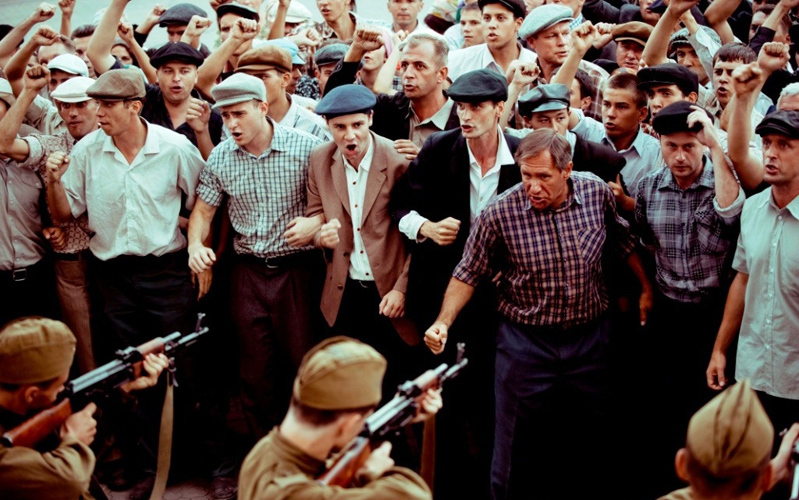
The Russian premiere of the domestic series, filmed three years ago and at the same time successfully shown in Ukraine, is something like the Soviet cinema regiment with an amendment to the technical conditions of the 21st century. “Once in Rostov, they removed for“ Russia-1 ”(the titles begins in the channel’s logo in the YouTube version of the series with Ukrainian subtitles), but in 2012“ Russia ”for some reason did not dare to show the series, and only now the Channel One bought the rights and showed“ once in Rostov ”to the Russians.
The dramatic story of the three -year failure of the film on the Russian screen - it can be considered part of the plot: it sometimes happens in the theater that the actors in stage costumes meet spectators at the wardrobe or even on the street. So here - a movie about Soviet totalitarianism begins at three years on a shelf, so that the viewer can feel in the USSR and in his direction of the screen. The premiere of the old film is given by the effect familiar to the older generations - in front of us, among other things, is almost unknown to the large role of the long -dead Bogdan Stupka and the thorough application of Vladimir Vdovichenkov to the title of the great Russian actor three years before Leviathan.
A movie about Soviet totalitarianism begins at three years on a shelf so that the viewer can feel in the USSR and in his direction of the screen.
To connect in one two main Rostov plots of the sixties and seventies, Novocherkassk and the case of the Tolstopyatov brothers, is an interesting trick. For some reason, in almost all Russian series of this kind (“liquidation”, “Mosgaz”, “Black Wolves”, “The Scream of Owls”, etc.), the crime is necessarily politically motivated: whoever is the killer, he, as always turns out in the last series, kills not just like that, but in order of revenge of the Soviet regime, and this is a traditional weakness of the Russian serial canon-you watch the series, you watch the series, You look, it’s interesting for you, and then it turns out that the whole point is that the main villain in childhood, the enkavedeshniki who came to arrest his father, confiscated his favorite rabbit, he, offended this, grew up and created a gang (about the rabbit-not a figure of speech, but a real episode from the Russian series), and this is somehow not very convincing, you feel deceived.
 © Channel One
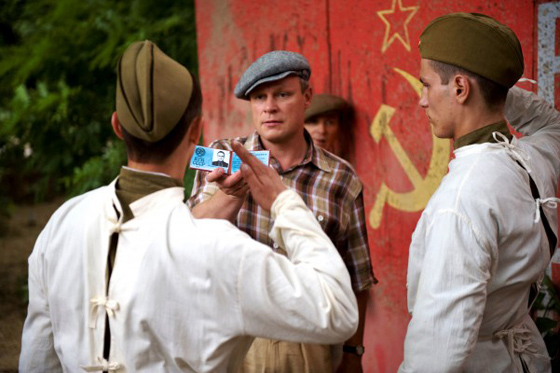
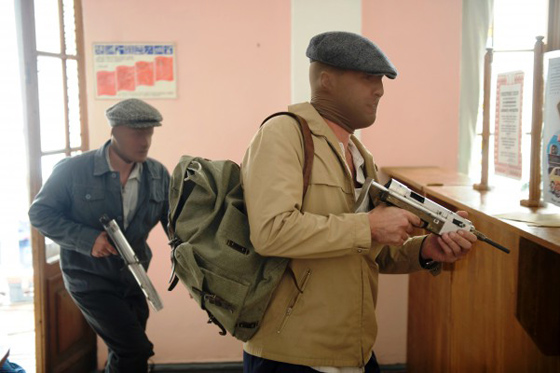
The creators of “Once in Rostov” placed the intrigue of politically motivated crime at the very beginning of the series: the glory of Tolstipit was horrified by what he saw in Novocherkassk and decided to take revenge on the Soviet regime, that is, a gang of Tolstopyatovs-this is a kind of seaside partisans. The hero of Vdovichenkov first wrote the leaflets “Novocherkassk, you and I”, but they did not work on anyone, and he decided to go the other way. Such a plot can also be considered slightly stretched, but since the real motives of real Tolstopyatov are also known, then why not assume that they really could take revenge for Novocherkassk? Their gang (at least by the standards of our time) was more similar not to the organized crime group, but to the underground terrorist group, and some intangible motifs that were not mentioned in a real sentence could really be in the Tolstopyatovs.
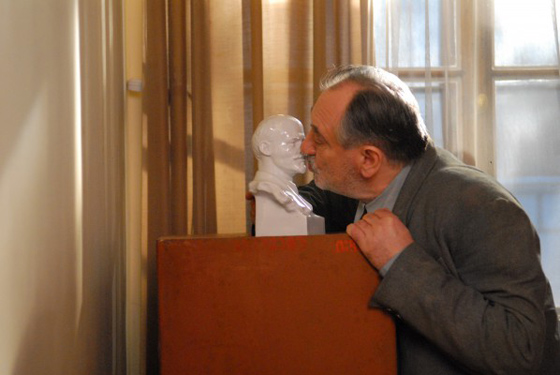
The plot “Once in Rostov” is several years of life of Tolstopyatov between two attempts to kill policeman Karpukhin, but between these two attempts the creators of the series placed so much that they themselves had to make a noticeable effort so as not to forget that it all started with Novocherkassk. In general, a frank desire to make the complete encyclopedia of Soviet life-so it probably critically damaged the series and will not allow it to become a new “liquidation”, not to mention something more. Novocherkassk in the history of the Tolstopyatovs, perhaps, is appropriate, but only he - all other signs of Soviet political history create overload and nothing more. A strange storyline with the hero of Konstantin Lavronenko, a janitor in a skyscraper on a Kotelnichesky and at the same time writer-dissident who transfers his manuscripts to the west and dying of tuberculosis received in correctional works-this is more for the end of the seventies than for the beginning of the sixties, and in terms of the reliability of the entire narrative, this is much stronger than any modern door handles and the reliability of the whole narrative and the authenticity of the whole narrative. There are a lot of sockets (which in Rostov, as it should be in the Russian series, is a lot), signs about finishing materials or “Pravda” with three orders. “There is no God, he died, and in their souls they have a political gram of political gram” - the hero Lavronenko composes the texts of Nikolai Bokov, which in this film certainly could not be, but, on the other hand, if the role was written for Lavronko and was a prerequisite for his participation in “Once in Rostov” - let it be, the film does not spoil this.
 © Channel One
The issues of reliability are inevitable when it comes to a historical novel or, like ours, a series. The history of the suppression of the Novocherkassk uprising is retold exactly as in the entire literature on this topic - in the “Novocherkassky” series there is everything that we know about 1962: the Chrushchev’s poster for sausage, and the director Kurochkin with his famous “There is no money for meat, eat Liever” (in most sources - “eat pies with Liver”), and General Shaposhnikov, who refused to shoot at People, and General Pliev (in the film is not named after the name), who gave this order and ensured its implementation without Shaposhnikov. General Lebed told General Lebed many times about children who were sitting on trees around the perimeter of the square during shooting during the shooting, which, according to him, was one of those children on the trees, and these children are also in the series.
The Chekist Kolesnikov is an absolutely Ernstist hero, that is, a person who buys a Donbass boy at work, but is still proud of the Olympics and films of Parfenov.
The most risky from the point of view of reliability is the figure of the head of the regional UKGB Kopyltsov. In fact, Rostov KGB was then led by Colonel Tupchenko, and this is not him at all. Kopyltsov is an invented hero, but so successfully invented that his inaccuracy does not matter at all; Such as the hero of Vladimir Yummatov, and there should be the main regional security officer-with a pregnant woman with a cipher, a suicidal sister and the seven-part in the phone, who constantly requires something and for the calming of which one has to go to all sorts of official crimes.
A funny and clearly determined by our Putin time the Chekist plot factor: the real Tolstopyatovs in 1973 were delayed by ordinary police officers, and in “Once in Rostov” the operation is developing and led by it, of course, a Chekist, a hero of Sergey Zhigunov, and a couple of Zhigunov -Patnyv, that is, the Chekist Koilles and policeman Karpukhin, - - - - - a Karpukhin, - - - Politioner Karpukhin. These, of course, are pure joglov and sharaps, but brought to the limit in the sense that the clever Zheglov works in the KGB, and the browstry Sharapov is a cop.
 © Channel One
Zhigunov, as you know, generally invented and produced this series, so his role, although not the main one, is the largest and most interesting. It is clear that “once in Rostov” was removed to “thaw” and such comparisons are not entirely correct, but “one day in Rostov” is precisely the provincial “thaw”, and the role of Zhigunov is literally the same role that Todorovsky was played by the neutrals Evgeny Tsyganov: such a good cynic, a moral relativist out of disgusting time, a person who makes such meanness, which performs such meanness, who performs such meanness, who are committing such viles, who are committing such vile In that historical situation, only can be justified and inevitable. And, most likely, it was in this hero, and not at all in the unmade theme of Novocherkassk in the current Russia, why this series three years after the non -trip bought the first channel. The Chekist Kolesnikov is an absolutely Ernstist hero, that is, a person who buys a Donbass boy at work, but is still proud of the Olympics and films of Parfenov. “I am at least doing something,” says the hero of Zhigunov in response to the next reproach of a definitely good hero of belonging to a Chekist corporation, and in a dispute with the head of the regional KGB says that he loves his homeland, but he hates the state to such an extent that he is not even afraid of him, and when the boss says that in the old days they would give you ten years without the right of correspondence, “I haven’t been with anyone with me. To correspond ”-maybe only because of this phrase, Ernst bought this series, which is arranged so that the audience has to cheer for people who are fabricating criminal cases, which plant innocent in prisons, breaking fate-to root for them, because the rest are even worse. This is the ideology of the first channel in its pure form - “Russia” is not dared to such confessions, as it did not dare and show “Once in Rostov”.
 © Channel One
And the alternative to the dosed evil of Chekism is the senior lieutenant of the KGB Furmanyuk, who could not withstand such work, washed down, and then read the gospel, released his beard and went a vagrant preacher in the Don. The most implausible and most positive hero of the series is to such an extent implausible and positive, which, it seems, has only been invented to show that there really is no alternative to staying in the system and specifically - service in the KGB.
But in fact, it is just that - dosed evil remains evil, and moral relativism leads to meanness, so it is better with a beard and the gospel than with epaulets and a pistol.