
Translated material
Icelandic bananas
It is harder to develop agriculture at the equator than behind a polar circle
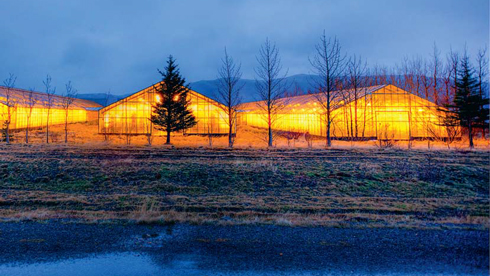
The greenhouses in which fruits and vegetables grow, Iceland to minimize its dependence on foreign products is a dream that the government would like to realize almost all countries of the world, regardless of ideology and continent. It is not obvious only how to fulfill this dream. Only a few countries were able to achieve success in this area without serious state intervention - Australia, Argentina, Thailand, New Zealand. In the rest, the state intervened and intervenes in the development of the agrarian sector more actively nowhere, but the results are very different - from amazing successes, which, it seems, refute the laws of not only the economy, but also physics, to collapse, ruin and mass hunger.
The well -fed island of Iceland is an amazing example of the successful replacement of agrarian imports in the history of mankind. You will think about her the latter that the exemplary history of success in such an industry can be a cold rocky island on the polar circle, where it is dark for six months, and the average daily temperature even in July in the southern regions does not rise above +15 degrees Celsius. What can there be agriculture in general, especially import -substituting?
Nevertheless, it is there and flourishes there. About two -thirds of the cost of the products consumed by the Icelanders - domestic production. This is a good indicator for a large European country, and for a small northern island - just outstanding.
The Icelanders began to seriously think about replacing foreign products in the 80s in the 80s, when they found that the level of the welfare of the nation grew strongly, and no one wants to live on the same lamb, potatoes and herring, as before. But I also did not want to give a significant part of GDP abroad, paying for grocery imports. Therefore, the Icelandic government decided to squeeze everything that is possible from the agriculture of the island.
State support for the agricultural sector in Iceland is following a common scheme. Basically, these are direct supplements to farmers from the budget-the state pays them simply for the fact that they are farmers and produce some food. Plus state consididia to pay for electricity and the introduction of new varieties and breeds, marketing and production of priority types of products. All this is supplemented by the minimum, by the state, guaranteed by the state by purchasing prices and high duties on the import of those goods that have domestic analogues.
Thanks to the active use of all these measures over the past 20 years, Iceland has become a major manufacturer of various types of agricultural goods, which had not happened there before. For example, the annual crop of grain in 1992-2012 grew 40 times, from 400 tons to 16 thousand tons. Production of tomatoes - almost from zero to 1.5 thousand tons (three quarters from national consumption), production of cucumbers - from zero to 1.8 thousand tons (90 % of national consumption).
Compared to the beginning of the 90s, the production of poultry meat has grown 6 times, pork three times, twice-beef. In geothermal greenhouses, Iceland began to grow bell pepper, strawberries and even its own bananas. Although the latter later crossed out of the priorities-due to the polar night, it takes one and a half to two years to ripen, and even the Icelandic budget is unable to pull such expenses.
It is clear that bananas are an extreme case, but in general the Icelandic policy of agrarian import substitution is a very expensive pleasure. For example, at the peak, in 2005, the state -owned expenses of the agricultural policy amounted to $ 255 million, despite the fact that at that time 10,600 people were employed in the country's agriculture. That is, it comes out of $ 2000 support per person per month. And if we take into account that the entire population of Iceland is about 320 thousand, it turns out that each resident, in addition to all other social benefits, could be given almost a thousand dollars for food per year.
In the European Union, which is famous for its generous agrarian subsidies, on average, the share of state support in the final cost of products is 23 %. This is a lot, but in Iceland it is twice as high - 47 %. And here the question inevitably arises, how justified such wastefulness is? The main trading partners of Iceland are the European Union, Norway, Canada, the USA. All these countries are stable and predictable, and the Icelanders have excellent relations with them. It would be no reasonable to purchase the same cheaply abroad, and spend the rest on something more useful than greenhouses with strawberries behind the polar circle?
Naturally, there can be no unequivocal answer here, but the Icelanders themselves believe that not, not more reasonable, and not from a stubborn pattern of irotism. Agrarian import substitution has already proved in practice usefulness for Iceland. When the country's financial system collapsed in 2008, the Icelandic crown followed the bottom with it. For a few months, her exchange rate fell to the dollar from 60 to 140 kroons, and remains at 120–130 still. About the same thing happened with the euro course. And after exchange rates, the prices of imported goods should have also taken off, especially for food.
If the most powerful part of food in Iceland were imported, then to problems with the foreign exchange mortgage, the collapse in the real estate market and the bankruptcy of all three Icelandic banks would also have a two -fold drop in the purchasing power of salaries. But this did not happen. Of course, in 2008-2009, inflation in Iceland accelerated greatly. But strongly - this is by Icelandic standards, up to 12 % per year. And then she began to fall quickly and now is only 3 %. To achieve such a result, the Icelanders had to give a significant part of their taxes to support farmers for many years, but it turned out that at least part of these investments later returned back, and at the most suitable moment.
The hungry island Successful experience of Iceland can create the illusion that state intervention in agriculture is an extremely useful thing. I took a standard set of measures to support farmers, charged budget money in them, and please - you can “import” at least bananas behind the polar circle. It will turn out not cheap, but in difficult times it will definitely pay off.
In reality, history knows much more cases of how the state, clumsily trying to establish something in agriculture, made a catastrophic situation even in the most favorable natural conditions.
Like many other countries of Asia, in the middle of the twentieth century, Sri Lanka survived a demographic explosion and, by the 70s, realized that he was not able to feed her population even at the very basic level. And this despite the humid equatorial climate, dug at the beginning of our era, a complex system of irrigation and three crops a year. It seems that the population of Sri Lanka was then only 12 million, and the territory was about the same as that of the Czech Republic or Austria, but even according to a record, it was possible to cover internal needs by only 75 %.
To avoid mass hunger, the state then had to spend about 10 % of GDP on subsidizing food. Moreover, a significant part of these subsidies went to foreign manufacturers, because their own agriculture could not cope, and the food had to be actively imported.
In paradoxically, agricultural products then dominated not only imports, but also in Sri Lanka export. They simply imported mainly rice, which was not enough, but taken out - tea, a drink of colonialists that you are not ate. This discrepancy prompted the Lankan government, it seems to be a logical solution to the agrarian problem.
The program for import substitution suggested itself: since there are so many tea in the country that there is enough for half a world, and rice is an eternal shortage, you just need to slightly correct the proportion between these crops. Pass part of the fertile lands from tea under fig.
In 1972, the Sri Lanka government announced the conduct of land reform. For all the owners who owned on the island more than 50 acres on the island, everything that exceeds this threshold was withdrawn, then to transfer the seized peasants taken away by the low -earth. The formulations in the law were common and without discrimination, but it was clear to everyone that British companies engaged in the production of tea would lose from this reform, and the Lankan peasants would be acquired, who would grow scarce rice. A great solution that cannot but work.
Indeed, the production of tea after land reform has decreased greatly. Schri Lanka’s export income decreased with him, because in the early 70s, almost half of the country's exports were for tea. The fall was such that by 1975 the Lankan export was only 40 % of the early 60s (comparison was carried out taking into account inflation).
But rice production also fell. Because small peasant farms with their archaic technologies were not able to make a serious contribution to production, and large farms were destroyed by land reform. In addition, for the better controllability of the agrarian sector, the Sri Lanka authorities introduced the state monopoly for the purchase of rice from the peasants, but the prices set by officials did not keep up with the market ones, which made rice production unprofitable. As a result, instead of increasing, the annual rice crop in the country in 1970-1975 fell by almost 30 %. From the Humanitarian catastrophe, Sri Lanka was saved by the fact that in 1977 an opposition came to power in the next election, which canceled the state monopoly for the purchase of rice and began the reverse privatization of tea plantations.
Sri Lanka’s leadership acted rude, but similar to Iceland. The Lankan authorities also protected domestic rice producers using import restrictions, subsidized them, if not money, then the provision of new lands, and entered guaranteed state purchase prices. But the results were exactly opposite.
The point is not in the methods of supporting domestic agriculture, which are not so many, and all of them have long been known, but in who uses these methods. The point as a bureaucracy that is going to organize this agrarian import substitution. If the quality is at the level of Iceland, then you can engage in the production of strawberries in the Far North.
Photo: Blog.lenstraveler18.com