
Translated material
The gates of the Adova
85 years ago, in 1930, the Gulag was created - the Office of the Camp of the OGPU of the USSR. Over the years of the Soviet concentration camp system, more than 15 million people passed through it
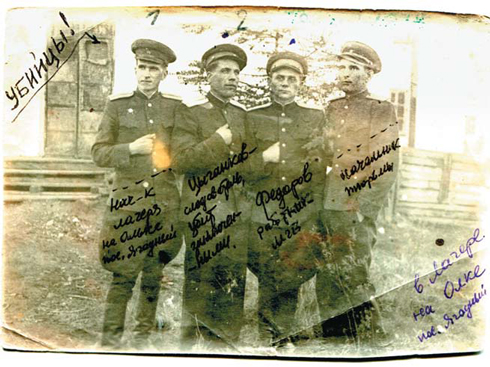
The daughter of a prisoner who died on Kolyma wrote "Killers!" In the photograph, captured by the head of the camp security, Magadan region, 1950
On September 6, 1932, the young platoon commander of the 81st Infantry Division Pavel Ionov, shocked by the abyss that opened to him between the romantic revolutionary performances and the reality of the Stalinist five years, wrote an open letter to the party cell, in which he said: “The whistling growling sirens, the heavy sighs of the plants and the deadly splash of water huge ones at the Plotin Dnieper and the Dnieper-Brief Volkhovstroy is a moan of tens of thousands of proletarians and peasants exhausting from hard work and hungry stomach. This blood of millions of workers was mixed with the cold later and now heavy millstones and powerful turbines are spinning. ” On September 28, specialists arrested a twenty -two -year -old Kraskom, charging anti -Soviet agitation. Ionov was lucky - he served only a month, and after 50 years he was rehabilitated. Millions of others had a cruel fate to become “camp dust” and, at best, be justified after death.
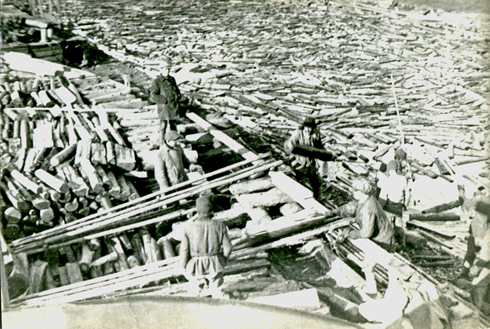
Camp, construction of the Lower Svirskaya hydroelectric power station. The alloy of logs. *Leningrad Region, 1931 *A million enemies in 1923 Felix Dzerzhinsky claimed: OGPU - a united state political administration, an armed detachment of the Bolshevik party - inside the country "has a million enemies" who "live and nourish the hopes for intervention and explosion from the inside." However, according to the statement of the head of the secret department of the OGPU Terenty Deribas, in 1924, under constant supervision, it was necessary to keep even a million enemies, but more than two million Soviet citizens in order to stop possible uprisings and other protest actions. In 1921-1929, the bodies of the Cheka -OGPU arrested 1,004,956 people (including “counter -revolutionary crimes” - 590 146), of which 208 863 were convicted (sentenced to execution - 23,391). In 1930, when continuous collectivization began, that is, in fact, the party’s war against the village, the OGPU bodies were arrested by 331,544 people (including 266,679 - 208,069 (20 201 were shot).
The backstory of the Gulag Bolsheviks began a giant experiment, the purpose of which was in social engineering - the creation of a new person who is deprived of the prejudices of the archaic bourgeois society. Therefore, the activities of traditional state institutions were filled with a new revolutionary meaning. In July 1918, the central punitive department of the People's Commissariat of Justice, who was in charge of the places of imprisonment in the RSFSR, released special instructions and formulated two innovative principles of the Bolshevik penitentiary system: self -sort of self -esteem and complete re -education of prisoners. Since the fall of 1922, the functioning of the isolation and correction institutions mainly ensured the Main Directorate of the Places of Conclusion (GUMZ) of the NKVD of the RSFSR. At the same time, the Chekists retained their separate prisons and camps, first of all, the control of the Solovetsky special purpose camp (Uslon), due to which the All -Union concentration camp system later arose.
Contrary to the predictions of party theorists, the number of prisoners in the USSR for some reason did not decline as socialist construction, but grew: from 80 thousand for 1923 to 200 thousand for 1927. Continuously arose problems with their content. In December 1926, the resolution of the Supreme Council of the National Economy (Supreme Economic Council) “On the use of prisoners” on the logging of the prisoners, but the self -sufficiency of the GUMZ institutions still could not achieve, was still possible.
However, by 1929 the bodies of the OGPU had accumulated useful experience in operating “counter -revolutionaries” (“kaer”) in the Uslon, first of all, in Lesopoval. On July 11, 1929, the Council of People's Commissars adopted a resolution on the creation of correctional labor camps (ITL), called in the intra-decoration of the concentration camps, for the development of natural resources of remote areas. Convicts were now sent to local correctional institutions of the NKVD for a period of only three years. Receiving from three years and above were transferred to the CHPU camps. The network of Chekist camps grew rapidly - the Office of the Northern Special Purpose Camps, the Far Eastern ITL, the Siberian ITL ... In 1930, Kazakhstan and Central Asian ITL arose. As of July 1, 1929, the number of prisoners in the camps of the OGPU was 22,848 people, by January 1, 1930-already 95,064, and by June 1, 1930 exceeded 155 thousand people. Mass dispossession and collectivization increased the flow of "Bolshogger". The use of cheap slave force required a centralized organization.
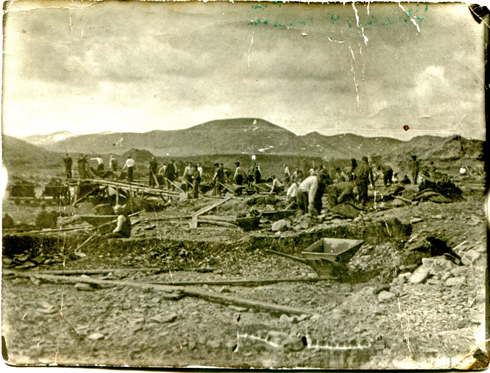
Hall Partisan (gold mining). The Red Call brigade works, the team leader Semyon Angels (a picture from the camp wall newspaper). *Magadan region, pos. Berry, 1939 *Gulag in numbers on April 25, 1930, on the basis of the resolution of the Council of People's Commissars adopted on April 7, was the light of order No. 130/63 signed by the Deputy Chairman of the OGPU Stanislav Messing “On the organization of the OGPU camp management”. Less than a year later, a new structure in the central apparatus of state security agencies received the status of the main management (Gulag OGPU). By April 1931, the number of prisoners in the concentration camps of the OGPU reached 234,600 people, the annual mortality was approximately 3 %. Next year, mortality increased to almost 5 %, and in the catastrophic 1933, it exceeded 15 %. In 1933, every sixth prisoner died in the USSR - more than 70 thousand people.
In 1931-1934, all places of imprisonment were united, including special settlements for dispossessed, and in 1935 the NKVD gulag turned into a monster who disposed of slave labor of prisoners at countless socialist construction projects. Special settlements, according to some evidence, turned out to be even worse than the camp. Here is one of the stories recorded in the post-war emigration, Major General Sysoa Borodin-his interlocutor in the 1930s worked at logging in the places of special settlements: “You will dump the tree, start to press it to the ground and see in the snow that begins to thaw a pile. And when you consider - the corpses of the father, mother and small children, in a grief form. This is from the administrative-extended. They left and died in the forest. Often such "heaps" came across. We took them and dumped them into marshy swamps. "Clup!" “Both the corpses were hidden, and from birds and from animals ... True-the most terrible, most miserable places were the camps of administrative-ejected.” By January 1, 1935, the number of prisoners in the Soviet Union, according to official figures, exceeded 1 million people. During the "Ezhovschina" (1937–1938), a stream of new prisoners poured into prisons and camps. Despite the high mortality and mass executions during the “large terror”, their number did not decrease, but increased. As of January 1, 1939, almost two million people were contained in the camps, prisons and colonies of the NKVD. Of these - approximately 650-700 thousand “kaer”.
We add the so -called labor settlers in special settlers for dispossessed ones, and it turns out that on the eve of World War II, the country of Soviets kept 3.1 million people in places of imprisonment (1.6 % of the population). About 55 % were victims of direct political repression.
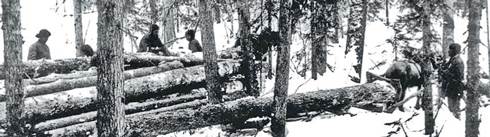
Prisoners on forestry in Karelia, the surroundings of Medvezhyegorsk, 1932-1933
“Frenkel’s method” created 85 years ago the special structure of the OGPU camps coincided with the introduction of the Frenkel method in the camp practice, which was named after the head of the production department of the Gulag Naftalia Frenkel (1883–1960). The former prisoner made an enviable career in the Gulag. In 1934-1938, he headed Bamlag, in 1941–1947-the Main Directorate of the Railway Construction Camps and safely retired with the rank of Lieutenant General of the Engineering and Technical Service. Frenkel prudently proposed to normalize the nutrition of the prisoner depending on the development. For prisoners, an ephemeral stimulus was created, as if allowing shock work to achieve early liberation. In practice, the “shock work” in inhuman conditions quickly turned the prisoner into a “goner” and guaranteed an ambulance - if not in the camp, then after liberation. This was reported in post -war emigration by the former guard Major of the Red Army Vyacheslav Artemyev, who served in 1938-1939 the chief of staff of the Militarized Guard of the Karllag NKVD.
According to Artemyev, in 1939 in Karlag the daily diets of prisoners in “common works” ranged from 400 g of bread and a two -time portion of liquid soup (“lowered”) to 800 g of bread and two -time hot diet from two dishes (“shock”). The average duration of the working day reached 12-14 hours, and the promoter was at a distance of 8-10 km from the camp. “When, as a result of exhaustion and disability, prisoners cease to be working,” wrote Artemyev, “they are dumped from accounts, and only that they are not physically destroyed, creates the difference between them and working cattle, but they are also doomed to the majority of slow dying in the invalid and sanitary camp points, which, in essence, is almost equivalent destruction. " In the camps, there was a “mass exhaust of people from overwhelming labor and hunger”, which led “to the complete loss of working capacity, disability and death”, no one was responsible for the death of people “from exhaustion, accidents and disasters”, “mass repressions aimed at the physical destruction of innocent people” were used. ” These, according to Artemyev, were the vast majority: the prisoners contained in the camps were 90 % not “real criminals”. Artemyev considered the Politburo, headed by Stalin, guilty and responsible for the death of prisoners.
The war with the people of the Gulag became the gates of hell for millions of people. It is one thing that the prisoners lost their rights like a human life - it was not enough in the wild, where the Stalinist collective farm with “sticks” in the table was the same symbol of hopelessness as the camp. But in the camp the prisoner could not count on human death. The hero of the Great War, the St. George Cavalier and a participant in the White Movement, the military foreman Alexander Tislenkov, who fell into the Gulag from emigration after the war, for many years, Martirologist led and recorded the reasons for the death of his colaigers-other Cossack white immigrant officers issued in Austria in May 1945 to the British command in the Soviet occupation zone. All of them sat in the Kemerovo region, turned into one large camp. Opposite two surnames: artillery colonel Evgeny Mikhailov, Podesaul Ivan Gubin-the same short and terrible death record: “Enraged by lice”.
In the 1930-1940s in camps, prisons, colonies and at stages only from exhaustion, overwhelming labor and diseases, at least 500 thousand prisoners died, and in total in 1930-1953 at least 1.7 million people. According to modern experts, this number does not include hundreds of thousands of so -called acted prisoners - executed by the administration under acts of barely living “goners”, who died at large, behind the gates of camps, whose mortality was not taken into account in the Gulag statistics. In tsarist Russia, for thirty years, in 1885-1915, 126 thousand people died in the prison system of the civilian department. In the USSR, so many prisoners died in only one 1938.
The system, which properly acted the whole war and with renewed vigor pounced on fellow citizens in the post -war years, when the criminal legislation was unprecedentedly tightened until 1956. From the 1920s to the mid-1950s, 15 to 18 million people passed through the Gulag. This figure is comparable to the losses of the country during the Second World War.
Photo: International Society "Memorial"