
Translated material
USA-Cuba: no one is to blame
On the fields of the “Summit of America” in Panama, the first meeting of the leaders of the United States and Cuba for almost six decades of frankly hostile relations was held, miraculously not overgrown with open military intervention of the United States.
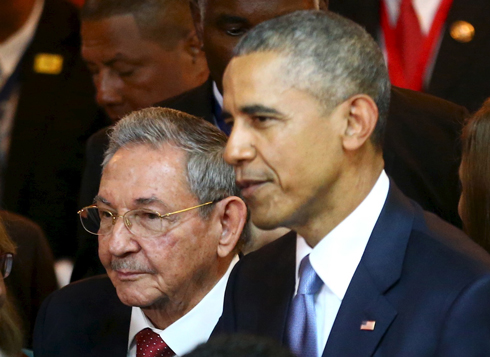
Cuban President Raul Castro and US President Barack Obama after the opening ceremony of the VII Summit of America. Panama City, April 10, 2015
The journalists who were present at the summit wondered whether two presidents would limit themselves with a handshake and exchange of a couple of protocol phrases, as it was already in 2013 at the funeral of the legendary fighter with the Nelson Mandela apartheid, or they will hold a full -fledged meeting on the eye. After it was reported that three days before the Obama and Castro Summit and Castro had been talking on the phone, and between the chapters of two heads of foreign policy departments John Kerry and Bruno Rodriguez, a long conversation took place, it became clear: the second format would be elected.
Obama and Castro were talked for a whole hour, and as then each of them declared the press, there was no “tension” between them. I attracted attention and tone of Raul Castro's performance at the opening of the summit. In his long speech, he listed the numerous facts of the hostility of the United States in relation to Cuba, but at the same time stated that Obama "was not guilt for the actions of his 10 predecessors." Prior to this, the Cuban authorities, as soon as the American presidents were not portrayed. The surname Nixon in Cuban newspapers was written through the swastika instead of the letter "X". The exception was made only for Jimmy Carter, in which there was some weakening of hostility between Havana and Washington, and the two countries even exchanged the so -called departments of interests that performed mainly consular functions.
What is a long and difficult path now? Obviously, the path of further normalization of relations will be long, in potholes and bumps. Obama can restore diplomatic relations with Cuba with his power, which involves, first of all, the exchange of embassies. However, it is not able to completely remove the half -century economic embargo against Cuba without the consent of the congress. And there the main violin is played by opponents of normalizing relations, including politicians, who, apparently, will participate in the presidential election.
Former Governor of Florida Jeb Bush and the current senator from the same state, Marco Rubio, had already harshly criticized Obama for his meeting with Raul Castro, calling her "an attempt to peaceful the bloody dictatorship." Apparently, relations with Gavana will become an important topic of polemic between democrats and the Republicans during the election campaign. Both Rubio and another senator - Ted Cruz from Texas, who has already declared his participation in the race - have Cuban roots, and they do not without reason that they know the situation on the island better than the current Washington administration. Hillary Clinton, who had just announced his participation in the elections, is already involved in this polemic. With some desire to distance herself from Obama, she will be forced to take responsibility for relations with Cuba and Iran to one degree or another - two countries, an improvement in relations with which should enter the presidential heritage of the current owner of the White House.
Realizing the certain vulnerability of his new Cuban policy, Barack Obama himself also did not seek to arrange in Panama something like a solemn banquet with Raul Castro. Since December last year, when after two years of secret negotiations it was announced to the beginning of the normalization of relations between the United States and Cuba, the Cuban authorities and a finger on the finger did not hit to weaken their pressure on the dissenters. Mass arrests and persecution of dissidents continue on the island. The government also makes it clear that it does not intend to share political power with anyone and will not allow the activities of opposition parties and associations in the country.
An indicator of the preserved fundamental disagreements between Cuba and the United States was the fact that the flags of the two countries were not posted in the hall where the Obama and Castro meeting was held. True, in Panama, Raul Castro moved away from his traditional rhetoric, intended for domestic consumption, and did not say a word about the need to protect the “revolutionary principles”. Instead, he stated that he was ready to discuss “any questions” with the American leader, although it is “necessary to normalize the relationship“ very gradually and smoothly ”.
The Castrovskaya revolution, meanwhile, continues to rage in the heads of the Latin American left. Groups of supporters of the Castro brothers arranged powerful protests against the presence of Cuban dissidents at the forum. As evidenced by the Spanish -language newspaper of the United States El Nuevo Herald among those who directed the crowd against opponents of the Cuban regime, the heads of the country's special services and the protection of the head of state, Raul Castro, were seen.
Photo: Reuters/Peru Presidency/Handout Via Reuters