
Translated material
Svivot-navigation | Colta.ru
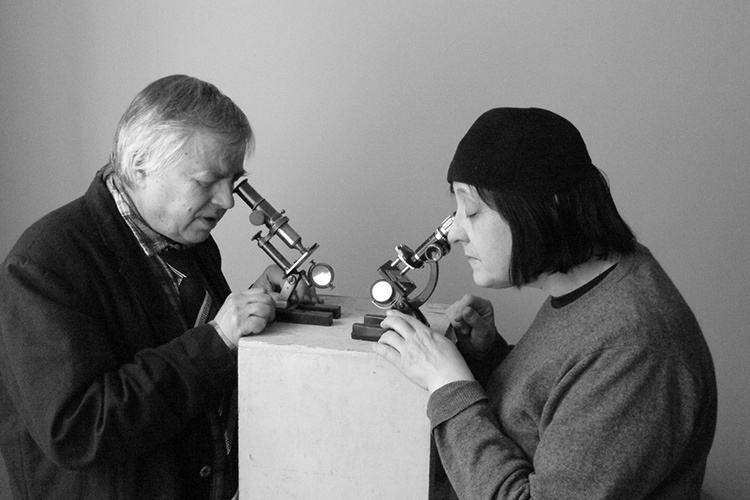
In the Tretyakov Gallery, an exhibition of Elena Elagin and Igor Makarevich opens. Within the framework of the museum special project “Makarevich -Elgina: and the mash of art” of the work of these two Russian conceptualists, active members of the “Collective Actions” group, will be placed inside the constant exposition of the GTG - among the painting of the mid -twentieth century.
Moscow conceptualism initially constructed its autonomous territory, contrasting it with the surrounding Soviet reality, which he either subjected to critical removal (such as Ilya Kabakov), or sought to slip away from it (as, for example, Andrei Monastic and “collective actions”). However, the question of the generation of conceptualism itself from the inside of this reality was articulated, but from the standpoint implying the complete consciousness of conceptualism (and social art)-as opposed to only partial consciousness and vast unconsciousness of the Soviet. The authors and critics of contemporary art have learned to see and read “Soviet” through Moscow conceptualism and perceive Moscow conceptualism as an intellectual commentary on the “Soviet”. But the ability to read Moscow conceptualism through the “Soviet” and see in the “Soviet” something that can make a semantic increase in conceptualism is much less developed.
The most striking example of this is “ Gesam T Kunstwerk Stalin” , the essay as influential as anti -historical, in which Boris Groys contrasted the Moscow conceptualism to a certain initial Soviet project, which includes both the avant -garde and the Stalinist culture, supposedly more successfully than the avant -garde itself, which realized the avant -garde intentions. Groys, constructing the “Soviet” monolith, thus legitimized the Moscow conceptualism as an alternative reflexive project to it, as if critical to any (including his own) authoritarian ambitions.
Attempts to identify the Soviet unconscious of Moscow conceptualism (and not to detect the unconscious of the Soviet in conceptualism) is much more small. One of them was undertaken by Anatoly Osmolovsky in his article “Political Positions of Andrei Monastyrsky” , published in the “Art Journal” . In this article, Osmolovsky proposed to see in the social structure of “collective actions” (“KD”) a semblance of the Soviet nomenclature with its isolation, hierarchy, dedication systems - which caused the indignation of the monastery. Osmolovsky’s course can be called a displacement from the spaceship of the content of statements (for example, the statements of the authors of the “cd”) to question about the structure that makes this statement possible, about the place from which it is made. Something similar was proposed by Ekaterina Grandvity, focusing on Soviet educational institutions in the field of art, from which conceptualists and social artists came out: Stroganovka, Surikovka, Polygraph, Art schools, including the famous Moscow Secondary School (MSCHS) ...
 © provided by the authors of the installation sketch Elena Elagin and Igor Makarevich
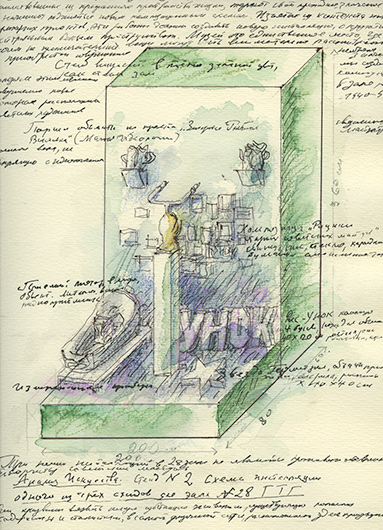
The exhibition of Elena Elagin and Igor Makarevich “Analysis of art”, which opens in the Tretyakov Gallery on the Crimean Val inside the constant exposition of Soviet art, promises to become material for reflection on the mutual interpretative potential of Soviet culture and Moscow conceptualism. The idea of the authors themselves is more likely unilateral (they comment on the exposed painting with their objects) and is even spatially designed to move in one specific direction. In the chronological movement along the constant exposure of the gallery, the audience, having passed the hall with colossal Stalinist canvases, first fall into the hall completely given to Elagin and Makarevich, filled with quotes from their past works (personal Gesam T Kunstwerk like the “monument of the disappeared civilization” of the Kabakovs or Tomes of “trips for the city” “KD”, which every Moscow conceptualist dreams of). And the direct dialogue with the exposition of Soviet art begins in the next hall, but at the entrance to it, the audience first see only the usual exposure of the painting of the 1940-1950s: Sergey Gerasimov, Arkady Plastov, Vladimir Stozharov, Helius Korzhev, the Tkachev brothers-and only passing into the depths of three pylons with paintings. Thus, Elagina and Makarevich build relationships with a constant exposition using a metaphor of the inside: their work serves as a flip side of the post -war socialist realism. This metaphor bothers to turn it over: if you go along the Tretyakov Gallery from modernity to the depths of history, then it is the Soviet canvases that will turn out to be the wrong way of conceptualist installations. Such an inversion of the inside and front side can be carried out and not so playful, but at a more serious semantic level.
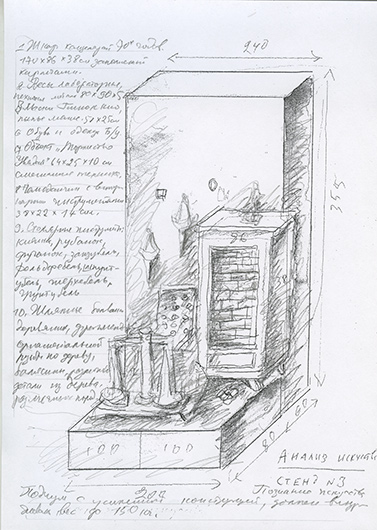
Makarevich and Elagina analyze Soviet painting, representing it as the sum of material elements: dyes, tools, hypostasized ideas - in which linguistic abstractions are as heavy as material objects. This understanding was declared by artists already in the 1990 closed fish exhibition, quotes from which were used in the current “Analysis of Art” or in the solo exhibition of Makarevich “Drawings of the Old Soviet Masters”, from where the letters “UNK” filled with rice were migrated to the Tretyakov Gallery. This elementary rebus decomposes the word “drawing”, denoting the basis of easel skill, on “rice” and a certain vague avant-garde “uck”, reminiscent of the Union of Malevich. For Makarevich and Elagina, the path of Soviet art under Stalin is determined by the suppression of two avant -garde methods of overcoming machine tools: on the one hand, turning art into an object, into a utilitarian thing like the tatlin tower, on the other - anti -utilitarian metaphysical aspirations in the spirit of Malevich. However, according to Elagin and Makarevich, both of these supplanted avant -garde methods can be found on the wrong side, in an unconscious of Stalinist culture, for example, Stalin's painting: the pragmatist of the utilitarian object became the pragmatics of ideology and its ossified language, metaphysicality turned into a new logic of machinekinism as the production of almost sacred universal images. And implicitly utilitarian objectivity and claims to the transformation of the world overcoming the laws of physics were able to generate strange Stalinist hybrids of scientific and magical. An example of this is the pseudoscientific theory of biologist Olga Lepeshinskaya, who suggested that inanimate can turn into living things. In 1996, Elagina devoted the “Laboratory of Great Work” to the Lepeshinskaya installation - and a quote from the “Laboratory” at the current exhibition is a paper cube with alchemical drawings.
 © provided by the authors of the installation sketch Elena Elagin and Igor Makarevich
Such a criticism (and a kind of chanting) of the Stalinist culture as a pseudo -canal practice, in which the language has gained almost material status, is quite popular - it was engaged in the same Grois. You can praise the productivity of such criticism, including artistic ones, you can condemn its inherent postmodern absolutization of the language. But another thing is important here: those methods that Makarevich and Elagin criticize Soviet culture or easel painting set their own logic of their work, and these methods themselves are generated by the Soviet cultural situation.
Both Makarevich and Elagina were engaged in monumental art in Soviet times - they decorated and painted interiors, for example, Brezhnev’s office in the Kremlin. Elagina owns a number of tombstones of cultural figures, including Vasily Shukshin. Talking to me about education at the MSHSh and at an art university , Makarevich recalled the instructions of teachers regarding the special structure of artistic space, ascending, for example, to the theories of Vladimir Favorsky. In the same conversation, Makarevich emphasized that it was very important for him to gradually develop his own understanding and a sense of the space of art - which is largely owed to teachers, as well as a regular visit to the Tretyakov Gallery in Lavrushinsky Lane, on the contrary, which was located. And, continuing the thought, Makarevich suggested that, it seems, this concern of a special, acquired by a long experience in developing the space of art distinguishes them with Elagin from the new generation of artists - and from many Western authors.
In their works, performed on the territory of modern (not official Soviet) art, Makarevich and Elagins reflect the autonomy of the work. Such reflection, in fact, distinguishes, starting from modernism, the notorious contemporary art. But Makarevich and Elagina carry out this reflection not through an attempt to overcome autonomy, like the Soviet avant -garde, and not through the articulation of its borders and laws, such as Western conceptualism, but through weighting, deepening, condemning and darkening meanings and matter within this autonomy. An alchemical cube, a cabinet stuffed with bricks, a huge wooden ball - all these elements of “analysis of art” denote a certain limit of art, but the limit is rather internal - a dark core of art as things, as cloudy in reality, as a secluded and terrible shelter. The sacredness that arises from here, albeit ironic, is a consequence of attachment to the development of art problems as a special spatial practice - a practice outlined by a certain frame that separates it from the surrounding reality and not questioned. This approach to art is rooted in the easel Soviet tradition of art education and thinking, within which Elagin and Makarevich were formed. And we can dare to assume that an unconscious desire read in the installations of the “analysis of art” located on the back of the pylons with paintings is a desire to create an super -knowing machine work in a situation of devaluation and the collapse of such a work generated by the destruction of the Soviet system.
The author thanks Elena Elagin and Igor Makarevich for the conversation and the opportunity to get acquainted with the materials for the exhibition "Analysis of art" before its opening