
Translated material
Driven Olympic
The exhibition for the 80th anniversary of Alfred Schnitsky in the Museum of Sergei Prokofiev reminded of the persecution that the composer was subjected to in Soviet times
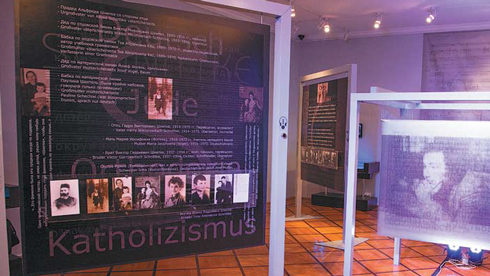
More than 200 exhibits from state and private collections have been at the Shnitka exhibition at the Schnita exhibition
The four exposition halls, scanned by infernal lilac light, were resolved as a series of biographical installations that demonstrate maximum spiritual and intellectual stress, in which Schnitka was his whole life. He was far from the everyday life and realities of his era, and the curator managed to create a special, insistent space in the very center of Moscow. The exhibition "Schnita/Schnittke" was placed on the third and fourth floors, where a solemn staircase, decorated with huge letters that make up the surname of the anniversary. Thus, you seem to ascend to a pure, unknown art - either into an ivory tower, or on Olympus. Meanwhile, the shnita himself during his lifetime was little like the Olympic.
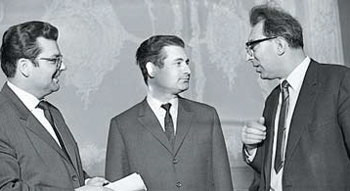
Alfred Schnita (in the center) with colleagues from the GDR Horst Domogalla and Wolfgang Lesser at the All -Union Congress of Composers, Moscow, 1968
The unsuccessful composer Schnitka recalled how once, deprived of any earnings (“We lived hard. I didn’t take me to work, no orders, no hopes ...”), he apologized to his mother -in -law because he could not properly provide his wife: “I should not marry your daughter! ..”
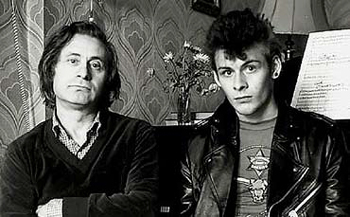
Alfred Shnitka with son Andrei, mid-70s
The life of a composer, who today became a universally recognized classic, was monstrously difficult. They crushed, persecuted, forbidden the music. They limited the scatter, for years forcing for the composition of applied plays - well, for example, for Soviet cinema. Of course, the directors of that time were lucky that a genius participated in the creation of their films, but if it were not for vile socio-political circumstances, he would have managed to do more. Much more.
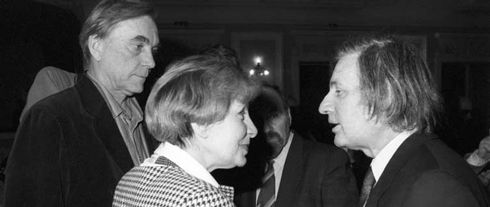
Director Ele Klimov (left), writer Zoya Boguslavskaya and Alfred Shnitka, 1992
In the book of Alexander Ivashkin “Conversations with Alfred Schnita”, a lot of evidence was collected with which the work of the composer's works made through the thickness of ideological prohibitions. The famous violinist Mark Lubotsky recalls how the first symphony was banned for execution in Moscow - it was necessary to prepare the premiere in the Soviet era closed in Soviet times for foreigners Gorky (now Nizhny Novgorod). Or as they forbidden to play the second violin concert in Voronezh: the musicians came to the performance and saw an announcement over the Philharmonic’s cash register that the concert was canceled. The day before, having learned from the conductor that the composition of the shnita was asked to replace the opus of any other composer, Lubotsky phoned the secretary of the Voronezh regional committee of the CPSU. “He carefully listened to my information that we were playing the composition of the Soviet composer Shnitka, that we have permission from Moscow ... He answered a single -word:“ You are mistaken: the regional committee and in general the CPSU do not prohibit anything. They simply do not consider it necessary to recommend. ”
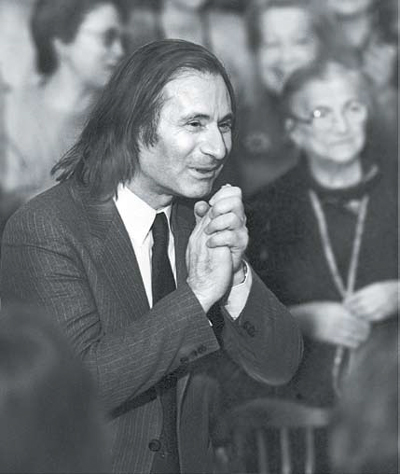
The festival dedicated to the work of the composer was first managed only during the years of perestroika, Moscow, 1989
The Voronezh Communist almost did not joke: the authorities really allowed to fulfill the works of Schnittke, but only on Western tour and only elected performers (for example, a quartet named after Borodin). Well, or in cases where it was necessary to impress the visiting celebrity. Irina Schnita, the widow of the composer, recalls this strange logic of the Soviet nomenclature: “For example, some Western composer came, and we had to show that we were not sewn. Then Edison Denisov, Alfred Schnita were invited. We also have! And, nevertheless, every time it was necessary to achieve permission to execute, there were obstacles ... "
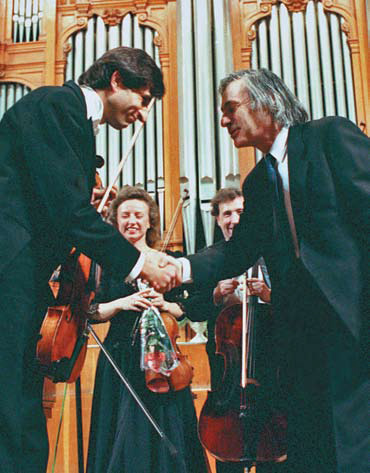
Alfred Shnitka (right) and altist Yuri Tkanov after a concert in the Great Hall of the Conservatory, Moscow, 1992
There were a lot of such stories not only in the life of Schnitsky: his colleagues in the workshop and creators from other cultural spheres were persecuted. All this did not pass in vain - the soul wounded, my health undermined, and creative abilities thinned out. Schnittke, unlike many, worked until his very last day, but his strokes, perhaps, were provoked by decades of persecution, the inability to work in full growth, and the need to adapt.
Gnobili is recognized and canonized earlier, now they praise and use. Alfred Schnita was erected to the official cultural canon. During the grand opening of the Sochi Olympiad in February 2014, his music accompanied one of the most powerful parts of the ceremony. At this ceremony, Schnita was put on a par with futurists and constructivists, dissidents and non-conformists-all those who were in the Soviet Union of Herring. Now, decades later, their work is demonstrated to the world as the most important achievements of Russian culture of the twentieth century. But the empty and ideologically verified sulfur, which was then set as an example, is safely forgotten. Resolved art is not able to compete with “stolen air”, it is quickly forgotten, it is obsolete even before its publication, since the “party attitudes” are constantly changing.
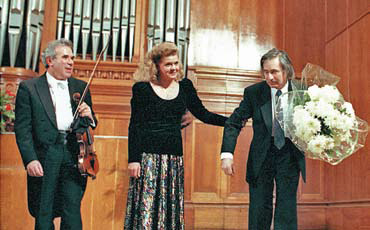
Violinist Mark Lubotsky (left), pianist Irina Shnitka and composer Alfred Schnitka after a concert in BZK, Moscow, 1992
Sooner or later, the moment comes when the state has to recognize avant -garde, whose fate was broken by the same state. Sadly, the theme of “artist and power” is still the most burning reality of today. But emblematic works, generalizing Russian life at the beginning of the 21st century, will quite possibly be the creations of artists and composers who are overstanded today.
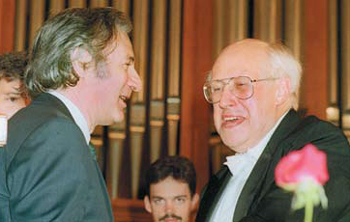
Alfred Shnitka and Mstislav Rostropovich, Moscow, 1993
Wandering at the exhibition of Alfred Schnita and considering unique archival documents, you understand that despite the change of regimes and socio-political formations, human nature remains unchanged. Many have the same fear of incomprehensible art, all the same desire to judge everything from the bump of their own low education. However, what is there to be surprised if, more recently, the great music of the shnita seemed to be a complex pile of dissonance sounds.
Photo: Glinka.museum, Alexander Konkov/Vladimir Savostyanov/TASS, Nikole Moshkov/Photochronika TASS, MF/FMS, Alexey Babushkin/ITAR-TASS, Dossier Photo-ITAR-TASS, Andrey Babushkin/ITAR-TASS