
Translated material
Putin and the people. The shortest version
"Direct Line" with the president: the main questions and answers
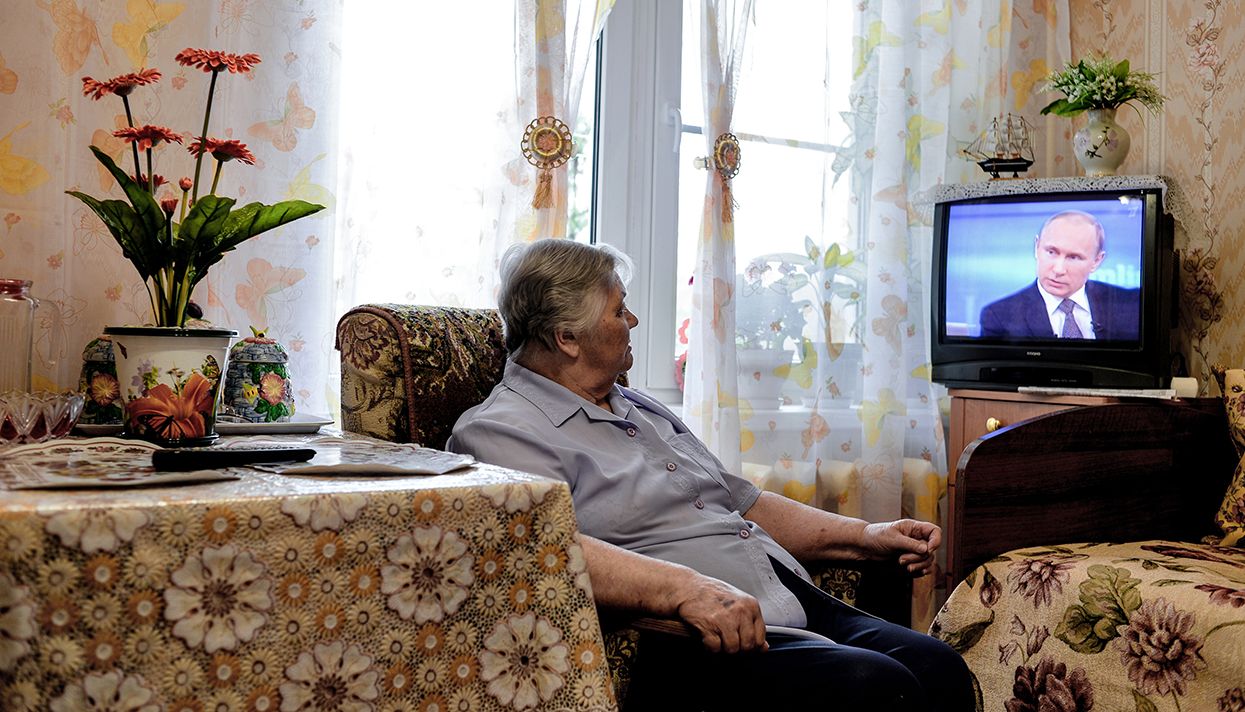
President Vladimir Putin held another “direct line” - a many -hour conversation with the people. Among dozens of issues repeating from year to year, the same requests for help from different regions of the country and the president’s ritual reports on the situation with milkings and GDP in general, there were several episodes that deserve attention. We talk about them.
A dispute with Kudrin. Leaders in the studio not only gave the former Minister of Finance Alexei Kudrin to ask a question, but also to enter into a discussion with the president. At the beginning of the Direct Line, Vladimir Putin said that the economy is not in such a poor condition as it is customary to think now: the ruble began to recover, inflation is stabilized, GDP and industrial production in 2014, at least a little, but Russia generally updated the record. Kudrin chose to talk about other figures-about the country's lag behind the average IDS of GDP growth and a sharp deterioration in economic indicators, despite the relatively high oil prices (compared to the beginning of the 2000s). Putin immediately translated the conversation to other countries: maybe in Russia a low GDP growth, but there is a large state debt in the USA, and the Eurozone “cracks at the seams”.
The accuracy of the Kremlin and the government. There was no separate question about the mistakes of the country's leadership, but the tone with which Putin spoke of sanctions, antisancies, import substitution turned out to be more important than much, which the president said. At a large press conference in December, Vladimir Putin repeatedly repeated that the government, the Central Bank and the Kremlin did everything correctly, and it was clear that the president really wanted to convince journalists of this, and, possibly, himself. Four months have passed, Putin spoke the same, but no longer doubtful: the antisanctions are useful, the economy is restored, import substitution occurs, the ruble is strengthened. There were no mistakes. Twice over the whole conversation, Putin shifted the blame on those who ask questions: first to Kudrin (he was to blame for developing a development program until 2020, which is not being implemented now), then to the business ombudsman Boris Titov (he began to ask a question about the problems of small businesses; Putin said that he is guilty of a small business-that is, Titov himself).
Investigation of the murder of Nemtsov. About Putin’s investigation was asked twice: first the politician Irina Khakamad, then journalist Alexei Venediktov. According to the president, the special services worked promptly and good, but whether it would be possible to go to customers and whether they were at all is unknown. Putin called Nemtsov a “shameful phenomenon”, and also promised to talk to the mayor of Moscow Sergey Sobyanin so that the flowers and icons that the Russians bring to the place of murder of the politician would not consider garbage and would not clean the bridge at night.
The difference between Stalinism and Nazism. Putin always spoke very neatly about the various historical periods of Russia and the Soviet Union, but this time he suddenly responded about Stalinist repressions. And yet, according to the president, it is impossible to equate Stalinism with Nazism, because Stalin never aimed at destroying entire ethnic groups. At the same time, Putin admitted that after the war, the Soviet Union by force planted “its development model” in Eastern Europe. “There is nothing good in this, and this is aking us today,” the president admitted (and added that the USA is doing the same now).
About the salaries of state managers. The discussion about whether the managers of state -owned companies should disclose their income as officials do was conducted between the state -owned companies and the government . The president in the battle (which the government lost) did not intervene, but during the "direct line" he suddenly decided to speak out. And then he led the argument after state -owned companies, which had previously sounded infrequently. Among the top managers of state-owned companies are foreigners. It is impossible to force them to disclose income, and it is wrong to apply different rules to different managers. Therefore, the state should not force Igor Sechin (Rosneft), Vladimir Yakunin (Russian Railways), Alexei Miller (Gazprom) and others to disclose income, but strongly recommends that they do it. Putin traditionally did not pronounce the names, but it was clear that it was about them.