
Translated material
Colta.ru
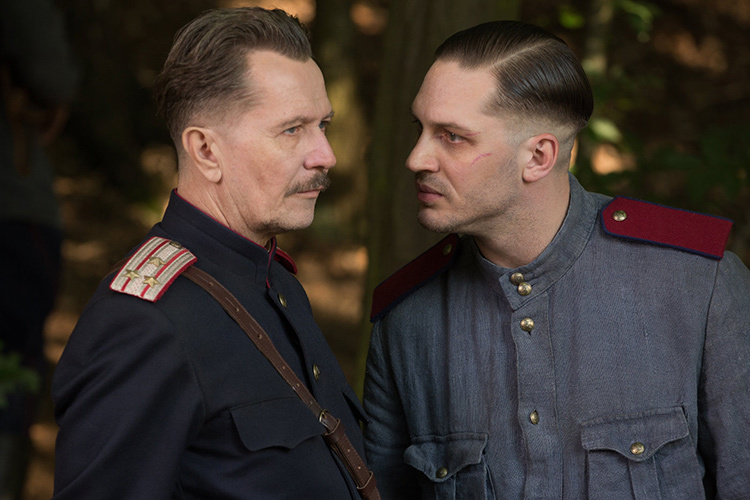
How to write about the strange case of “numbers 44” when you just informed you: your opinion does not matter? When this modest, boulevard film suddenly appeared that viewer who considered himself the right to remain the only one - and managed to carry out the maneuver? When this viewer immediately made up the discussion of both the film itself and even its ban? When did he get ahead from his note of the hybrid genre and Valley and Maslov ? Notes of a peremptory, stupid - but backed up by business. Should I try to understand the motivation of such a viewer?
Judging by the official, not by Medinsky himself compiled (not his syllable) stationery, the minister was offended by the distortion of "historical facts and images of Soviet citizens." Let us leave aside the question of why to believe the historical truth is an example of a frivolous genre - all the more, an unsuccessful example, suitable only for the night broadcast of cable channels, and even better for many hours of air travel (it is easier to fall asleep under it). Moreover, Medinsky has already become with his own, with its expanded text, self -disclosed: the historical truth has nothing to do with it, offends the minister the mismatch of that bloody cranberries that on the screen, with his ideas about the truth of fiction. How else to understand the whole second half of the text of Vladimir Rostislavovich? In it, a historian with a degree and the Minister of Culture in one fell swoop, not condescending to the arguments (except, of course, the allegedly clear example of certain “crumpled” unnamed enemy “brothers and neighbors”), does not cancel the pluralism of views on history, but pluralism of stories. The approach is not a historian, but a religious fanatic, who in advance declares the heresy of any superstructure on his only correct version of the myth (yes, this is how Medinsky calls the current official ideas about the Great Patriotic War and the victory in it - more precisely, about its price and consequences). The resentment of Medinsky is nothing but the envy of the writer.
It is seductive to report that “number 44” actually portrayed the ideal Russia of Medinsky.
Or not, not quite. Whoever composes here is Tom Rob Smith, the author of the literary source of the film, the novel "Child 44". He invented around the dry statistics of the victims of the Holodomor, repressions and the case of Chikatilo, a thin detective plot - the Fallenda spy of his contrast, the incompetition of the light genre of the police PALP and the severity of which leads the investigation. The solution and its consequences in his “child 44” are easier than that of Robert Harris - but the crimes of Stalinism were not officially condemned as unconditionally as the crimes of Nazism. Puppies, filming Smith's Roman, and director Daniel Espinos. He is trying to fold out of monumental scenery, tense stellar faces (the springy forehead of Tom Hardy is the main source of Sassens in the picture) and the same Palp Shabel Soviet Noir. But he stumbled-about these stupid Russian names (here everything is forever Vasily and Alexei, Mikhail and Raisa), O Miskast (it seems, by the standard of Soviet man, including women, Vladimir Mashkov was taken here), about the inappropriate and unnatural happy ending of the original source.
Medinsky watched “Number 44” - and also tried to compose. He saw in him "Mordor with physically and morally inferior subhuman, bloody mess in a frame from some orcs and ghouls." Of course, there is nothing like that in the film - there are cowards and fanatics, fools and conformists, victims and executioners, heroes and traitors both separately and in visual symbiosis - in the face of the hero Hardy, the shoulder, not too thoughtful, word, Lev Demidov’s exemplary thunder. Medinsky is outraged that the demidas with a comrade-maraudian “later [turn out to be] working ... investigators of the MGB”. How to explain dissatisfaction with such a rather ordinary turn of the fate of the character (it is clear that the Reichstag in the Monologist of the Minister is the usual figure of speech, speculation, exaggeration)? Unless the habit of the minister to those apparently more modern plots, in which they first become security officers and only then - heroes, in no way. It is not surprising that Medinsky looks in the Stalinist myth as in a mirror. In “Number 44” the mirror turns out to be crooked, but instead of laughing (humor and self -irony are generally a sign of mental health), the minister announces the cartoon, a military base, from where the terrible tentacles of the abroad stretch in the heart of the homeland. "Ingrid, this is just a movie!"
It is seductive to report that “number 44” actually depicted the ideal Russia of Medinsky (there would be beautifully justifying Smith's games with the names of the characters: the suspicious tailor Brodsky, who remained behind the scenes, the fashionista Akhmatova, Maniac Malevich-everything is quite consistent with the aesthetic tastes of the Ministry of Culture). But it would be a substitution of concepts. Russia and its story are not at all in business. The scale is much smaller. In that shock -to -shuttlecock, Stalinism, as the “number 44” turned out, has one character, Major Kuzmin (Vincent Cassel). Kuzmin does not take personal participation in arrests or executions, no: he is only a thick troll his own employees. “Demidov, your wife is a spy. Check, get an increase. " “There are no maniacs in the USSR. Think otherwise - a capitalist infection. ” Compare with “We ourselves agree with lies and slander. We ourselves have embarked on films from the series "Bastards from the penal battles". " The writer himself turned out to be a character - who will endure this?