
Translated material
Memory. Mikhail Diterichs
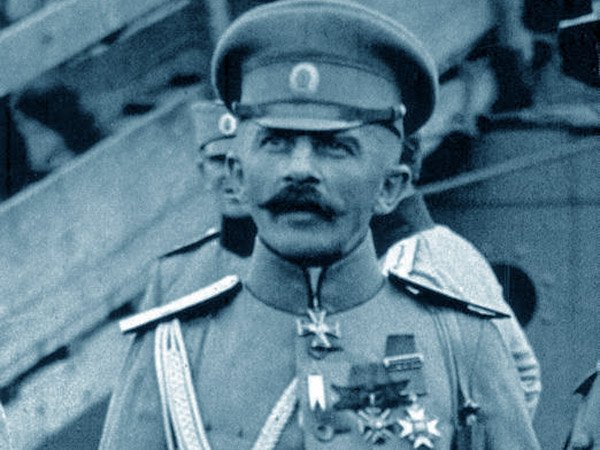
On April 17, 1874, Mikhail Diterichs, a military leader, a white movement figure was born.
Personal business
Mikhail Konstantinovich Diterichs (1874-1937) was born in St. Petersburg in a family of hereditary military Swedish origin. He graduated from the Page Corps in 1894 and began military service as a lieutenant in the Turkestan Horse-Goric Battery. In 1900 he graduated from the Nikolaev Academy of the General Staff, was promoted to staff captains. He served in the Moscow Military District in the posts of the senior adjutant of the headquarters of the 2nd Grenadier Division and the chief officer for instructions at the headquarters. In 1903-1904 he commanded a squadron in the 3rd Dragoon Sumy Regiment. During the war with Japan, he participated in the battles near Liaoyan, on the Shah River, under Mukden. He was promoted to lieutenant colonel. In 1906, he was appointed headquarters officer for special assignments at the headquarters of the 7th Army Corps, the next year he was transferred to the headquarters of the Kyiv Military District. Since 1909 - Colonel. In 1910 he was appointed senior adjutant of the district headquarters.
Since June 30, 1913, Mikhail Diterichs is the head of the mobilization department of the Main Directorate of the General Staff. After the beginning of the First World War, he was appointed the performance of the general for office work and instructions of the Office of the General at the Supreme Commander -in -Chief, and was engaged in the development of various operations of the Russian army. Then, as the chief of staff of the 3rd Army of the South-Western Front, he participated in the development of the Brusilovsky breakthrough plan. Since 1915-Major General, awarded to St. George's weapons. He headed the 2nd special infantry brigade, who went from Arkhangelsk by the sea to Thessaloniki to support the Serbian army. Since November 1916, the head of the United Franco-Russian division as part of the Serbian army. Under his leadership, units of the Bulgarian army were defeated, as a result of which the allies occupied the city of Monastir on November 19.
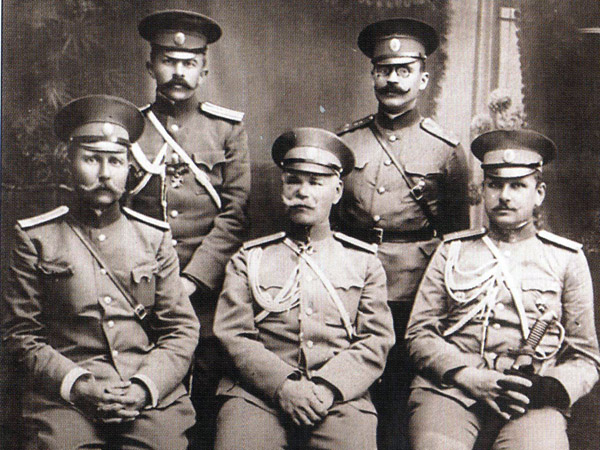 Mikhail Diterichs (from Leva in the background). 1913
In June 1917 he was recalled to Russia and enlisted in the reserve at the headquarters of the Petrograd Military District. From August 24 to September 6, 1917 he was the chief of staff of the Special Petrograd Army, from September 6 to November 16-a quartermaster General of Stavka. He temporarily fulfilled the position of chief of staff of the Supreme Commander-in-Chief, who at that moment was Lieutenant General N. N. Dukhonin. He contributed to the mitigation of the regime who was in the Bykhov prison General Kornilov. He ensured that the internal protection of the arrested Nesinsky horse regiment - a personal convoy of Kornilov. He was seconded to the commander in chief of the Caucasian Front, but did not go to the place of appointment, remaining in the headquarters. When Mogilev was occupied by the Bolsheviks, Diterichs took refuge in the French military mission and, dressed in French uniforms, left with the mission to Kyiv, where his family was.
In March 1918, he became the chief of staff of the individual Czechoslovak corps, with whom he reached Vladivostok. He headed the Siberian army in the Kolchakovsky troops, then he was the commander of the Eastern Front, the chief of staff of A. Kolchak and the military Minister of the Government in Omsk. He resigned due to disagreements with Kolchak and went on exile in Harbin.
In the summer of 1922 he headed the Amur Zemstvo army. After its defeat, he finally left Russia. He lived in Girin, then in Shanghai, where he worked as a clerk, and later the main cashier in the French-Chinese bank. After the abduction in January 1930, the NKVD agents of the chairman of the ROVS , General A.P. Kutepov , became the head of the Far Eastern Department of the ROVS. He distributed an appeal “to the white Russian emigration of the whole world”, calling for the fight against Soviet Russia. He died of tuberculosis on September 9, 1937.
What is famous
In July 1922, the Amur Zemsky Cathedral gathered in Vladivostok, who elected General Diterichs the ruler of the Amur Zemsky Territory. The armed forces of the region were called the Zemstvo army, and the Diterichs commanding them was called the governor. In the first decree, Diterichs proclaimed the priority of the overthrow of the Soviet regime. In September, the Zemstvo army began an offensive against the People's Army of the Far Eastern Republic. In the first half of the month, the offensive along the Ussuri railway to the north developed successfully, but then the Zemstvo army was forced to first go to defense, and then begin to retreat. She suffered a major defeat on October 9, when a fortified area in Spassk was left. The Zemstvo army was finally defeated by October 16. Vladivostok was left on October 26, 1922. With the surviving warriors and refugees with a total number of up to 9 thousand people, the Diterichs crossed the Russian-Chinese border near the city of Hunschun. The defeat of the Amur Zemstvo Rati ended the battles of the Civil War in Russia.
What you need to know about
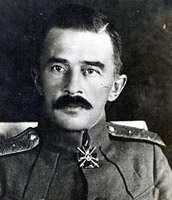 Mikhail Diterichs
On behalf of Alexander Kolchak on January 17, 1919, Diterichs was the head of the commission for the investigation of the murders of the members of the Romanov dynasty, both in Yekaterinburg and in Alapaevsk. With his help, the body of the Alapaev martyrs were taken abroad. In exile, he wrote the book “The Murder of the Tsar’s Family and members of the Romanov House in the Urals. Causes, goals and investigation. ”
The execution of the royal family in the interpretation of Diterichs appears as a ritual murder that occurred as a result of a Jewish conspiracy: “During this period of the existence of the newly created kingdom of the followers of the religion of the lies between the leaders of Bolshevism, a split occurred on the left; The sons of lies from the Jewish tribe, led by Leiba Bronstein, Nahamkes-Steclov and Yankel Sverdlov, turned out to be stronger, historically tempered, savage, ideological wrestlers. Their slanders, in most sons of the lies of their own tribe, were scattered everywhere and interspersed into all official Soviet organizations in the field and in the center. ”
Direct speech
“Our first task is the only, exceptional and definite struggle against the Soviet government - its overthrow. Further - this is not us. Further, this is the future Zemsky Cathedral. This is extremely important, because so far this principle has not been pure, and the constantly arising Russian authorities, except for the Amur, constantly pursued the principle of the supremacy of the All -Russian, because they put not only the principle of struggle with the Soviet government, but also the head of Russia. It was a strange mistake. And the fact that the Zemstvo Cathedral rejected this principle at least in the form that he rejected the title of the Supreme Ruler, he thereby emphasized our idea. We can lead our struggle with a dynastic face, but still now there is one task before us - the struggle against the Soviet regime, its overthrow. After that, we can tell the Lord God: "Now you let us go. Others will work." <...> The Romanov dynasty could be anointed, but for us mortals cannot be dreamed of accepting the title of rulers of the whole of Russia. We are the rulers of the struggle against the Soviet government and the rulers of those state associations that are born for this, ” from the first decree of Diterichs as a ruler and governor of the Amur Zemsky Territory.
“The Earth forces of the Amur Rati are broken. Twelve difficult days of the struggle with the same personnel of the immortal heroes of Siberia and an ice campaign without replenishment, without cartridges they decided the fate of the Zemsky of the Amur Region. Soon he will no longer be. He, like a body, will die. But only as a body. In a spiritual basis, in the meaning of brightly flashed within his Russian, historical, moral-religious ideology-he will never die in the future history of the revival of Great Holy Rus'. The seed is abandoned. It has now fallen on the soil not yet prepared. But the upcoming storm of horrors of the Soviet government will smash this seed along the wide field of the great mother of the Fatherland. And in the future it will flickery through the limit of our repentance and, by the endless mercy of the Lord, to the fertile and prepared piece of Russian land and then give the desired fruit. I believe in this goodness to the Lord; I believe that the spiritual significance of the short -term existence of the Amur Region will leave even deep, indelible traces. I believe that Russia will return to Russia of Christ, Russia - the anointed of God, but that we were unworthy of this mercy of the Almighty Creator, ” - from the last decree of Diterichs as the ruler and governor of the Amur Zemsky Territory (October 17, 1922).
11 facts about Mikhail Diterichs
- The ancestors of Diterichs entered military service in the Russian Empire under Anna Ioannovna.
- The Diterichs family was distant with Lermontov and Aksakov.
- In August 1917, Mikhail Diterichs was offered to take the post of military Minister of the Provisional Government, but he rejected this proposal.
- During the service in the Kiev Military District, Mikhail Diterichs repeatedly legally and illegally sent abroad, where he studied the fortifications of Przemysl, Carpathian passes and approaches to Lviv.
- In 1919, in Omsk, Diterichs created a guesthouse for the officer orphan, "Origin", originally located in his own house, and then taken out by him for Harbin.
- In December 1919, A.V. Kolchak contacted Diterichs who was in Vladivostok, inviting him to take the post of commander in chief again. As a condition, Diterichs demanded the resignation of Kolchak and his departure abroad.
- In 1920, in Harbin, Diterichs opened a shoe workshop where he worked himself.
- For a firm commitment to Orthodoxy of Diterichs, the officers of the White Army called "Your Grace" for the eyes.
- In the famous song “For Valley and Film”, battles with the Zemstvo army of Diterhs are mentioned. “Sturlock Nights of Spassk”-an operation to seize the Spassky fortified area on October 8-9, 1922, which became one of the last battles of the Civil War.
- The daughter of Diterichs, Natalia Poluektova, remained in Russia and spent 13 years in camps and links.
- In Shanghai, Diterichs and his wife, a former teacher of the Smolny Institute, opened the institute for Russian girls.
Materials about Mikhail Diterichs
Article about Mikhail Diterichs on Russian Wikipedia
Mikhail Diterichs in the project "Chronos"
Mikhail Diterichs on the website "Russian Army in the Great War"
Diterichs M. The murder of the royal family and members of the Romanov House in the Urals. Causes, goals and investigation. 1922.