
Translated material
Lost drummer
About the writer Gunter Grasse, who at the age of 17 was enrolled in the Vaffen-SS division, but all his life called for compatriots to remember the "golden teeth, torn from the corpses"
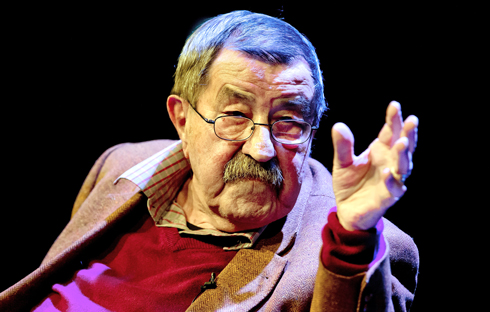
Gunter Grass, Munich, November 20, 2014
The day after the report of the death of Gunter Grassa (the writer died on April 13, 2015 at the 88th year of life.- NT ) I had two remarkable conversations. One is with my former teacher born in the mid-1930s. “It's hard to believe,” she said, “that the author of the“ tin drum ”could survive to this day!”
No, she did not read any of his books anymore. “Of the older Germans” she appreciated only the Manne brothers, and from the young waited for the release of every new book by Heinrich Bellu (born in 1917). Neither the Nobel Prize, which Grass received in 1999, nor the scandals of the beginning of the zero around several texts of the writer worried her.
My second interlocutor, on the contrary, did not read the “tin drum” (1959), watched only “Gloomy Film”, who received “Oscars” in 1980 * * The picture of Schlendorf’s folker “tin drum” also received the “Golden Palm Branch” of the 1979 Cannes Film Festival. . But he certainly knew that Grass hid from the public that at the end of the war he served in the Vaffen-SC tank division. To the question, why Henry Bellu, who was wrapped in the whole war, is “saying goodbye”, and almost a teenager who did not manage to fight really, in his old age should keep an answer to the public in his rest, an immaculate life, my expert on the international literary party replied that everything, they say, should be done on time. Admit Grass immediately after the release of the “tin drum” - no one would have noticed anything. Maybe my interlocutor admitted, not a single German writer told so much about the formation and rooting of Nazism in Germany. But by the very fact of silence, he, they say, clearly demonstrated the weaknesses of his generation, and as if with a belated recognition of personal guilt, as if pushed his reader away from himself.
I was struck by how easy it is to formulate judgments about the just deceased writer to the one who did not read this writer, but he heard about his Faux Pas (translated from French - “False Step”. - NT ). What needs to be done, I ask myself in order to connect these completely different grasses that Russian readers of different generations remember?
For an elderly lover of literature, our author died almost in the middle of the last century. For the young humanitaria of the first quarter of the current one, our author is a loser who overshadowed the sunset of his days with careless recognition.
With each decade, removing the grass from the “tin drum”, the writer experienced an increasing bitterness from the impossibility of means of language to express his current “I” with the youthful power with which he did this, written on behalf of the strange boy Oscar Macerata. In the early 1930s, seeing the nightmare of folk unity around the ideas of National Socialism, the author-hero forbade himself to grow, hid his remarkable but strange abilities from the adults, just not to participate in the further madness. Oscar Macerat was endowed with another supernatural ability - a scream to beat the glass. Like his hero, the author of the “tin drum” took over the ungrateful task - to scream and say that the mainstream majority will currently be across the wool. Grass called this a demand for him from the language in which he speaks and writes.
The last big book he wrote - “The Words of Grimm. Explanation in love ” * * Grimms Worter. Eine Liebeserklarung. Steidl Verlag, Göttingen. 2010. - Dedicated to this language itself, which requires to express it sometimes impossible from its speaker. It came out in 2010 and represents the PalimpSest: the biography of the founding fathers of German lexicography, the Grimm brothers corresponds to the biography of the grass himself, one of the faithful servants of the German language. Someone must say this, he says, and now I say. After a “tin drum”, a boy who knew how to make a window or glasses cracked in a voice, now and then turned to compatriots with open letters. In 1961, only 15 years after the end of the war, he addresses such an open letter to Anna Zegers - on the very day when the GDR began to build a Berlin wall. How to live in a country, to run from which is even more dangerous than staying in it? There was no answer.
Five years later, in 1966, he will again write an open letter-this time the Chancellor of the Federal Republic of Germany Kurt Kizinger, the former active member of the NSDAP and an employee of the Ministry of Propaganda, and now-the chief representative of the Christian Democratic Union (CDS). How can we believe you when you are a convinced Nazi yesterday? It was also the voice of Oscar Macerata, interrupting glass in many windows.
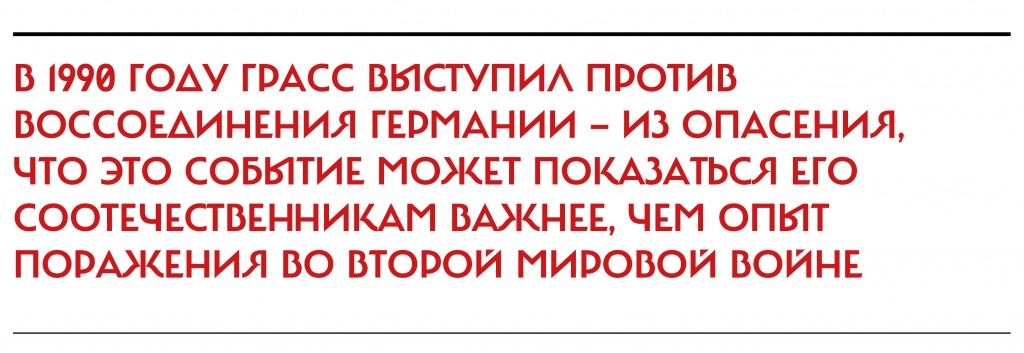
In 1990, Grass will oppose the reunification of Germany-out of fear that this event might seem more important to its compatriots than the experience of total defeat in the Second World War, which is now unlikely to be able to think to the end.
Thinking to the end - the farther, the more ugly - the grass was in the drawings, then in memoir things, or even in poetry - gloomy, like the dwelling of the drummer of Oscar Macerata.
In the "small call for a wide opening of the mouth" (translation of Vyacheslav
Kupriyanova) Grass explained this:
Who wants all this rot,
what lurks behind the paste of tooth
spit out, exhale, -
He must open his mouth.
We have time to open our mouths, -
DRITED GOLD TEARS,
torn from the corpses,
Submit to the authorities.
And to puff dad -
Although we ourselves are already dad and chuckle, -
spit out, remove,
It is necessary to open the mouth;
For our children over time
Rot your mouth: and old rot,
DRITED GOLD teeth, puffy dad
spit and remove.
And then the drummer left.
* Hasan Huseynov-Doctor of Philological Sciences, Professor NIU HSE, author of the books “Soviet ideologems in the Russian discourse of the 1990s” (2003), “Zero at the tip of the language. Brief guide to Russian discourse ”(2012).
Photo: Sven Hoppe/EPA/TASS