
Translated material
Great crime
100 years ago, a disaster broke out on the territory of the Ottoman Empire. On the night of April 24, 1915 in Istanbul, and then throughout the country, the arrests and murders of representatives of the Armenian elite - intellectuals, scientists, and public figures began.
Since then, on this day all over the world, they pay tribute to the memory of the victims of the genocide of Christian peoples who inhabited Ottoman Turkey. For 8 years, from 1915 to 1923, 1.5 million Armenians, 750 thousand Assyrians, 500 thousand Greeks were destroyed. However, after a century, only 22 countries recognized genocide, including Russia, which did this in 1995. But, for example, Israel, whose people themselves have become a victim of mass destruction, have not yet recognized. Moreover, studies show that even in the civilized countries of the Western world more than half of the population, according to the latest surveys, have not heard anything about the tragedy of a hundred years ago. A detailed story about her is in the main topic of the room. 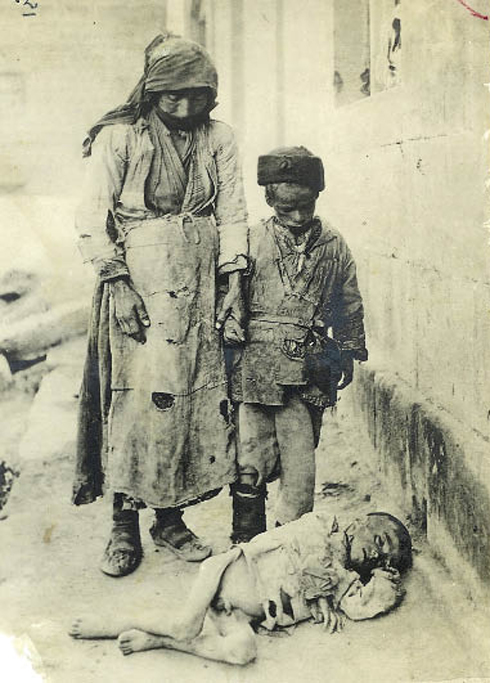
Of the 10 million Armenians living in the world, more than half live outside Armenia - in Russia, the USA, Europe, Australia, and South America. Today it is a significant part of the descendants of those unfortunates who in 1915-1920 managed to escape or lucky and be taken out from the territory of present -day Turkey, where they were threatened with death.
Military
At the end of 1914-early 1915, Türkiye, which entered the First World War in alliance with Germany, suffered the first serious defeat on the Caucasian Front. The military department, who was headed by Enver Pasha, who is part of the ruling triumvirate Mladourkov * * Triumvirate Mladourkov, or “Three Pasha”-Minister of Internal Affairs Talaat, military Minister Enver and Minister of Fleet Jemal. They, as well as the head of the "Special Organization" Behaeddin Shakir are considered the main organizers of the genocide. , this was found a simple and reliably acting explanation for the inhabitants: treason, betrayal of Christian, Armenian, first of all, officers who took place in military service, and aiding the advancing Russian army from the border Armenian population. In February 1915, Enver Pasha gave an order to disarm, transfer to non-combat units and then the destruction of all Armenians who served in the Turkish army-about 60 thousand people. This order was carried out in a short time and with unprecedented cruelty. Then followed the eviction of all Armenians from the border provinces. 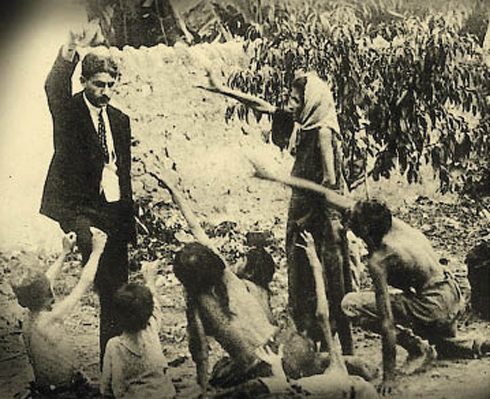
On April 24, at first in Istanbul, and then throughout the country began the destruction of the Armenian intelligentsia. Then, as now, intellectuals were considered responsible for the state of minds - scientists, teachers, doctors, priests, and Medzhlis deputies shared the fate of the military. It was a signal for the excessive destruction of the peaceful Armenian population.
In the May -June of 1915, the massacre and mass deportation of the Armenian population of Western Armenia (Van, Erzerum, Bitlis, Harberd, Sebastia, Diarbekir), Cilicia, Western Anatolia and other provinces began. Deportations were carried out according to the following scheme: first, in order to break resistance, they killed men, then robbery and brutal violence against women began. The survivors with children and helpless old men were driven to the columns and under the escort of the gendarmes were sent “to the internal areas of the country” (a standard answer to the questions of the expulsed), that is, to Mesopotamia and the Syrian desert. Without food and water, almost without clothes suffering from diseases, exposed to endless violence of gendarmes and gangs of robbers, exiles in thousands and tens of thousands died along the way. It is estimated that the destination has reached no more than 10 % of the deported. But even there, in the camps of the interfluve, they continued to destroy them. 
Those who miraculously managed to survive, as well as eyewitnesses to the tragedy - some Turkish officials, foreigners - talked about monstrous torture and bullying that the Armenians were subjected to. One responsible Turok official in an interview with the American ambassador did not hide the fact that the government approves of torture and that “the details of torture were discussed at a night meeting at the headquarters of the ruling party“ Unity and Progress ”(Young Town). 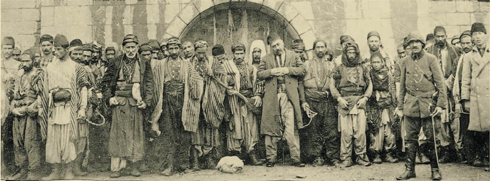
One of the evidence of eyewitnesses tells about the methods of extermination, to which the gendarmes and detachments of the armed assistants of the authorities resorted to. The inhabitants were driven into large samanniks without analysis, the doors were covered with straw and set fire to them, so they suffocated in smoke. Many died from bullets, knives and daggers. The authorities hired butchers who received 1 pound per day for the craft. Women and children were associated with each other and threw down a height. People were thrown into wells or in pits and buried. Many Armenians were drowned in Tiger and Euphrates.
A German school teacher in Aleppo named Nipage, who left the memories of tragic events, asked himself and asked him to his Turkish interlocutors: for which the authorities are not punished by criminals, but by all Armenians in a row, including the obviously innocent. And he cites a cynical answer: “One of these gentlemen (meaning the military minister Enver and the Minister of Internal Affairs Talaat) said to the reporter:“ Of course, we also punish many innocent people. But we must protect yourself from those that could become guilty. ” 
How could it happen that at the beginning of the twentieth century, which was called the century of progress and humanism, the massive brutal extermination of people on the basis of nationality and religion became possible? Moreover - that it was not a blind element of the dark masses, but was conceived and inspired by the top of the authorities and was carried out by all official structures of the state? After all, then it seemed that Turkey, where, as a result of the revolution, in 1908, the Mladourkov party came to power, restoring the constitution and significantly expanding the civil rights of all the inhabitants of the empire, began to evolve from despotism to European parliamentarism, from imperial suppression of minorities to recognize their rights and the creation of a single nation. In addition, Logordorets figures declared their goal to eliminate centuries -old antagonism in society, where various religions are professed.
However, on the eve of the First World War, the mood of the ruling elite changed dramatically: the liberal vector gave way to the nationalist in its extreme form. They began to actively spread and prevailed the ideas of pantyurcism. The trigger of the tragedy was the world war.
Politicians of the war are always perceived as a way of resolving seemingly unsolvable or poorly solved problems. The “Armenian question” in the Ottoman Empire has always existed. The Armenian population was a Christian minority on its territory, but the minority was very relative: in the territory of Western Armenia (now the eastern regions of Turkey), Armenians in many Vilayets (provinces) amounted to up to 40 % of the population, while the Turks - a little more than 25 %. The eternal enmity from time to time poured into cruel pogroms and massacre throughout the 19th century. But in the age of XX, it overgrown with ideology and gained the status of state policy. The war is also an excellent “excuse” from world public opinion, the opportunity to hide excesses. And “progressive” youngsters understood this perfectly. According to one of the Mlado -Turkish figures, at a secret meeting, a member of the executive “Committee of Three”, specially created for the “solution of the Armenian problem”, Dr. Nazim insisted that “the Armenian people should be destroyed in the root so that not a single Armenian remained on our land and this name itself was forgotten.” “Now there is a war,” he said, “there will be no more such a convenient case. The intervention of the great powers and the noisy protests of the world press will remain unnoticed, and if they find out, they will be set before the fact, and thereby the question will be exhausted. ” 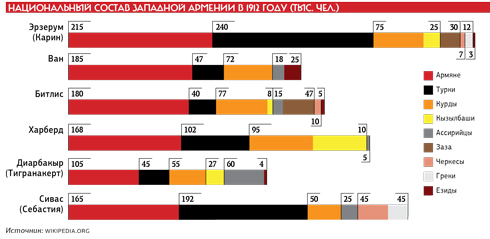
War is also a time of aggressive chauvinism. He raged in all countries that joined the world massacre. But in the Ottoman Empire, he resulted in an unlimited nationalist fumes, a delusional idea of “cleansing” the nation through the extermination of its enemies. The words of another “triple” Behaeddin Shakir are known: “In our national culture, we can only allow the prosperity of the Turkish seed. We are obliged to clear our homeland from the remaining non -treasured peoples, to eradicate them like weeds. ”
Today in the world there are still many politicians and intellectuals, for whom these words and aspirations of a hundred years ago are not an archaic at all. The idea and bloody practice of the “final solution” of the Armenian issue, as well as the destruction of dozens and hundreds of other Christian peoples of the Ottoman Empire - Greeks and Assyrians - was, as Pope Francis recently said, “the first genocide in the 20th century”. But, to the great shame of mankind, not the last. He preceded the Holocaust during the Second World War, the “great terror” and the Holodomor in the USSR, and already in the closer times, the “cultural revolution” in China, the half-Potod mass extermination of the population in Cambodia, the massacre of the Tutsi nationality in Rwanda in 1994, and today's ethnic wars in Africa. 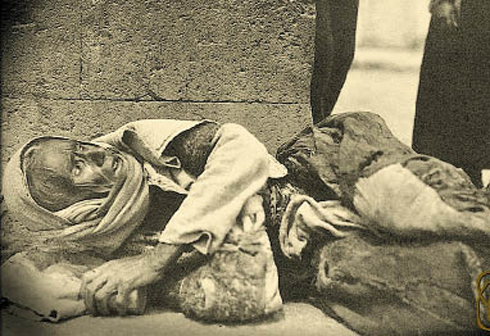
Armenian genocide recognized only 22 countries, including the Vatican. At the same time, Türkiye still denies him. On April 15, the European Parliament adopted a resolution in which he called on Turkey to recognize the genocide - Ankara left the appeal unanswered. Meanwhile, in Russia, almost half of the population-45 %, according to the March survey of the Levada Center-justifies the crimes of Stalin and Stalinism. The progressive world, as events in the Middle East show, did not come up with an effective means against the growth of religious intolerance and Islamic terrorism. Humanity stubbornly does not want to study either mistakes or crimes.
The genocide did not go into the past, did not become a story - it continues to be a cynical tool for modern politics.
Photo: National Archive of Armenia, humus.livejournal.com, wikimedia.org, skepticism.org
