
Translated material
Peaceful atom and war of civilizations
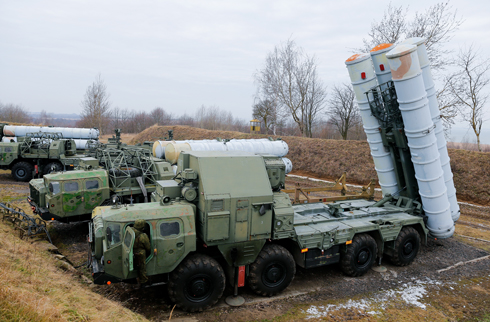
The deal of Iran and Russia on the supply of S-300 missile systems was concluded back in 2009, but Moscow was in no hurry to fulfill the contract
On April 13, Vladimir Putin unlocked the embargo for the supply of S-300 missile systems in Iran.
Just the day after the Putin’s decree of the Israeli media, citing a certain source in the Ministry of Defense, they wrote about the likely supply of Israeli weapons to Kyiv. Are such supplies in reality? It is unlikely. This would mean a sharp deterioration in relations with Russia, and Israel would not have benefited anything from this.
Putin is absolutely right when he says that the S-300 is a defensive, not offensive weapons. Nevertheless, these missiles will allow Iran to create an offensive weapon. And then many in Israel will think: is it worth a doomed to a living under the Damoclam Sword of their children and grandchildren, or is it better to leave for the USA or Canada?
If the “hawks” in the US Senate and Tehran will fail the agreement signed in Lausanne on the Iranian nuclear program, then Iran will no longer restrain nothing from the creation of nuclear weapons. It will force the enrichment of uranium and it is quite possible that in a year or two will bring the degree of enrichment to 90 % - and this is already uranium from which you can produce an atomic bomb.
Apparently, they will stop there. It is unlikely that Iran is going to bomb Israel and generally wants to create an atomic bomb. Homerally, Tehran will achieve the opportunity to create it and stop there. Ayatolles want to be in a state of five -minute readiness and thus keep the world thus: they say, another step - and we will have a nuclear weapon. This will allow Iran to be hegemon in the Middle East. Moreover, such a scenario is also likely: one morning, the population of Israel, waking up, finds out that last night Iran made underground tests of a nuclear bomb.
In order to prevent this, Israel can apply an airline on the main nuclear facilities of Iran. It’s great, however, realizing that this will not lead to anything: the Iranians will start again all over again - they will have to be bombed every few years. With Russian missiles, the S-300 Iran will not feel like a blow one hundred percent from such a blow, but will be able to protect most of the nuclear objects from the air from the air. Thus, Iran will feel unpunished and not be afraid that Israel will destroy everything.
The Israeli Prime Minister Netanyahu insists on imposing even more sanctions against Iran, but bend the stick: it requires the destruction of all centrifuges and the elimination of two factories in Natanze and Fordo, where Uranus enriches. Tehran will never go for anything, because for the Iranian people a nuclear program has become a national idea: there they believe that Iran will become a great power thanks to this. And Netanyahu is deeply mistaken, thinking that if the United States introduces new sanctions, this will force Iran to turn the nuclear program. Rather, in Tehran they will say: we will starve, but we will not kneel before America.
The possibility of an Israeli air strike on Iran is nevertheless quite real, but you need to keep in mind: if objects in Natanze can be destroyed, then the Fordo factory is too deeply hidden between the rocks, and Israeli, unlike the United States, does not have a bomb that could hit it. This means that the enrichment of uranium at this plant will continue.
In addition, in response to Israeli, Iran can start bombing American objects (military bases, fleet) in the Middle East and even arrange explosions in America itself, which in this case will suffer more than Israel. The conflict can develop into a real war of civilizations. That is why in Israel almost all the leaders of special services and intelligence against bombing Iran. For - the parties "Our House - Israel" and "Jewish House".
Iran is a closed state. He who is ready to support aggressive actions against Israel in his domineering elite, cannot be affirmed with confidence. It is generally accepted that the President of Rukhani is more peacefully configured, and a number of ayatalls - on the contrary. Ayatollah Khamenei is not an omnipotent tyrant and is forced to take into account views and moods in society. His predecessor Ayatollah Khomeini, as you know, stood in the 80s for the continuation of the war with Iraq, he owns the famous phrase: “For me to sign a peace treaty with Saddam Hussein is the same as drinking a bowl with poison.” And he drank this bowl: he signed a peace treaty in 1988 and soon died. Any state leader is sometimes forced to take steps that he does not want to take.
Photo: Vitaly Nevar/TASS