
Translated material
Caravans of sorrow
The Armenian population of the Ottoman Empire was destroyed with unprecedented cynicism and cruelty - evidence of eyewitnesses to the massacre
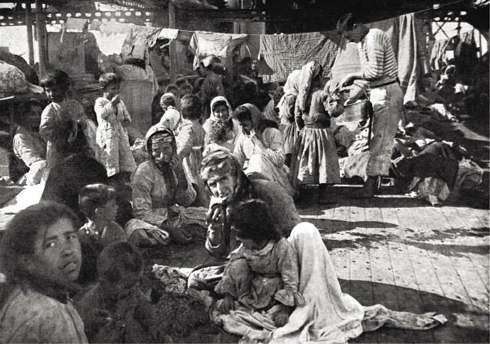
Armenian refugees in a camp, equipped on board the French cruiser who saved them from the death of a French cruiser, 1915
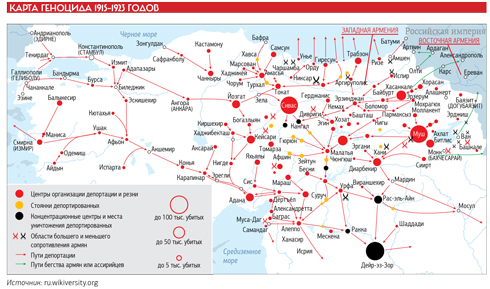

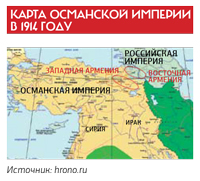 |
| increase |

"Not even 8–10-year-old girls were not left uninquisitive"
The story is recorded from the words Ms. P. Fyants, a young lady from a wealthy family
On the first day of May 1915, we were suddenly arrested in Harbert and imprisoned all the most influential, most wealthy Armenians. In prison they were beaten and tortured, they said: you have weapons warehouses, indicate where they are? No one said anything. Yes, there were no warehouses. They tortured terribly, inhumanly. <...> In men, their nails on their feet were torn off, bloodied legs were laid in hot water, then they beat the wounds with willow twigs. They shaved their heads in women, dressed on them hot copper bowls or burned breast fire ... Many could not stand torment, died in prison; Some are obsessed. But we already gave everything we had, and could not give anything else. Then they announced that all Armenians should be deported from the region, that there is an order from Constantinople ...
The eviction has begun. <...> We gathered and on Saturday June 14, together with others, went along the way to the Urals. Our party consisted of the most common, most educated and respected families in the city. We had carts and horses with us, but moved very slowly, because the men walked. <...>
We dotted the path from isoli to Malatia by many corpses. But the most terrible, the most unbearable was that on this path, violence against women began. They raped with vile cynicism, with brutal mockery, in front of husbands, fathers and mothers ... <...> Then we were collected to lead at UrFU. The carts and horses were taken away. They did not even leave donkeys so that they could put children on them. Mothers took the kids on their backs, and those who could already walk - by the hands, and went. <...> If a child’s scream was too annoying any of the gendarmes, he pulled out a screaming from his mother and killed, crushing his head on a roadside stone. On the first night, violence against women resumed. They were not even taken to the side. These people (gendarmes.- NT ) were worse than cattle-they had at least some kind of shame, and this, on the contrary, wanted more vileness and abominations ... They established something like normal and queues: for every 10 soldiers they appointed one woman, amused her for 2-3 consecutive hours, then abandoned the tormented, half-dead unconscious ... They did not leave even 10, not evenly left for 10, even 10, even 10. 8-year-old girls. This was repeated in every parking lot. There were pregnant women among us, who were allowed from violence and beatings prematurely, bleeded and died before our eyes. <...>
From the book "On the way from Harbert to Urfa." M., 1917
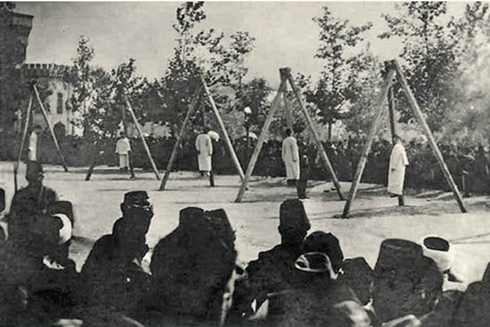
Armenian execution in Istanbul (Constantinople), June 1915
"Traces of terrible atrocity"
From the testimony of Persians and Turks about the massacre of Erzerum Armenians in June 1915
<...> The Camel Camels Kerbala Ali Memed said the following: “I transported ammunition from Erzinjan to Erzerum. Once, in June 1915, when I drove up to the Khitursky bridge, an amazing sight appeared before my eyes. A myriad of human corpses filled 12 spans of a large bridge, stripping the river so that it changed the flow and fled past the bridge. It was terrible to watch; I stood with my caravan for a long time while these corpses sailed, and I was able to go through the bridge. But from the bridge to Ginis, the whole road was littered with the corpses of the elderly, women and children who have already decomposed, swollen and stinks. Such a terrible stench stood that it was impossible to go along the road; My two camel drovers from this stench fell ill and died, and I was forced to change my path. These were victims and traces of unheard of and terrible atrocities. And all these were the corpses of Armenians, unfortunate Armenians. ” <...>
TsGIA Armenia, f. 57,
OP. 1, d, 632, l. 17-18.
From an eyewitness of an eyewitness Fayz
El Hossein about the massacre of Armenians in 1915
<...> We continued our journey to Kara-Jurn. Our coachman, Turkish by nationality, pointed to a pile of stones, in the distance about one hill, and explained that in this place, Zrogry and Wardkes, two famous Armenian deputies were killed in this place.
The Zogre was the Armenian deputy of Constantinople in the Ottoman parliament. His merits, eloquence and liberal views could not like young people who have no idea about true politics and constitutional principles. <...> As for Vardkes, one Kurd told me that he was a bold and courageous person. Even at the time of the reign of the Sultan Abdul-Gamida, he stood at the head of the Armenian rebels and was wounded by an explosion of a shell; He was imprisoned, where he was made false promises so that he would repent. “I will not sell my conscience for any positions,” he answered. <...>
Mladots could not tolerate such people. Therefore, they sent a zegob and Wardkens from Constantinople along with numerous representatives (Armenian) intelligentsia, giving an order to destroy all of them along the way. Then they let the rumor that they were killed by robbers. <...>
Faiez El Ghocéin. Témoignage
D'AB ARABE MUUSULMAN
Sur i'innocence ut le massacre
des arméniens. Trad. de l'Arabe
Par A. El-G. [Bombay], 1917.

"The purpose of the expulsion of the famous people"
From the memoirs of the Turkish official Nam-Bey
<...> Once the following telegram from the Minister of Internal Affairs came: “The purpose of expulsion of the famous people is to ensure the well -being of our Fatherland in the future, because wherever they live, they will never abandon rebellious ideas. Therefore, we should strive, as far as possible, to reduce their number. ”
This telegram arrived in November 1915. Eight days later, it was transferred (representative of the chief committee on expulsion affairs.- NT ) Abdullahad Nuri-Bey, even without approval by the General-Governor. <...> Nuri Bay immediately showed them (the head of the expelled Eyub-Bey and the head of the gendarmerie Emin-Bey.- NT ) the received telegram. <...> Ayub-Bay stood for an open massacre, but Abdullahad Nuri Bay, a very cunning man, did not agree with this plan. His idea was that it is more advisable to subject them to severe tests of needs and harsh winter. Killing them in this way, it was possible for the future to enlist the proof that they had died a natural death. <...>
It was followed by what government representatives counted on. Every day, reports of hundreds of deaths, cold and illness were received ... Typhus raged everywhere. Kaimakam * * Head of the administration of the county. And the officials who were in charge of expulsion affairs daily sent reports on mortality. Death was not only Armenians, she also mowed the local population.
Once I told Abdullahad Nuri Bey: “Bey-Efendi, let's make a link of the Armenians less strict, otherwise death will threaten all Mesopotamia. In these vast areas, no one, except the devils, will remain. Kaymaks in Rasul Ayon reports alarming information. ” Nuri Bay laughed. “My boy,” he said, “in this way we will immediately get rid of two dangerous elements. Together with the Armenians, Arabs die! Is it bad? After all, the road for Turkism is clearing this! ”
This answer made me shudder. <...>
The Memoires of Naim Bey. Turkish Official Documents Relating to the Deportations and Massacres of Armenians. London. 1920.
 |
| increase |

Message of the American missionary V. Jacks
<...> Army Armenian eviction was carried out systematically, monstrous methods. <...> I saw caravans, in which 5-10 people went between each other, in other places - I already saw corpses related to two or five. <...>
The little girl from ZIL told me that when, when evicted from Marzuan, Amasia, the turnee set off, in the so -called Sar Khshlu (between Sivaz and Caesarea), the children were selected from mothers and locked in a separate room, and mothers were forced to move on. And then in neighboring villages it was announced that those who wish (Turks. - NT) can receive any of the children. This girl herself, with a friend, Navvard from Amasia, was brought to Constantinople with a Turkish officer. <...> Caravans of women and children in every city and village were flaunted before government institutions so that Muslims could choose them in their way.
<...> Baybourg, after eviction from the city, partially cut out the rest, mainly women and children, near Erzinjan was thrown into the Euphrates. <...>
"Armenian Bulletin", M., 1916, No. 3, p. 7–10.
"He held up steadily"
From the memorandum of Catholicos of all Armenians. Arsen Khachikyan's certificate
I heard from eyewitnesses and saw myself how ruthlessly the Turkish government turned, in particular, with the faces of the spiritual rank. <...>
The priest the ter-Asature from the village of Karmir, who is three and a half hours from Harberd, hung in a half-aged state, then removed from the loop and demanded that he indicate the place where the weapon is stored. He held on a steady, and he was brutally beaten for it. The venerable priest was released in the morning - again so that he indicates the place where the weapon is stored. The unfortunate fled to the village of Hoyle and rushed into the well, from where the gendarmes immediately removed him and, after long tortures, crushed his head with an ax.
One of the Pauli priests, Ter-Atovma, was saddened as a horse, they sat on him and persecuted an hour and a half. He was brought to exhaustion and then demanded that he give out secrets and indicate where the cache with weapons. Ter-Atovm stubbornly and firmly unlocked, then he was borne and crucified ... Under the weight of these torments, he gave up a spirit.
TsGIA Armenia, f. 57, d. 622, l. 16.
From the story of Yelarzar Karapetyan, a peasant from the village of Avatorik Mushi district
October 27 Musarriff * * ruler of Sanjak, an administrative unit in the Ottoman Empire. Shevki Pasha with 22 horsemen arrived in the Ara and demanded that the Armenians who were there immediately register and go to Mush to accept Mohammedanism. When everyone gathered at the door of the office of local authorities, the armed policemen drove 600 captives on the way to Mush with bayonets. Upon arrival in Mush, all men were taken from the mass of prisoners - 150 people and took to the east, to Bitlis, and women and children were hijacked to the west. We did not receive any news about the future fate of these six hundred prisoners and only later learned that they were all killed. In all those areas where the Armenians surrendered, the same thing was repeated as in Araha.
In January 1916, almost a single Armenian was not alive in Musha, only the ghosts of single women and children, naked and homeless, secretly wandered along the streets of the city and Kurdish villages. The Armenian areas of Sasun were burned and completely depopulated. <...>
After January 15, the Turks fell into despondency and whispered about something; We learned that the Russians (troops. - NT) approached the Khnus and the Turks are in danger. On January 27 and 28, the city was experiencing alarming days. The streets were teeming with asker and gendarmes. People were in mourning, curses and crying were heard from all houses. Turkish women with curses accused their government and said: "This is a punishment for innocently spilled Armenian blood ..."
A few days later, when the fugitives gathered in various corners gathered in Musha, I calculated and came to the conclusion that out of 1,200 inhabitants who inhabited a few months ago, only 8 men and 12 women and children, only 20 souls remained. <...>
Archive of the Institute of History
AN Armenia, f. 1, Op. 1,
d. 219, l. 24–36
From the report of the headquarters of the Russian Army Crimea Shamkhalcha, the head of the 2nd Caucasian Rifle Division
Mush, February 14, 1916
<...> It was usually done like this: a large pit burst out, women and children were driven to its edges, and mothers were forced to push the children into this pit, after which the hole fell asleep a bit of the earth, then women were raped in front of the associated male Armenians and killed, after all this, the men finally filled the hole almost to the top. Some of the Christians were driven to the river and was discharged from bridges into the water, and the emerged ones were caught and dropped a second time. In Euphrates and the river closest to Musha, there are now at least 25,000 corpses of Armenians.
The local Muslim clergy protested against this atrocities, and the Imam of the city of Sheikh Avis Kadyr addressed the Musarrith Sarvat-Bek personally, asking the latter to respect the law of Mohammed, allowing the male sex, which could wear weapons and resist, that is, at the age of 15 to 60 years, to which he received the threat of being arrested and incurred abuse. After that, the enmity began between the city clergy and secular authorities, and the clergy retreated from public life. At the same time, the clergy began to cover the Armenians in their fines and insults from the governor and the police. <...>

"You have done a good deed"
The story of two sisters of mercy who served in the German military mission in Erzerum
<...> Early in the morning, a column of expelled was held in front of our house, heading along the highway leading to Yerezka. We followed them. <...> It was a large party, but there were only two or three men in it, the rest were women and children. Many women were like crazy. They shouted: “Svy us, we will become Muslims, Germans or what you want, only spare us. We are leaded to Kamam-Bogaz to cut our throat, ”and they made an expressive gesture. <...> ... the horse gendarmes, waving their whips, drove the crowd non -stop. On the outskirts of the city, the road in Kamam-Bogaz branched from the main highway. In this paragraph, what is usually happening in the market for the sale of slaves. We also took a little girl and a family of six children aged three to fourteen years old - they all literally clung to us. <...> Then we went to the city to get permission to take these children with us. We were told that the authorities are now at the meeting and decide the fate of the newly arrived convoy. Nevertheless, B.'s sister managed to talk with one person familiar to her who allowed her to take her children with him and advised them to give them false names in the passport. This was enough for us, and, having returned to the hospital, we moved with our luggage, children and everything that we had, to the hotel in Erznka that evening. Sanitar-Turks in the hospital reacted well to us. “You have done a good deed, taking these children,” they said. <...>
The Treatment of Armenians
In the Ottoman Empire 1915-1916.
London, 1918.
In the preparation of the publication, the materials of the site www.genocide-museum.am and the books “Genocide of Armenians in the Ottoman Empire” were used, ed. M. G. Nersisyana, M., 1982 editors thanks the Museum-Institute of the Armenian Genocide under the Academy of Sciences (Yerevan), the National Archive of Armenia and the 100Lives Foundation for help in the preparation of the material
Photo: Photo/Vig/Getty Images, Wikiversity.org, AFP/East News