
Translated material
The dance of the alpine valley
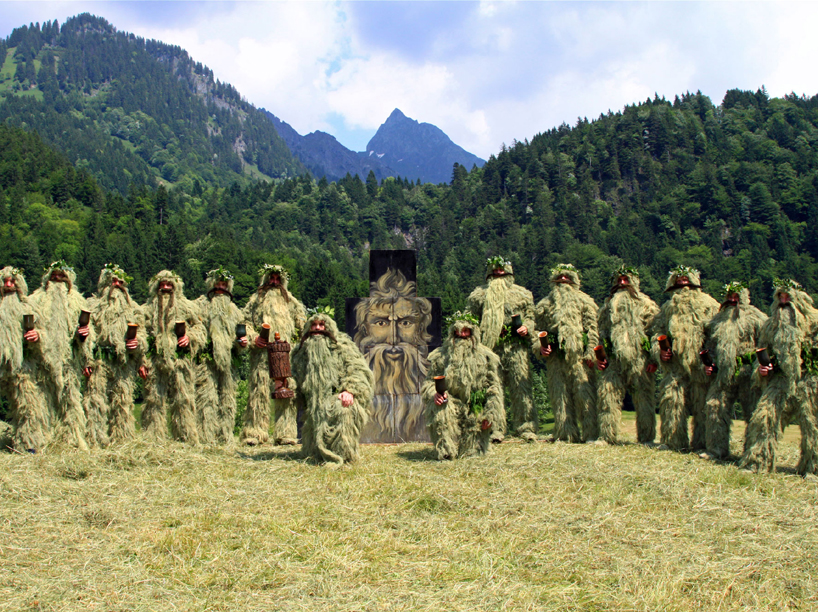
In Oberstdorf, in the Bavarian Alps, near the border with Austria, tourists come in winter. There they can spend time on ski routes or see competitions, because the city regularly takes place one of the stages of the “tour of the four fences”. In the summer, Oberstdorf is empty.
But once every five years, Oberstdddorf should come in the summer. There will be, what to see. If you choose the right day, you will see a group of people covered from head to toe with strange pale green hair performing no less strange dances. If you ask what is happening, others will say: “Wilde-Mändle-Tanz”-“Dance of Wild People”.
Such a dance can be seen in Oberstaddorf in the years whose number ends on the five. 13 men participate in the dance, all representatives of hereditary Oberstdorf clans. Membership in this peculiar club, as a rule, is transmitted from father to son. They do the costumes of "savages" on their own. Green wool is actually a lichen from the family of Sennaya ( usnea ). This lichen grows in coniferous forests, where its long strands hang from the branches of trees, resembling beards. The folk names of the Uses in different languages reflect this similarity: Russian pine beard , Borod of the Lesh , the Board of St. Panteleimon , the English Woman's Long Hair , Old Man's Beard , French Barbe de Jupiter , Barbe de Saint-Antoine , Spanish Barba de Viejo , Polish Brodaczka , Czech krakonošovy vousy
It looks like a sleep in the forest
So, each of the future dancers collects a sufficient amount of Usai in alpine forests and makes a dance costume for himself. Also for the costume you need Padub (Ostanist), from which a wreath decorating the dancer's head is built. Flexible young branches are used as a belt. The total weight of the costume is about six kilograms.
The dance consists of 17 separate "numbers". Contractors vigorously stomp on the ground, jump, build acrobatic pyramids. Sometimes dancers pick up staff. The second part of the dance uses wooden boards, which depict the face of a “wild man”. In the finale, a wooden cup is filled with beer (and drunk with dancers) and a special song is sung.
What is the story of this dance? There are two stories. First, we will tell the first, which can be called the “official mythology” of the dance of wild people. According to her, the dance was continuously performed for centuries. It is a legacy of the beliefs and rites of the Celts and Germans who lived in the Alpine region, and was once distributed "from Upper Savoy to the Tatra, from dolomite Alps to Garnz and the Touring Forest." It is believed that he was dedicated to the German God Torah (Donar), over time, pagan beliefs were replaced by Christianity, the old rites were forgotten, and the dance was preserved only in Oberstdorf, covered in a mountain valley. It is claimed that the first description of such a dance was made in 615 by St. Columban .
But, when professional historians take up the case, the presented version is crumbling. Neither confirmation of the antiquity of the Oberstddorf custom, nor the mention of his works in the works of Columban or in the "Life of St. Columban", compiled after his death, Iona from the monastery in Bobbio. Scientists offer their version of the origin of the dance of wild people, which, although it refuses it in ancient times, is also very entertaining.
They say that in the Middle Ages, the image of a “wild man” was popular in the popular, but in a “high” culture: a shaggy creature with a club allegedly living in the forests. Wild people appeared in Heraldry, on art objects.
"Wild people" depicted by Albrecht Dürer
The image of a “green man” (Jack-off-the-Green) as an architectural decoration is likely to be connected with them, the earliest examples of which dates back to the 4th century. True, the “green man” on the facades of medieval churches and other buildings is covered not with wool, but by leaves, grape or oak.
An example of a "green man" in the abbey of the Holy Trinity in Vandom (France)
Dressing in the “Wild Man” was one of the entertainment on court masquerade balls. The most fame among such masquerades was the ball, which ended tragically. It is called the " Ball of the Flame". It was arranged in Paris, in the royal residence of the Saint-Paul Hotel, on January 28, 1393 on the occasion of the marriage of a knight from Verdandanda and Katerina de Fatovren from the retinue of Queen Isabella. King Charles VI and several courtiers appeared at the ball in the image of “wild people”. A disheveled hemp depicting wool was attached to their clothes. Alas, during the ball, the king’s brother, the Duke of Orleans Louis, inadvertently brought the torch to one of the “savages”, the hemp caught fire and the flame quickly spread to the rest. As a result, four of the six dressed up were killed.
Ball embraced by flame
Later, mention of the costumes of the “Wild Man” is found in the description of balls at the court of Henry VIII in England. But we will return to Germany to find out what evidence has been preserved about dancing in Oberstdorf. The following is known. In 1793, the Trirsky Elector and the former prince of Augsburg, Klensburg, ordered the Sakson , ordered to arrange a “twelve savages comedy” for his guests, inviting dancers for this. In 1811, Clemens Ventseeslav visited Oberstadddorf with his sister, where local residents performed this dance and song in front of him. Then the local music teacher Joseph Anton Bach first recorded the notes of these dance and songs. It generally corresponds to the musical art of the Baroque era. Subsequently, the dance of wild people was performed in summer residences in Lindau, Constance and Switzerland. It is believed that gradually it turned from court entertainment into custom, supported by the inhabitants of Oberstdorf.
Clemens Ventseeslav Saxon
However, it is better to see once than to hear a hundred times. In 2015, the dance will be performed once again, so those who wish can go to Oberstddorf and watch it personally. The performances of hereditary wild dancers will be held eight times in the summer: June 13, June 27, July 17, July 25, August 9, August 22, September 5 and September 26.