
Translated material
Zombies - fast and dead
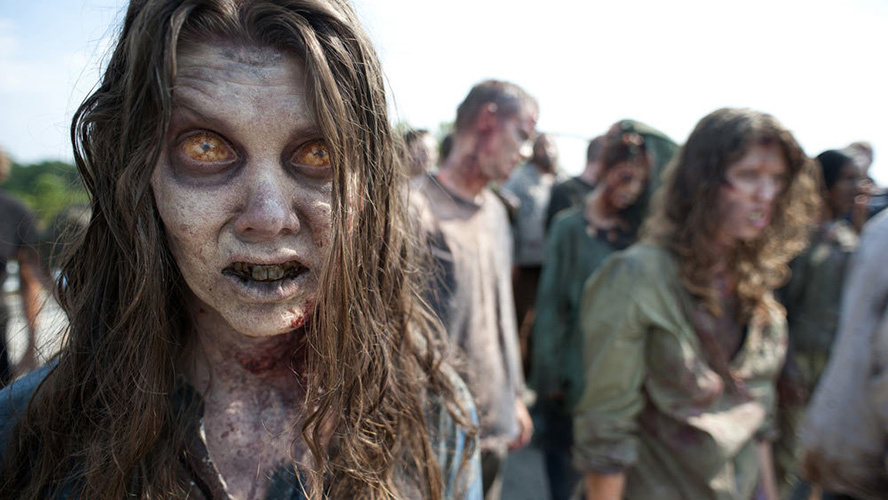
Imagine that you wander in a fog on the outskirts of an abandoned village. Suddenly, a dark silhouette appears from the gray fringe of rain. The zombie growls in the womb and reaches for you with touched arms. Horror fetters you, but memory helpfully suggests that the revived dead people are usually slow. You turn around and, for a month with your feet, that you have a spirit, you will get into a blurry field. But the zombie overtakes you in three jumps and begins, rumbling, dinner with your brain.
All because you probably did not think about the exponential growth of speed, with which the living dead move in the movie of the XX -XXI centuries. And it is unlikely that you have ever seriously paid attention to the details of their physiology-and the associated biological incidents like the intercourse of zombies and the birth of a zombie, as in Peter Jackson’s film “Living Dead” (1992). Do you know, in fact, the difference between the zombie, the “living dead” and the “walking dead”? Have you tried to tame the zombies? The typology of serial zombies and the history of their study are one of the plots of the book of the philosopher Alexander Pavlov “Obscene pleasure”.
In the section “Telemetic: the evolution of the appearance of the zombie”, its author turns to the traditions of Zombie Movies . We are talking about “walking dead”, who recently completed their fifth season, and the series “In the Flesh”, closed after two seasons in January this year. The author notes that in the 21st century, the film industry realized that the canonical zombies - slow and inconspicuous - deprive the spectacle of the drive. In a big movie, the era of fast zombies began, they became much faster and more aggressive. But unhurried dead still remain popular among fans. In the series, there is a tendency to portray the living dead as they were introduced by George Romero - a venerable founder of the genre. So we can talk about the difference between modern cinema zombies and a traditional television tan.
The author of “shameful pleasure” is interested in not only the typology of the screen dead, but also the socio-political side of Zombie Movies . According to Pavlov, the “walking dead” offer the audience the same view of political regimes, which was characteristic of ancient Greeks - when the phenomenon is considered outside historical conditions, in its pure form. So, in the third season, the complete flaws of democracy, which is professed by Rick, and the “virtuous” tyranny of the governor are contrasted.
Do you know, in fact, the difference between the zombie, the “living dead” and the “walking dead”?
More in more detail, Pavlov explores the political addictions of the main characters of the Simpsons, one of the longest animated series in history-in mid-May its 26th season will end, and it is already known that history will continue. If the little Maggie has not yet managed to form, then Lisa turns out to be a convinced feminist random and green. And also - the main intellectual of the series, “which, however, does not make it happy,” the author of “shameful pleasure” notes casually. The eternal non-conformist Bart is compared with the main character of the cult film of the 1950s “rebel without ideal”. The most conservative religious housewife, the mother of three children and the artist Marge. To determine the political orientation of Homer Simpson, the author turns to Max Weber - and it turns out that Homer is not just a “instinctive liberal”, but a part -time politician (of those for whom politics may be a occupation, but not a matter of life).
There is a feeling that the author of “shameful pleasure” takes to heart not the most flattering image of Russians in Simpsons, noting that “the creators of the TV show show some potential and unconscious fear of Russia.” However, America also gets - "the authors of the show with great pleasure are mocking not only the American presidents, but also the Russians." It is emphasized that the “Simpsons” as a mirror of American society of the late XX - early XXI century. Some ideologies are undermined, but they promote another. After all, the lack of a clear system of values is also a position. Analyzing the series, the author of “shameful pleasure” comes to the conclusion that the “Simpsons” are drifted towards moderate conservatism. In his interpretation, the story of a non -pound family from Springfield is now almost the only conductor of family values in mass culture.
A considerable place in the chapter “Animated Policy” is assigned to another veteran of television - the series “South Park”. From the cartoon, you can learn a lot about the views of its creators of the Libertarians and the cultural, social and economic life of the United States as a whole. It is characteristic that all the well -known characters of our time are cruelly ridiculed here: the evolutionist Richard Dokins enters into intimate relations with the transsexual, not suspecting this, actor and director Mel Gibson was bred by a radical masochist, and Saddam Hussein, ending up in hell, starts a shawl with a delicate and insecure satana. According to the author of “shameful pleasure”, the main lesson of “South Park” is the need for a critical attitude to any cultural product. There is enough such an attitude in the book of Pavlov with excess.
The Simpsons are drifted towards moderate conservatism.
The name "shameful pleasure" should not mislead you. In fact, the author does not at all consider the pleasure of contact with mass culture at all, but refers to the origins of stereotypical ideas about its “shame” - and indicates overcoming these stereotypes. Its goal is no less “to propose a conceptual frame of modernism/postmodernism to read cinema and fix the transition or the impossibility of transition of low genres to mass culture”, as well as “show what ways the social and political reading of American mass cinema is possible.”
Of course, it does not do without a kind of apologetics: the researcher still constantly justifies his right not to justify his love - scientific or not too scientific - to mass culture, since it has long become the subject of understanding for intellectuals.
Before us is not so much a monograph about mass cinema as a collection of articles of different years, as honestly said in the preface. The book can be started to read from any section, but texts, united (sometimes rather conditionally) with a common theme, nevertheless do not scatter. Basically, the author turns to the experience of the left intellectuals-the dose of the glory of Zizhek sometimes runs out-which is generally reasonable, given their attention to the popular culture.
With some conclusions of the author of “shameful pleasure” could be argued. For example, when he confidently says that the Harry Potter franchise is rather mainstream and, it seems, has not acquired such fans as fans of the Lord of the Rings. ” Or claims that "a high culture no longer performs those functions that were characteristic of it throughout the entire time of existence." But these statements do not cancel the fact that we have a completely serious study of the actual phenomena of the Massquulture - with our methodology and extensive bibliography, written in a lively, sometimes almost conversational language. For those who first hear the terms “Camp” and “Graindhaus” or do not know anything about Zombie Movies , “shameful pleasure” can become a useful and not too boring encyclopedia. And for fans of the series, this book is a good reason to look at the familiar stories in anticipation of the new season of “Walking Dead” or “Southern Park”.