
Translated material
The seeker of truth
Exposition "Serov. Not portrait painter ”in the Russian Museum of St. Petersburg is dedicated to the 150th anniversary of the artist’s birth. Visitors to the exhibition learn that Valentin Serov was a brilliant animalist, illustrator, expert on history
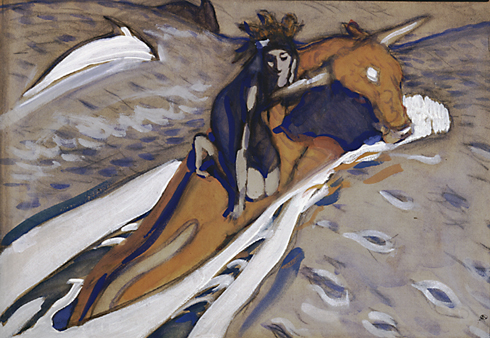
"The abduction of Europe", 1910
On April 13 (25), 1895, 120 years ago, the Russian emperor Nicholas II signed a nominal high decree.
“... our unforgettable parent, in wise care about the development and prosperity of domestic art, foreseed the need for the formation of a vast museum in St. Petersburg, in which outstanding works of Russian painting and sculpture would be concentrated. Such a high -handed intention of the deceased monarch was not destined, however, to be realized during his lifetime. Nona, responding to the mental need, we were urgently recognized as the good to establish a special establishment under the name of the Russian Museum of Emperor Alexander III with the posting of the main knowing one of the members of the Imperial House under our election, with the assignment of the title of manager of the mentioned museum ... ”
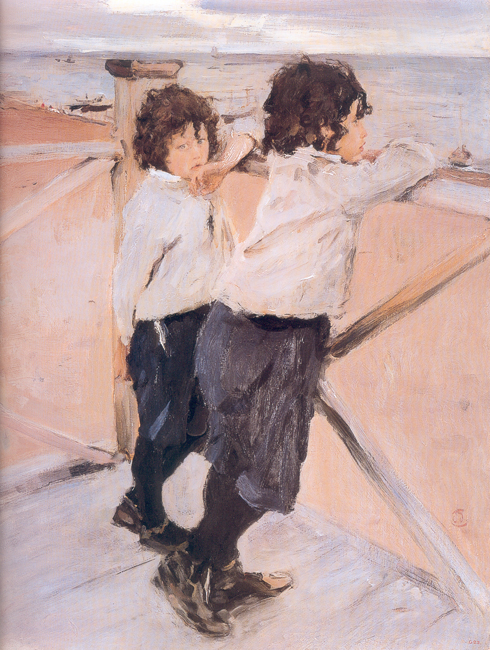
Children. 1899
Three years later, in 1898, the museum was opened, his first manager was the grandson of Nicholas I, Grand Duke Georgy Mikhailovich.
Portraits of all the “defendants” of this event could probably be seen at the recently opened exhibition in the Russian Museum, dedicated to the 150th anniversary of Valentin Serov, because many people of the era of the XIX -xx-centuries era, we see the eyes of this particular artist, and the museum is a lucky owner of a brilliant collection of the painter's works. But do not look at the exhibition of Alexander III, Nicholas II, the Grand Duke, as well as the famous portraits of Sergei Diaghilev, Princess Orlova, Ida Rubinstein.
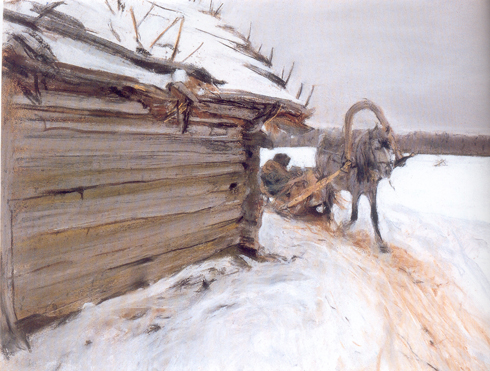
In winter. 1898
The Russian museum decided to show another Serov.
The exhibition is called "Serov. Not a portraitist. " Quote from the statement of Valentin Aleksandrovich himself: "I am not a portrait, I'm just an artist."
About 250 works from the Russian Museum, the Tretyakov Gallery and other museums of the country - historical painting, genre paintings, landscapes, graphics - evidence of the latitude and uniqueness of Serov’s work, which he knew everything in his craft.
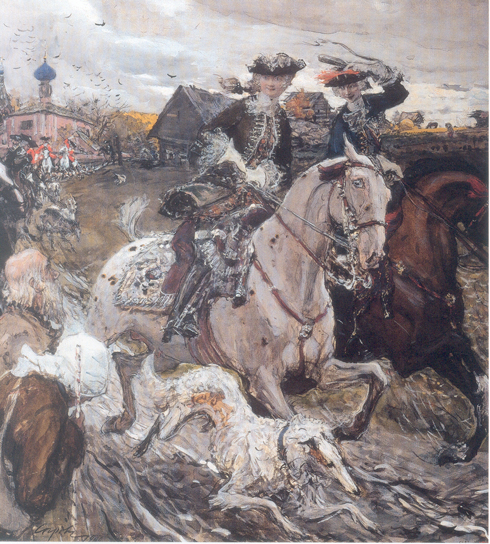
Peter II and Cesarevna Elizabeth on a dog hunt. 1900
"The Russian nightmare is squeezed into the chest"
“I have few principles, but I adhere to them tightly,” Valentin Serov admitted. He was often compared with Anton Chekhov. Konstantin Korovin, one of the artist’s close friends, said after his death: “Maybe there was not so much an artist in him, no matter how great he was in art, but the seeker of truth.”
Like all Miriscoses, Serov is a fan of the 18th century. But he is not interested in a ceremonial story, he is occupied by the domestic details of the life of the reigning persons: “The Cup of the Great Eagle”, “Peter I on the seaside”, “Peter I at work”. In the beloved by many painting “Exit Emperor Peter II and Cesarevna Elizabeth Petrovna to hunt” there are many the smallest details of the era.
The picture “Soldier, bravo, guys, where is your glory?”, Written after the events of 1905, is a completely different Serov. This satire was published in the first issue of Zhupel magazine. The angry canvas “after pacification” he signed: “I am certified by the work. Serov ” - and abandoned the title of academician, because Prince Vladimir Alexandrovich, commander of the capital's military district, was the president of the Academy of Arts.
“Again, all this Russian nightmare is squeezed into the chest. It’s hard ... somehow it’s terrible to live in the world, that is, we have in Rossi, ”he writes in one of the letters.
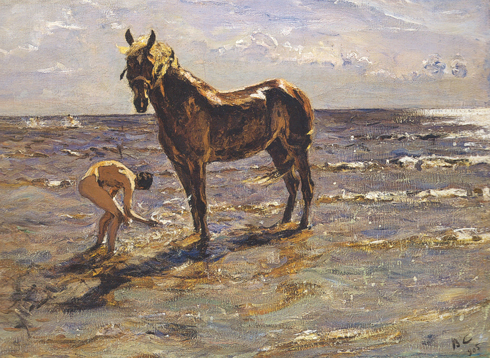
Bathing-loshadi. 1905
Until better times
The exposition has a highlighted photograph of the panel “Walking Christ through the waters”. Konstantin Korovin was offered to write a picture for the parish church of Kozma and Domiana of the Kostroma manufactory of Pavel Tretyakov and Vasily Konshin. He decided to invite a friend who had just married and needed funds. Serov wrote figures, Korovin - everything else. For more than thirty years, the canvas was in the temple, then it was removed from the wall. Not so long ago, the panel hit the Kostroma Regional Museum of Fine Arts, from there to the Russian Museum. When the canvas tried to roll out when preparing the exhibition, it turned out that it was impossible to restore it with modern means. The panel suffered not only from time to time, but also from unprofessional restoration. The picture was mothballed before new technologies.
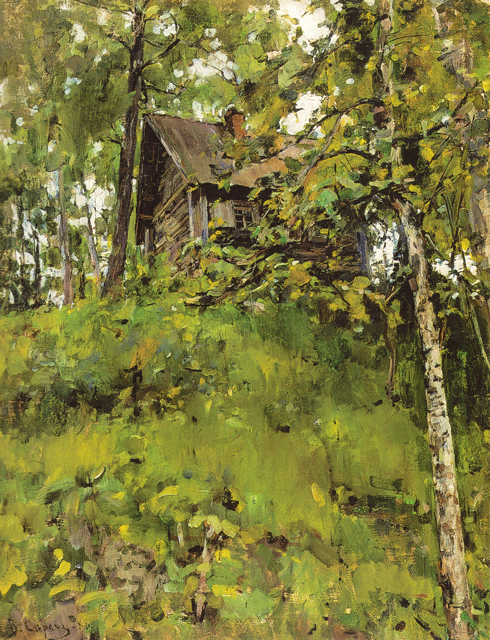
The old bathhouse in Porotkanov. 1888
Change of scenery
Igor Grabar wrote: "Serov is a draftsman, perhaps even stronger than Serov-livingor." The artist himself sought to ensure that "there was less pencil in the figure." Illustrations for the works of Pushkin and Lermontov have long become a classic. A special story with drawings to Krylov's fables. The publication did not take place, but Serov did not abandon the work and returned to her for sixteen years. All these lions, foxes, crows are perfection itself. In 1911, Serov decided to publish illustrations for twelve chosen fables. I did not have time.
Serov experienced special love for horses. To draw them with four legs, and not with thirteen small Valya, Nikolai Ge taught. Adult Serov admitted: “I love horses - a beautiful thing. Try it, draw, yes, you know, it’s hard. ” And he painted a lot of them. The most famous picture is the “bathing of the horse”, the harbinger of the famous canvas of Kuzma Petrov -Vodkin.
They even put up pencil cartoons. “Repin and the 30th Mobile Exhibition” - no mercy to the first teacher. Friends - Bakst, Benois, Grabar also got. Well, to himself - in the car step "boring Serov."
When at the Mariinsky Theater they began to prepare the second production of the Opera Yudif, Fedor Chaliapin, who performed the Olofern, insisted on a change of scenery. First, the order was given to Konstantin Korovin, but he lost to Serov - as the son of the composer. Of great success to the Paris public was the Serov curtain to the ballet of Rimsky-Korsakov “Scheheerezada”, depicting a hunting exit to the Shah surrounded by a retinue and animals. Ballet entered the program of third Russian seasons in Paris, and Sergey Diaghilev was going to continue working with the artist. But it did not take place ...
Two late works, “Odysseus and Nazi” and “The abduction of Europe”, inspired by a trip to Greece, on Crete - the master's connection of the “museum” and “nature”, which the painter achieved all his life and which anticipated the discoveries of the Russian avant -garde.