
Translated material
The deposit of unfulfilled hopes
100 billion barrels of oil near the London airport were very similar to fake
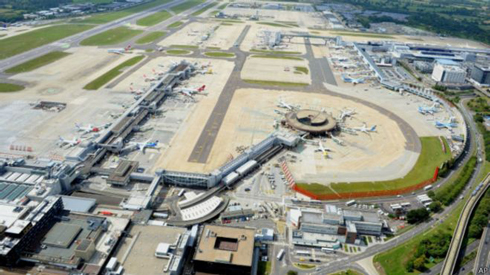
The company UK Oil and Gas Investments (UKOG) announced on April 9 that as a result of a deeper drilling and the use of progressive data analysis technologies, oil reserves in a deposit located three kilometers from the Gatwik airport can be ten times more than before. The UKOG leadership compared it with reserves near Texas Dallas, and the American company Nutech, specializing in geophysical analysis, estimated at 158 million barrels of oil per square mile.
“Based on this, we assume that this area contains oil reserves with a volume of 50 billion to 100 billion barrels,” said UKOG General Director Steve Senderson, adding that this is the largest deposit on the land of Great Britain, discovered over the past 30 years, and that a resource with world potential has been opened. ” To understand the scale, the Bazhenovsky retinue-the largest shale deposit of Russia-various experts was estimated at 22-350 billion barrels, and from the North Sea Britain in 40 years got 45 billion barrels.
Oil pantry Britain in the company’s press release says that to confirm the reserves, further trial drilling will be needed in different areas. If preliminary calculations are confirmed, then these reserves will be enough to satisfy 10-30 % of the total needs of Great Britain by 2030. Oil lies at a depth of 762 and 914 meters, and it can be obtained by traditional horizontal drilling.
UKOG shares on a message about the opening of huge reserves have risen sharply and at the peak increased 4 times. The shares of all companies in which UKOG belongs also went up in price.
However, the first enthusiasm was quickly replaced by sighs of disappointment.
“The impact on the global oil market and on the British financial market will be zero,” Ken Odelugu, senior analytics of the City Index investment, quotes the Independent newspaper. For the past 40 years, Britain has produced its own oil mainly in the North Sea, from where 45 billion barrels were obtained during this time, but the extraction volumes there are gradually reduced due to high cost. To extract “black gold” from the sea is expensive. Therefore, 15 billion barrels, which, with luck can be expected from the land deposit, where it is cheaper to get, will come in handy, but will not shock the global oil market. The fact is that Britain, in principle, does not produce so much oil - about 770 thousand barrels per day. For comparison: Saudi Arabia and the United States produce more than 11 million barrels per day each.
Matthew Zhureki, the head of energy research Globaldata, an analytical company in the field of energy, said The Telegraph that the alleged reserves of 100 billion barrels were “introduced into a serious error”, and that such statements cannot be made based on the result of one trial drilling.
Dag Parr, senior researcher Greenpeace, told reporters: “Analysts of the oil market are right, accepting these statements with distrust. Reserves are based on data on only one drilling and contradict the forecasts of leading British experts in the field of geology. ”
In May, the British Geological Service estimated the field reserves of 4.4 billion barrels. Yes, and UKOG itself only six months ago estimated them many times lower than now.
“Maybe some experts will want to believe it! - The Minister of Natural Resources of Russia Sergey Donskoy emotionally wrote on his page on Facebook. “Obviously, the data on the reserves are overstated many times.”
Penny Stocks, a restrained assessment of such promising news by British experts is largely associated with the reputation of David Lenigas, the President of the UKOG, whom the British media is political correctly called a "serial entrepreneur."
A native of Australia and a resident of the principalities of Monaco, Lenigas specializes in presidency in small companies that are traded in the London alternative investment market (AIM), where the requirements for disclosing information are not as strict as on the London Stock Exchange. AIM shares are literally a penny, or rather, Penny, which is why Penny Stocks are called. According to Financial Times, in 2010, Lenigas headed more than ninety of such companies at the same time. Now he is led by sixteen, and at least three of them own the shares of the deposit in Gatwika, which, incidentally, is called Horse Hill. And everyone had a capitalization significantly grew on the news about the British Dallas.
The Times newspaper for the next day after the sensation announcement described in detail how they guide and what shares own Lengas and his closest partner Donald Strand, the financial director of the UKOG, in companies investing in Horse Hill. One UKOG campaign now costs about 2-3 pence (1-2 rubles), but the share of Lenigas at 4.3 % in this company is estimated by a newspaper about £ at 2.2 million (162.6 million rubles). The material, which is now preceded by an editorial mark that Lenigas suits the newspaper on this occasion, leads the reader to the conclusion that with a sensational announcement, the company could hurry to increase its own capitalization.
From the annual UKOG reports it follows that back in 2012 it was called Sarantel Group and produced miniature antennas for mobile phones and other wireless devices, mainly for the army. In 2013, the business ruined and sold, renamed UKOG, re -profiled for oil exploration, and Lenigas and Strelng began to work there. Another circumstance that the British media perceived suspiciously-shortly before the announcement of the successful find UKOG replaced the analyst that worked with him and increased the share in the field.
That is why the media and markets coldly met loud statements about the "world level of deposit."
A week after the sensational statement, the UKOG itself, from which the AIM exchange demanded to confirm the announced results affecting the price of the shares, made a much more restrained statement in which the words about the “world level” no longer sounded. On April 15, the company said that the announced "estimated volumes should not be considered likely or future resources or reserves."
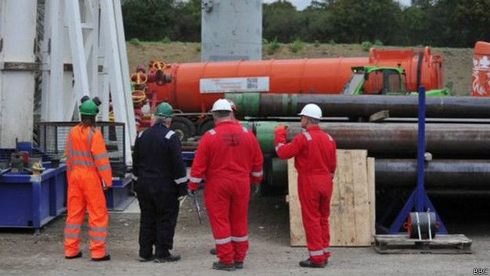
The brown among the forest is a comparison of British gardens with Texas Dallas, where huge deserted plots of land are covered with towers pumping oil from under the ground, and natural residents and local residents were very strained. The Daily Mirrior quotes a resident of the county of Surrei Elizabeth Igan, whose house is located near the tower of trial drilling: “We are worried about how this will affect the environment and on us. So far they don’t tell us anything, but will they force us to sell the house? We have no idea what is happening there, but, most likely, it will really affect our life. ”
Although UKOG immediately stated that for the production of oil on Horse Hill, it is not necessary to use the method of hydraulic fraction of the layer, which is considered harmful to nature in many countries and is already prohibited in Scotland and Wales (but not in England), this did not take off fears.
“Any company gathering to drill the land in this region knows that it will meet huge resistance,” the company quotes the representative of the organization of Friends of the Earth to Brand Pollak. “The prospects for dirty oil production in Southern England will force the entire local population.”
“Technologies are now different, roughly speaking, you are drilling many wells from one platform. Oil production in our time is much less affecting the environment than before, ”Lenigas answered, complaining that he was forced to expect permission to drill from the government, and the authorities are making decisions“ at the speed of the snail ”.
“The main thing in our discovery is the question that Britain and the British government want to do with this strategic margin,” said Lenigas. “Because our business was just to find him.”
On May 7, national elections will be held in Britain, and you should hardly expect some decision to them. And then, as experts say, if the deposit is really promising for development, in two years it can begin to give oil.
The area where the UKOG so successfully drilled the well is the forest on the border between the two regions of Southern England, Surrey and Sussex. The nearest commercial centers are located within a radius of two miles - a small town of Horli on the one hand and the second most important London airport Gatwik - on the other. Directly at the scene of exploration drilling, there is nothing particularly interesting. The Telegraph correspondent, who went there, wrote that he had seen a fenced land of deserted land the size of a couple of football fields, in the center of which there is a trailer. In it, apparently, there is a drunk well.
“All the activities that I saw there are erecting a fence there in return for the one that stands now, but in the sky a helicopter hired by television people flies,” the reporter says.
Photo: AP, BBC.co.uk