
Translated material
"Now our relics!"
COLTA . RU with great pleasure continues to order and publish the texts of students of the school of civil journalism .
In addition to the holiday itself, the Russian Orthodox Church of the Moscow Patriarchate also celebrated the Russian Orthodox Church of the Moscow Patriarchate, which was also won to it in the old Suzdal: the church, its Vladimir diocese, had two most important relics - the relics of the two places in Suzdal of saints, revered Euphrosyns and Euphrosyania Suzdalsky. On April 14, after the solemn worship of the Vladyka, Vladimir Elogy, in honor of the bright Tuesday and the day of the memory of Euphemia, his relics were to go to the Spaso-Evfimiev Monastery (but so far they have not gone), and the relics of the Euphrosyne were transported to the Risopolozhensky monastery, where they were stored until 1917.
They went to the churches in a very non -trivial way, in the form of a gift from the local department of the Federal Property Management Agency, and he, in turn, was from local bailiffs who took relics (and not the first time) from another church - the Russian Orthodox Autonomous (RPAC), the center of which is located just in Suzdal; The Moscow Patriarchate (MP) calls this Church of schismatic, and in the RPAC hierarchs of the MP is called heretics. Two churches have long opened in each other, and the case of relics is only one episode from a long history of this confrontation that has been lasting for more than one decade. We tried to understand the complex and conflicting ups and downs of the relationship between the Chonel Church and the persecuted church, and also find out what awaits the latter in the near future.
Execution
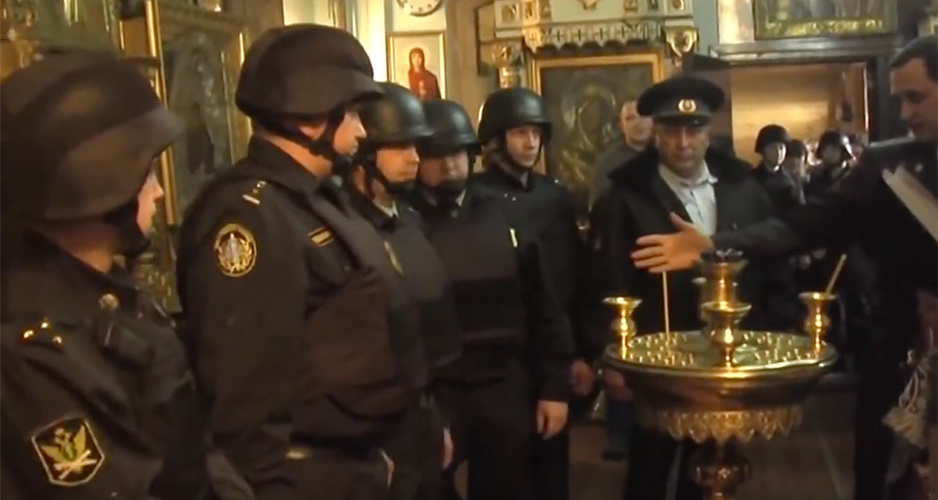
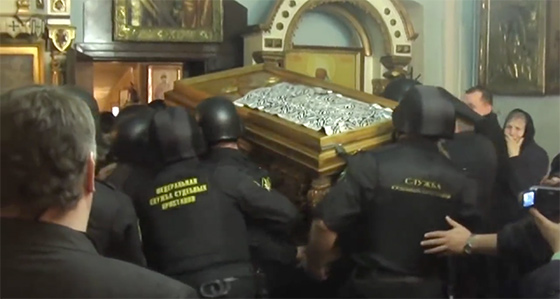
“The bailiffs, let's start,” the representative of the central apparatus of the FSSP Panchenko ordered, and the group of capital's bailiffs in helmets and body armor, breaking into two parts, approached the cancers, storages of holy relics, located on the opposite sides of the temple at the Iversky Synodal House of RPats. “The request of the people here, to move away and not to hinder - the attempt of this will be regarded as an administrative offense!” - The bailiff added, but this did not produce the desired effect - the parishioners of the temple, mostly elderly women, went into a single hum: “Crayfish! Where are you carrying crayfish! Lie down, do not give them relics, do not give them crayfish! " Some of the old women really tried to lie under the feet of the performers, but they, not particularly distracted, stepped over with crayfish right through them. At the exit, the bailiffs already had to use force and shove the servants of the temple closing the passage - Archimandrite Euphia, the nun Anastasia and the First Hierarch of the RPAC, Metropolitan of the Suzdal Theodore. “Calmly, in the corridor, we go to the corridor,” the main bailiff commanded his people to the cries “Do not give them crayfish! Do not touch the lord! ”, Gradually flowing into a friendly prayer of the Virgin. When the bailiffs carried the second cancer to the corridor, Metropolitan Theodore rushed across the exit and lay down on the way with the performers - they also stepped over him, the singing of prayer calmed down and was replaced by the indignant “Nazis! The lord trampled! Turned off with your feet! " One of the parishioners, a middle -aged man, proved to the main bailiff: “Your actions are illegal! Go to people, young and old! ” "Bandera!" -shouted after the crawls taking off to the corridor. “You are not ashamed, guys, are you not afraid that you are paying for it? Are you not afraid? " - repeated the man. “Putin needs to write,” one of the old women concluded.
All these events became available to the public in the video .
Soon after them, the bailiffs were revealed, but the relics were not found inside-the internal containers are smaller, special small arks, and somewhere disappeared. The miracle did not happen - literally a week later, on April 3, 2015, the search for the missing arcas again brought bailiffs to the same Iversky Synodal House, and for the second time they came out with them: as Koltte knew, Vladyka Theodore hid them in the lower temple of the Synodal House before the first storm. According to him, along with the hidden ark during the second search, the bailiffs seized other relics, which have not yet been returned. In any case, on this in history with the removal of the relics of the RPAC, you can more or less put an end. “It is useless to wave his fists after a fight,” says Metropolitan. Now it will be more interesting to trace where the legs grow from this fight - and when the next blow will be delivered in it.
Nazis! The lord trampled! Turned their feet!
Story
The RPAC has two sources of origin, explains Father Grigory (Lurie), one of the most noticeable representatives of its non -ryzdal part, the chairman of the Church’s Bishops' meeting and Bishop of Petrograd and Gdovsky. In 1989, the Russian Orthodox Foreign Church (ROCZ), the heiress of the pre -revolutionary church, began to accept parishes in Russia in her bosom - the future Metropolitan of Suzdal Valentine (Rusantsov) moved to it from the Russian Orthodox Church in response to the decision of the Moscow Patriarchate to transfer it to another place from the parish, in which he served more than 17 years. This was the first way to replenish “alternative Orthodoxy” - the outcome from the Moscow Patriarchate. The second source of the RPAC-catacomb communities, in the early 90s, numbering tens of thousands of people, the heiresses of the communities, who were constantly in the Soviet years in an illegal situation; A significant part of these communities also joined Metropolitan Valentin in its outcome. So Suzdal became the first and main growth center of the foreign church, the growth of the extraordinary-throughout the country (and, wider, the CIS) to the “foreigners” were transmitted by dozens of parishes, the final number was about 150. In 1994, the New York Synod of the foreign church put the Metropolitan of the Suzdal Valentine before-to pass the complete re-registration of all parishes in accordance new administrative division ( creation of a temporary higher church administration); This meant that the previous registration was reset, and many chapters of the parishes were afraid that they would lose their church real estate and that would eventually get the Moscow Patriarchate. Many saw in this a direct indication of the conducted negotiations of the "foreigners" and the Moscow Patriarchate of the merger. In the spring of 1995, all ROCZ parishes in Russia, possessing any church real estate, broke with the New York Synod and remained with Metropolitan Valentine-so the RPAC appeared as an independent church. This church, like its maternal foreign, condemns the Moscow Patriarchate, among other things, for the "heresy of Sergianism", its merger with the atheistic Soviet power (and modern power in the RPAC is considered it to the heiress). Now the foreign church has already abandoned the MP accusations of Sergianism, and in 2007 a significant part of it united with it.
In 1993, the Yeltsin government decided to fill the spiritual vacuum that arose during the years of perestroika and concluded Condordat with the Moscow Patriarchate, which put it in a slightly more profitable position than other religious organizations. Metropolitan Valentine, now the first hierarch of the new RPAC, knew very well about this new trend: after all, he, according to Father Grigory (Lurie), had “beautiful hardware instinct” and no less excellent ties with Vladimir and Moscow officials-for example, the old Soviet authorized religion affairs of the Vladimir region, a good friend of the Metropolitan, went to work in Moscow and there was a lot of rose there, he rose a lot there, he rose a lot. Having become a prominent functionary of the Ministry of Justice. Thanks to these connections, the role of such a quasi -state church in Vladimir and Suzdal performed the RPAC, and not the Russian Orthodox Church, it was the “autonomas” who went to preferences in the form of free lease of architectural monuments (that is, churches), in the rest of the country, which were obtained by the Moscow Patriarchate. Such an superiority of the RPAC was kept exclusively on the ties of the Metropolitan, but by the end of the 90s, when his acquaintances of the officials died, grew up or resigned, Valentine's hardware weight was greatly reduced, and from that moment the rpatz has existed in an inert position.
In 2001, the new officials of Vladimir inflicted the first blow to the RPAC, but the intention to inflict this blow originated in the depths of the Church itself - Metropolitan Valentine quarreled with his secretary, Archpriest Andrei Zetrov, graduate of the faculty of amateur performances, a person of great creative abilities and ambitions; He wanted to take the unofficial position of the main ideologist of the RPAC, in which Grigory Lurie prevented him, who did not trust the trustworthiness of the Archpriest and his devotion to truly Orthodox ideals. After his personal fiasco, sturgeon moved to the Moscow Patriarchate and set the goal of destroying the RPAC and personally Metropolitan Valentine. He began with the classics - he shot a film in which Vladyka Valentine was accused of sexual harassment in relation to little boys studying at a Sunday school at one of the Suzdal parishes of the RPAC. This film was shot in many ways specifically for law enforcement agencies, and after it the criminal case immediately followed - the officials saw in this scandal an ideal opportunity to end the RPAC.
The objective prerequisites for the initiation of such a criminal case were, Lurie believes, the accused Metropolitan Valentine really had a technical opportunity to commit a crime for him, since he was alone with minors without legal representatives of minors. In such cases, it is enough if the victim declares in court or in the investigation that there was something; So in the end, it happened - one boy during the investigation announced sexual harassment. The crime was proved only by these single investigative indications, the court did not have another evidence base. The Metropolitan received only a conditional term, but the goal was in many ways to achieve - even if sturgeon was not able to defeat the RPAC and to the prison of Metropolitan Valentine, the authority of the Church was still seriously undermined, and many officials, both local and at the level of the Central Federal District, believed and still believe that the late Metropolitan Valentine was pedophile and for them, and for them. The incriminating evidence served as a serious argument in favor of deploying against the church center of the RPAC in Suzdal of broad repressions.
So, we go to an object called the “cemetery”, where objects called “graves” are located, and in them are already objects called “corpses”, and these corpses are property of the state.
And the w toughed wide repressions against the RPAC were already in the departure of state property received by the Church in the 90s on the basis of free lease. This began in 2007 - special commissions began to look for a problem with restoration in church buildings, but they found nothing much; The next wave went in 2009 , and much more successfully - this time all the architectural monuments occupied by the RPAC were seized and subsequently transferred to the Russian Orthodox Church. In a large part of the churches taken by the RPACs, full -fledged parishes worked that stopped functioning after that (the Russian Orthodox Church was currently “to revive” some of their number). This was done by the official of the Federal Property Management Agency of Gorlanov, who was remembered by the inhabitants of the Vladimir region, including in the criminal case where he was a defendant, he was accused of illegally selling the basement of the regional military commissariat to private individuals (the court acquitted Gorlanov). To comment on such long -standing stories of Gorlanov, now the head of the Kostroma Directorate of the Federal Property Management Agency, refused.
On this, the persecution temporarily ceased until Metropolitan Valentine - the Moscow Patriarchate and local authorities perceived this as a clear signal that the RPAC was to finish and put pressure on. The current Metropolitan Theodore did not have a reputation as a strong leader, and many believed that he would not be able to hold the RPAC together and everyone would scatter - just a day after the death of the old hierarch, representatives of the Federal Property Management Agency came with claims already to the relics of Evfimiya and Euphrosyne. By this, according to Lurie, the local authorities wanted to create panic inside the RPAC and, due to the lack of a clear leader in the church, destroy it to the ground. Nevertheless, by the mid-end of 2012, it became obvious that the RPAC was able to resist -the story with the relics rally the church, and this can be seen even by the example of improving the relations of the two Vladyk, Gregory and Theodore, who until recently in very cool relations due to the canonical conflict of Gregory with the previous metropolitan. The last stage of the struggle for the relics, the hearing of the arbitration court , was held against the backdrop of preparing a visit to Vladimir Patriarch of the Russian Orthodox Church, and many associate a similar result of history with this.
The Vladimir bailiffs made everything that they could, but at some point, at the end of 2014, they realized that they could no longer (could not step over the old cranks who covered crayfish with their bodies), and the case was transferred to the central apparatus of the FSSP. The representative of the Vladimir branch of the FSSP Anna Filippova, who was engaged in the case with the relics, refused to comment on any attempts to withdraw relics-both previous, unsuccessful, and current, successful.
 © YouTube.com
“This story generally benefited this story - the bishop's meeting raked (the administrative body of the RPAC. - Ed. ), Theodora approved as the leader of Suzdal, holds the church in some tone. Churches generally feel best in persecution, ”says Lurie. - If the federal authorities, God forbid, began to observe the Constitution in matters of freedom of conscience, there would be a benefit to be in alternative Orthodoxy, and not in the Moscow Patriarchate, an incentive to bite a piece of state pie. This would lead to a huge number of people who want to come to church for selfish reasons, and this does not benefit a single church, which is well traced on the example of the Russian Orthodox Church. Now such people, church businessmen, will simply not go to us, for which they and thank you. ”
Priest Andrei Zetrov to this day remains in the Moscow Patriarchate and leads the arrival in the temple of the XII century building in the village of Kideksha, which he had during his service in the RPAC (the parish itself went to the ROC with his shepherd). He did not make a significant church career in the Russian Orthodox Church.
Vladyka
The Iversky Synodal Temple of the RPAC in Suzdal is a converted residential building, now belonging to Vladyka Theodore. There are two hours to the nearest service, and there are no parishioners yet, inside the temple is only his faithful guards - Archimandrite Evfimiy and nun Anastasia. Vladyka Theodore invites to talk to his office, from the walls, they listen to the conversation of the portraits of the deceased fathers of alternative Orthodoxy - Vladyka Valentine, Bishop Grigory Grabbe, Metropolitan Vitaly. Theodore himself does not resemble the image that is a word “metropolitan” - a modest black monastic cassock, long, almost to the shoulders, gray hair, a wide gray beard. Despite the recent gloomy events for his church, he does not look depressed - he jokes and laughs a lot, sparkling with a golden tooth.
“They wrote appeals, complaints, of course. And in Vladimir, and to Moscow, and to the Constitutional Court, but here it is such a matter - I never owned these relics. It just so happened, here they were with us. They were handed over to us from the museum during perestroika, “for constant free storage to believers,” with the words, they say, historical justice is returning. And now, it means that I stole them from the state, and they declared this immediately after the death of Vladyka Valentin-I thought they came to express my condolences, and they came to say that I was going to sell relics abroad. And then, almost immediately, one priest from the MP called me and said: “Vladyka Theodore, give them better voluntarily!” - recalls Metropolitan. - The bones suddenly became state property, and became not just bone remains, but objects that are called “relics”! So, we go to an object called the “cemetery”, where objects called “graves” are located, and in them are already objects called “corpses”, and these corpses are property of the state. In the Constitutional Court, they explained to us that if you yourself have or had significance for the history of Russia, then your remains will automatically belong to the state. I tried to appeal to the 244th article of the Criminal Code of the Russian Federation, but I still have not received any clarifications from the court. And so the Vladimir Arbitration Court during the processes on the relics came to the fact that all the relics of the Orthodox saints are the property of the Russian Federation - that is, the relics of the Apostle Peter, located in Rome, also belong to Russia. ”
The nuns of various ages in strict scarves at the sight of an unfamiliar guest scatter: “Mother! There is some kind of man here! "
Purely theoretically, according to Vladyka, a precedent has appeared in the Federal Property Management Agency, thanks to which this department can now take any relics from any church, even from the MP. Metropolitan did not sign any documents before or during the seizure, citing his religious beliefs, not allowing to sign the papers regarding the Holy relics. When the bailiffs came to the Synodal Temple for the second time, behind the missing ark, Vladyka, he said, threatened 7 years in prison under the article “Obvoring the investigation”.
Митрополит Феодор согласен с епископом Григорием (Лурье) в том, что в Суздале Московский патриархат через местное чиновничество работает на добивание — в своем церковном центре, в Суздале, у оппозиционной церкви осталось всего два прихода, и то один из них (как раз при Иверском синодальном храме) по факту расположен в жилом доме. Переданные в РПЦ приходы функционируют, но полноценные общины, по словам владыки, сохранились не везде. «У нас все забрали, мы недостойны, документы у нас, значит, не те. Ризоположенский женский монастырь РПЦ МП, в котором сейчас находятся отобранные у нас мощи, тоже, кстати, когда-то принадлежал нам, причем передали его в Московский патриархат задолго до основной волны гонений — патриарх Алексий лично просил Ельцина выпустить для этого специальный указ. У меня вот целая папка писем со всякими протестами против этого (смеется) . Мы потом и Путину писали, просили оставить нам хоть что-нибудь. Ничего не оставили», — с иронией вспоминает священник.
При этом, в отличие от Лурье, ничего хорошего митрополит Феодор от будущего не ожидает: «Нет никакой надежды на то, что нас оставят в покое. Не буду никаких прогнозов делать, но вспомните фильм “Морозко”, как там Баба-яга говорила: “Я и спать не могу, я и жрать не могу, пока Иван не уйдет”. Так и РПЦ — ни спать не может, ни жрать, пока существует РПАЦ».
Monastery
В Ризоположенском женском монастыре РПЦ МП, одном из древнейших в России, 1207 года постройки, находящемся буквально в квартале от Иверского синодального дома РПАЦ, особенно праздничной атмосферы в связи с приобретением святыни не ощущается — монахини самых разных возрастов в строгих косынках при виде незнакомого гостя разбегаются кто в свои кельи по разные стороны тускло освещенного пустого коридора, кто к игуменье: «Матушка! Здесь какой-то мужчина!» Как-то комментировать обретение своим монастырем и храмом мощей простые монахини отказываются и перед тем, как захлопнуть свои кельи, говорят одно и то же: «Нам не положено», «Я не имею права даже». Игуменья Екатерина соглашается поговорить, но только после 15-минутной подготовки — она погружена в приготовления к очередной торжественной службе с мощами и заметно нервничает; отойдя в дальний конец коридора, она выслушивает одну из монахинь: «Матушка, надо поменять смену!» — «Я что, в Москве работаю? Где это я возьму еще одну смену, интересно».
Через 15 минут игуменья выходит из своей кельи. Она неуловимо похожа на владыку Феодора своей строгостью и старомодностью — непроницаемо-черное облачение, такая же черная скуфья, сухое лицо. «25 марта приставы с Москвы и с Владимира принесли нам две раки. Пришла женщина с камерой, и при ней, при включенной камере, срезали замки с рак, — рассказывает монахиня. — Они оказались пустыми — Феодор не все отдал, только обивка там и была, в этих раках. 3 апреля, в пятницу, приехал священник с Владимирской епархии и нас обрадовал: “Матушка! Открывайте храм, сейчас вам принесут мощи”. Ну, они, те же приставы, и принесли нам два ковчега, один с Евфросинией, другой с Евфимием. Приставы их сразу же положили в раки, раки опечатали, окрутили бечевой и поставили по двум сторонам нашего храма».
Мы тут 16-й год скорбели, что у нас нету мощей.
По словам игуменьи Екатерины, проверяли приставы наличие мощей в ковчегах по запаху. Женщина-пристав распарывала ковчеги и по запаху идентифицировала содержимое как «костные останки». В юридическую часть обретения мощей игуменью не посвятили: «Мы этого ничего не видели, никаких бумаг. Просто факт — нам принесли, а что там да как происходило, мы не знаем». Главное, уверена игуменья, что «все по закону там было». Тогда же, в пятницу, 3 апреля, Елена Кострова, и.о. начальника местного управления Росимущества, написала расписку, что мощи из пользования ее ведомства переходят в пользование митрополита Владимирского Евлогия. «Теперь мощи наши!» — заключает игуменья.
Такой выбор места хранения мощей святой Евфросинии не случаен: Ризоположенский монастырь считается местом ее подвига, и до революции ее мощи находились именно здесь. «Когда татары напали на Владимирскую землю, они же все сровняли с землей, все города разрушили, а монастырь разрушить не смогли — молитва Евфросинии защитила его». «Мы мощам каждый день молимся: с утра — тропарь Евфимию, а вечером — тропарь преподобной Евфросинии (на момент разговора мощи Евфимия еще не увезли в мужской монастырь. — Ред. )».
В процессах по делу мощей игуменья не участвовала, по ее словам, это была целиком инициатива Росимущества. «Там задумались — ведь в 90-е годы они передавали мощи Русской православной церкви, а попали они в итоге почему-то в эту, “свободную”, — рассуждает матушка. — Я очень рада такому итогу. У нас вся епархия последний год молилась за это: владыка дал распоряжение, чтобы в каждом храме, в каждом монастыре два раза в неделю служились молебны с акафистом, один день — преподобному Евфимию, другой день — Евфросинии. Мы тут 16-й год скорбели, что у нас нету мощей».
На вопрос, понравился ли ей сам способ изъятия — через судебных приставов, матушка ответила так: «Мирно получилось, и по закону все, без всяких искушений. Жаль, что не с первого раза, но тут как уж получилось. Конечно, надо было их раньше изъять, процесс немножко затянулся. Но в конце концов все получилось, и слава Богу за это!»
Не все в Московском патриархате разделяют это мнение. Священник Федор Людоговский, настоятель храма Святителя Николая Чудотворца, выступил с критикой такого силового разрешения конфликта: «Могу сказать лишь одно: апелляция к государству в решении конфликтов между религиозными деноминациями является, как иногда кажется, неизбежным средством в достижении справедливости, однако опыт показывает, что в долгосрочной перспективе последствия таких действий оказываются разрушительными не только для побежденных, но и для победителей. “По тому узнают все, что вы Мои ученики, если будете иметь любовь между собою”, — говорит Христос (Ин. 13:35)».
По мнению священника, было бы гораздо лучше и правильнее, если бы христиане, пусть и не имеющие друг с другом евхаристического общения, решали спорные вопросы в духе евангельской любви, а не полицейскими методами.