
Translated material
Sains-Art | Colta.ru
Art and science have always developed in interaction, and in the pre -industrial era such separation did not exist at all. How do contemporary artists and scientists find the intersection between these two areas ? Colta Club asked curator Programs Polytech.Science.Art Polytechnic Museum Natalia Fuchs tell about his favorite projects and books that will help to understand this issue.
Sonia Cillari - "Sensitive to Pleasure" (2010)
One of the most interesting interactive performances. Sonya Cyllari explores and unites different genres: from neuronac and sensory communication to psychology and philosophy. The performance takes place in a dark space, where the performer is connected to the artist in the next room, electric shows that broadcast the signal. Depending on what force there is a contact between a performer and the viewer, the artist feels the corresponding electric impulse, experiences different emotions - from positive to negative, being in close and direct contact with a performer. I really like this work, because it rethinks the limits of the interaction of the viewer and the artist in a modern interactive performance. For me, this is one examples of the ideal Sins Art-the artist works not only with purely technical and scientific aspects, but also with the psychology and perception of the viewer.
Joe Davis - "Microvenus" (1988)
Joe Davis works in the Department of Biology at the Massachusetts Technological Institute and at the Harvard Medical School at the same time. It is engaged in molecular biology, bioinformatics, and uses genetic material, electromagnetic radiation and prostheses as a media. He was called the father of Biort after creating the first art project in the history of art, related to DNA manipulations, synthetic molecules created by Davis contained an encoded image of the female genital organs and information about generic contractions. His 1988 Microvenus also became a very important experiment related to access to scientific laboratories to work on an art project, the molecular geneticist Dana Boyd worked with Davis. In the 1980s, this was not at all just abroad, and the phenomenon of “wet” media before Joe Davis did not exist in nature.
Art Orienté Objet - “May the Horse Live in Me” (2011)
Interesting work in terms of the aesthetics of modern scientific art - it is the visualization of a classic laboratory experiment. One of the most important projects of the French duet of researchers and artists Marion Laval-Jante and Benois Manzhan, who have been working together since 1991 and are interested in various aspects of life in general, was the performance “ May The Horse Live in Me ” , where they act as the first experimenters from the field of medicine, who instilled unverified vaccines or tested unreleased medicines, risking their lives for the sake of new knowledge and the benefit of mankind, in the case of the performance “ May The Horse Live in Me ” we are talking about transfusing blood from a horse to a person.
The Tissue Culture and Art Project-“Semi-Living Worry Dolls” (2011)
One of the last curious works of The Tissue Culture and Art Project is called Semi-Living Worry Dolls , it is represented by Science Gallery in Dublin. The authors offer children and adults to talk with handmade dolls from decomposed polymers - to express their fears and anxiety to them. After that, the dolls are sown with living cells, which during the exhibition gradually replace polymers with living tissues - the bioreactor in this case acts as the creator of the surrogate body. The dolls become partially alive, but the audience destroy them, like Voodoo dolls, and bury them with their anxiety. The authors of the project The Tissue Culture And Art Project is the Australian group Symbiotica , created as a laboratory dedicated to research from different fields of natural sciences, in which artists and designers could participate in order to organize access to methods and technologies, usually intended only for scientists and engineers.
KEN RINALDO - "Autopoiesis" (2010)
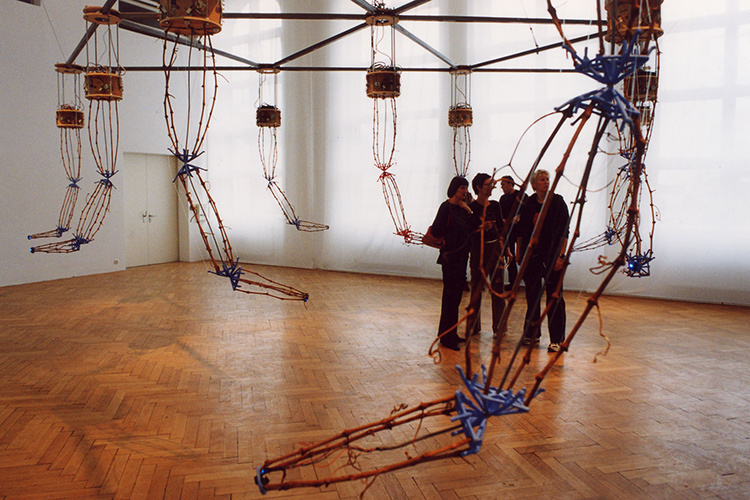
Ken Rinaldo creates the interactive installations of autonomous environmental systems and explores the connections between natural, natural and technological systems. It is known for the work of “Autopoiesis” - a robotic sculptural installation created for the “Alien Reason” exhibition in Kiasma Museum in Helsinki, which was the famous media armyologist Erki Khukhtamo, in 2010. The installation consists of 15 robotic sculptures interacting with the public through infrared sensors and changing their behavior in accordance with this interaction.
5 books for acquaintance with scientific art
Historical excursion into the problems of the synthesis of science and art. The text is important, first of all, because the meaning of Leonardo da Vinci cannot be overestimated in either scientific or cultural context. And it seems to me that it is especially important right now - at the moment of return to the concept of a “universal person” - to rethink both this concept and the experience of a brilliant inventor and artist. The formal boundaries between science, technology and culture are unequivocally erased-not only specialists engaged in the field of Sincert, but also ordinary people feel it.
Oliver Grau is a German philosopher who is now working in Austria. He is engaged in both the history of media art and early Italian art - for a long time Oliver studied how science, technology and art were united historically. A large block in this book is dedicated to architectural and engineering, as well as immersive traditions. When you read the book, there is a voluminous idea of how interdisciplinaryness passed through the centuries and what significance this heritage has for contemporary art history.
In this author's selection, Art + Science presents almost all key authors of various genres of scientific art. An important source of knowledge for those whose professional activity is associated with the synthesis of science and art. The encyclopedia was published in 2010, so there are no later works and new authors there. Only classic!
A unique two -volume publication for Russia, which contains a large number of art history and theoretical texts. Its compiler is one of the largest Russian theorists and curators Dmitry Bulatov, who helps his readers to make a thorough idea of scientific art, especially the biort. For me, the second volume is of particular importance where exceptionally interesting texts of the theoretical nature are collected.
One of the classical works that reveals the main changes in the thinking of modern man that have occurred throughout the 20th century. Suitable as basic reading for a mass reader, because it is very easily perceived by any person with any level of training. The text demonstrates a synthetic, interdisciplinary way of thinking. From the point of view of history, this is a very important era for a Russian person - the era of key achievements. After reading the book, we can understand that the tradition of experiment and invention is inextricably linked with a humanitarian study.