
Translated material
"The idea of monkey ancestors does not belong to Darwin"
Alexander Sokolov, editor -in -chief of the Anthropogenesis.ru website, collects and disassembles the arguments of people who are injured by the idea that a person came from a monkey. His book “Myths of Human Evolution” was published by Alpina Non-Fixes; Colta .ru publishes several fragments from it.
Myth No. 2. Most of the fossil evidence of human evolution - fakes.
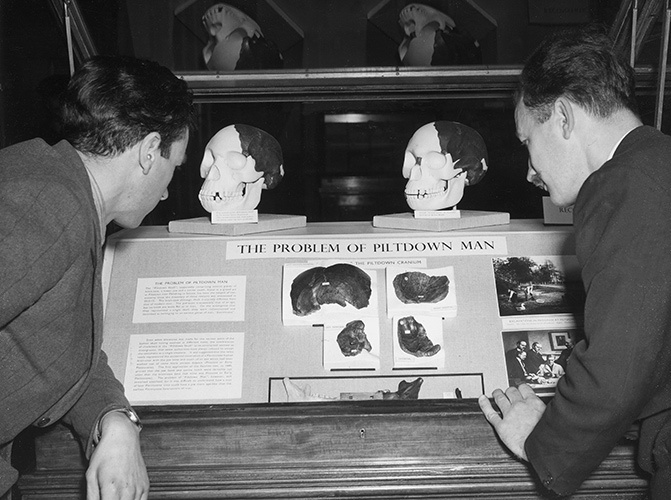
Yes, the fake of “fossil evidence of human evolution” is known. One. This is the famous Piltdaun skull. The history of the Piltdown fake is repeatedly described in the literature (including Soviet). The find was made in 1912, exposed in 1953. The fragmented skull and the lower jaw of the “very first Englishman” were found in Piltdown (England). The found creature was described as an eoanthropus dawsoni - "Man of Dawson." It was assumed that this ancient ancestor of a man lived in England a million years ago. After 40 years, it turned out that the skull belongs to a modern person, and the lower jaw - an orangutan with sawn teeth.
So, this story itself is, and there is a powerful propaganda myth created around it by fighters with science. Part of this myth sounds like this: after1912, for as long as 40 years, “the find was not seriously criticized,” and “everyone stubbornly considered the fossil of genuine.” “Since 1953, and until 1953, all monographs, textbooks and encyclopedias explained to the reader what important place the Piltdaun man occupies in the evolutionary history of modern man,” writes, for example, Nathan Avizer, professor of physics of the University of Bar-Ilan and anti-evolutionist, in the book “Faith in the era of science”. It immediately follows the conclusion: if all experts in the world were so easily inflated and led by the nose for decades, there can be no talk of any scientificity of anthropology!
Let's clarify the situation.
1) With a special pet, the skull was treated in the UK (but what: after all, the first Englishman!). Outside of its borders, many experts were not at all enthusiastic about the "man of dawn." Look, for example, what Soviet anthropologists wrote about the eoanthop. Here are a few indicative quotes - pay attention to the years.
“Around this“ man of dawn ”numerous disputes caught fire. Some scientists proved that such a creature with a monkey lower jaw and a human skull could be; Others objected and said that they found the remains of two creatures here: firstly, a person who lived in post-studio time and was not different from the present people; And, secondly, monkeys, very similar in chimpanzees, which lived within England much earlier-at the end of a tertiary time, which means even before the onset of glaciers.
All these disputes have not yet been completed, and there is still no final solution to the issue of this interesting find. ”
Gremitsky M. The origin of man (1925)
***
“Also, the skull of the so -called Pildaun man, recently found in England, stands apart: with the high development of the cranial arch, he is equipped with a jaw, very close to the jaw of chimpanzees; Since the skull and jaw were found separately, there was doubt about their belonging to one organism. ”
Milkovich N. Life and History of the Earth (1928)
***
“This paleolithic person represents a great riddle if you attribute the remnants of the skull and the lower jaw of the same being that is disputed by many.”
Pavlova M. Paleozoology (1929)
***
“The lower jaw that caused in recent years, which was found in the alloy layers of gravel, is probably pleistocene age near Piltdown in England, or the so -called Piltdown Unterkiefer) , according to Herritis Miller , 1915). Belongs to the "ancient chimpanzee". "
Weber M. Primati (1936)
In the textbook of anthropology edited by V.V. Bunaka (1941 of the publication) on 350 pages to Eoanthropus is given one single paragraph in the notes to the description of the Heidelberg jaw:
“Eoanthropus dawsoni, from which in England in 1911 and in 1915, was attributed to Eoanthropus Dawsoni . the remains of two skulls were found; The lower jaw found together with the first skull, according to G. Miller, belongs to the “ancient chimpanze” (Pan Vetus) . ”
Bunak V., Nesurkh M., Roginsky J. Anthropology (1941)
So, the fact: there were no unanimous delight of scientists about the eoanthropic. From the very beginning, many experts doubted the authenticity of the “man of dawn” - he really stood out against the background of the rest of the finds.
2) Before discussing the fools-anthropologists who were circled around the finger, it is worth considering that at the beginning of the 20th century. Paleoanthropology was just formed as a science. There were catastrophically few materials for comparison; Scientific methods for analyzing finds still had to develop. Of course, this should be added to the great desire of the English scientists to provide humanity with “noble origin” certainly within the vague albion.
It was the development of natural science methods that allowed in the middle of the XX century. Bring mystifiers to clean water. After all, the fluor dating method helped to expose a fake, shortly before that proposed by Anthropologist Kennet Nastya. This method is not very reliable, but it allows you to approximately assess the antiquity of the bones. The fluorine test showed that the Piltdown skull cannot be more than 50,000 years old. Further chemical analysis helped to establish that the jaw, most likely, is generally modern.
In the "origin of species" the author does not concern the topic of the origin of man. The diplomatic and cautious Darwin perfectly understood that he had come close to a very sensitive topic.
So the new tools designed to serve anthropologists helped to open the fraud. And it was the widespread use of such (only much more advanced) techniques that made a repetition of Piltdown history impossible.
Since then, for more than 50 years, not a single anthropologist has been using a skull from Piltdown in his constructions. For what? Other materials found are more than enough. The story of Eoanthropus continues to chop mainly "fighters with Darwinism." There is probably nothing more to trash ...
Another thing is interesting: why are fakes and hoaxes are still found in a variety of areas of science at times? After all, paleoanthropology is not in this regard in some special case. The reason why a scientist can stand on a slippery path of deception is a little -studied topic. Apparently, several factors should converge together:
- young, recently formed scientific field;
- The object of the study itself is difficult to vulnerable - is located, as they say, at the limit of measurements;
- There is a certain fashion, a request of society for opening.
If there is a request - there are adventurers from science ...
Let's look at a few curious examples.
Example No. 1. Paradise birds
On September 81522, the ship “Victoria”, who was considered to be dead, arrived in Seville - the only surviving ship from the Magellan flotilla. The sailors of Victoria brought with them the skin of birds of extraordinary beauty, donated by the captain of the ship to the Moluccian sultan. The outlandish birds were nicknamed "paradise birds." Their origin for a long time remained unknown (now we know that they live in New Guinea). The collectors were ready to pay fabulous money for the scarecrow of an amazing bird. Well, then:
“Traders and drugs cleverly used this demand. And now in the collections there are old skins skillfully made up of feathers and pieces of skin of various species of paradise birds. So, the “white -winged paradise of the bird”, which was described in 1987, the English zoologist to the Latam, who got it into a scarecrow for his private collection, turned out to be composed of completely different species of paradise birds, with skillfully attached white wings. One particularly luxurious view from the collection of the Frenchman Levayan also subsequently turned out to be composite. This copy has a stomach, tail and beak from different birds. The magnificent flying feathers turned out to be artificially attached. ”
Grmykuk B. Australian sketches
Interestingly, the paradise of birds, guided by incorrect descriptions, made legless. When it turned out that they still had paws, the craftsmen began to attach the legs from galls or even hawks to the scarecrow of paradise birds ...
Example No. 2. Cardiff giant
Now get acquainted with the greatest archaeological mystification of the XIX century.
USA, 1866 George Hull, Tabachnik and Skeptic, came to the town of Cardiff (New York) for personal matters. In the church he has a dispute with a preacher, discussing the antediluvian giants. Seeing that the parishioners gullibly look at the preacher in their mouths, Hull is thinking of playing their compatriots, and even earn extra money on this.
And now Hull buys a gypsum block of more than three meters long, transports it to Chicago, where the sculptor and a stone he hired by him make the figure of a lying person in huge sizes. In order to artificially age it, the sculpture is shared with acid.
Some believed that in such a guise, only some God could come to Earth in antiquity. Others declared him a forgotten monument to President George Washington.
At night, the “giants” are delivered to Cardiff and buried on the farm of Newwell, the cousin of Hall.
In 191869, the giants “accidentally” found a well when digging a well.
“The very next day, the whole state of New York learned about the giant found. Thousands of people hurried to the farm to look at him with their own eyes. Opinions regarding its origin were divided. Some believed that in such a guise, only some God could come to Earth in antiquity. Others declared him a forgotten monument to President George Washington.
But there were more and more votes, claiming that we were talking about a primitive man who was petrified several millennia ago. "
Matveev G. American Goliath
This version prevailed. Thousands of onlookers flocked to Cardiff to see the “American Goliath”, and from each the owner of the find took 50 cents each! The giant from Cardiff made a lot of noise, visited several museums, and before the deception was exposed, the mystifiers earned $ 100,000 on the “antediluvian giant”.
Cardiff Giant is now in the Museum of the Cooperstown City Farmers (New York).
Example No. 3. Is not free from hoaxes and physics
At the beginning of the 20th century, after the opening of x -rays, a fashion for all kinds of radiation appeared. And in 1903, the famous French physicist Rene Prosper Blondlo said that he discovered new rays, which he called N -Racks. These rays allegedly emitted by some metals, when caught in the eyes, they could strengthen the ability of a person to see in the darkness and had other wonderful properties. Although a number of scientists were not able to reproduce experiments on the observation of N -Rap people, the French Academy of Sciences awarded the opening of Blondlo of a gold medal and a prize of 20,000 francs.
To clarify the situation, the outstanding American physicist Robert Wood came to the Blondlo laboratory. After several simple tests, Wood was convinced that n -rays are a fiction. This is how Wood himself describes one of the experiments:
“Then he showed me a weakly lit clock on the wall and tried to convince me that he could distinguish their arrows if he was holding a large flat file above his eyes. I asked him if I could hold a file over his eyes, since I noticed a flat wooden ruler on his table and remembered that the tree was just one of the few substances that had never radiated n -rays. He agreed. I felt in the dark a ruler and held it in front of his face. Oh yes - he saw the arrows perfectly. It also proved something to me. ”
This example shows that the authors of false openings can be sincerely mistaken. Apparently, Blondlo was confident in the existence of N -rays, and, according to some reports, he continued to believe in them and 20 years after the exposure made by Wood.
Resume
Perhaps every large new area of science, growing from the diapers, should pass “Baptism by a large hoax” - and be cleansed. One such large mystification was in the history of paleoanthropology. Fortunately, it has long been exposed - and, which is characteristic, not marginals and sectarians, but by the efforts of the scientific community itself.
Myth. Most part of the fossil evidence of human evolution - fakes.
Refutation. Only one fake of this kind is known - Eoanthropus, the "Piltdaun man." Mystification was possible at the dawn of the formation of paleoanthropology, when the knowledge was scarce, and the research methods were still formed. The development of science has made a repetition of history with an eoanthropic impossible.
Myth No. 7. If evolution is reality, there should be millions of skeletons of human ancestors.
Mr. Skeptic grunts contemptuously: think, several hundred finds! Everything around should be littered with skeletons of the missing links. We must walk on them! “Darwin wrote about this” ... And on the basis of a few fragments separated by thousands of years, build your hypotheses!
Let's count. And take a prosaic object for an account - a house mouse. After all, you constantly find skeletons of house mice in your garden. No? Strange ... Look: the female a house mouse brings 5-10 marks of 3-12 cubs in each year. In six weeks, each cub already reaches puberty and can bear further. As a result, after 12 months there are already tens of thousands of them - small gray beasts that can multiply and multiply!
Simple calculations lead us to the question: where are millions of mouse skeletons in the territory of any Russian village? Someone will object: the bones are small, fragile ... Okay, and where did the millions of skeletons of the GNU antelopes go, which should be dotted with African savannah in Serengeeti? Even now, despite the active economic activity of a person, more than a million of these large ungulates live there.
If the skeletons of all animals were preserved after their death, it would be impossible to live because of the multi-meter layer of bones that would cover the surface of our planet.
Of course, a person is not a mouse, but not an antelope of the Gnu. The fertility of humanoids is generally small. The population density (judging by modern hunters-gatherers) up to the appearance of agriculture was very low-obviously less than one person per square kilometer, and the number of all of mankind did not exceed several hundred thousand.
O'Kay, the opponent continues to persist, so where are the bones of these hundreds of thousands?
But if the skeletons of all animals were preserved after their death, it would be impossible to live in view of a multi -meter layer of bones, which would cover the surface of our planet ... In reality, a tiny part of the remains remain in the ground; In most cases, the bodies are pulled out and eaten by scavengers, and the remaining - including bones - is absorbed by bacteria and mushrooms, is eliminated and eroded.
In order to preserve at least something, the remains must be buried quickly-this happens if, for example, the animal is drowned in a swamp or was under a layer of volcanic ash. But in this case, the process of destruction continues.
David Lambert in his beautiful popular book “Preistorical Man” gives an example that shows why the remains of our ancestors are difficult to find and why they are often fragmentary:
- Here are the remains of the deceased hominids are tormented by scaders - vultures and hyenas;
- the remaining bones crack in the sun and are pulled by animals;
- If the body lay on the banks of the river, then when lifting the water level, the bones are covered with sediments; In this case, water takes away teeth and small fragments downstream;
- If then fragments of the bones are exposed as a result of changes in the river bed, then they are again subjected to the sun and destroyed by winds and rain before anthropologists find what remains ...
Of course, if the body is not abandoned to the mercy of fate, and carefully buried by fellow tribesmen, the chances of preserving sharply increase. But only Neanderthals began to bury their dead - and even that is far from always.
By the way, we were very lucky that the ancestors of a person lived in the savannah and near reservoirs. They would have lived in the forests - a line with two paleontologists would have found so much! In the forest, the body often, as a rule, remains on the surface and decomposes completely; And in those places where forests still exist, for obvious reasons, it is extremely difficult to excavate. That is why we know little about the evolution of our closest relatives - gorillas and chimpanzees - inhabitants of African forests.
Now the methods of searching for fossil remains are being improved, and paleontologists work more and more carefully, and therefore there are more finds, and their safety is better. Technical sophistication of researchers is amazing. So, in 2008, Australopithecus Sediba in 2008 allowed the popular Google Earth service: using a satellite card, several hundred previously unknown karst caves in South Africa were revealed. In one of them - Malape - and found skeletons of two hominids. And how many caves are still waiting in the wings!
Resume
It is necessary to thank fate, as well as the intuition and perseverance of scientists that so many were found! And wait for new amazing finds.
Myth. If evolution is reality, there should be millions of skeletons of human ancestors.
Refutation. After death, the body, as a rule, completely decomposes (including bones). The remains of ancient animals that paleontologists find are rare luck; This is only possible thanks to special burial conditions.
Миф № 13. Главная идея Чарльза Дарвина — что «человек произошел от обезьяны».
Именно за это Дарвина клеймили больше всего: выводили в образе обезьяны на злобных карикатурах, предавали анафеме в религиозных журнальчиках. Однако идея об обезьяньих предках человека принадлежит не Дарвину. Об этом почти ничего не говорится в его главной работе — книге «Происхождение видов путем естественного отбора», и вовсе не в этом заслуга великого натуралиста.
Мысль о том, что предком человека является древняя обезьяна, за полвека до Дарвина высказал другой отец биологии — Жан Батист Ламарк, автор первой законченной теории эволюции. В своей книге «Философия зоологии» в1809 г. (год рождения Дарвина!) Ламарк пишет:
«Допустим в самом деле, что какая-нибудь порода четвероруких — вернее всего, совершеннейшая из них — отвыкла в силу тех или других внешних условий или по какой-нибудь иной причине лазать по деревьям и цепляться за ветви задними конечностями наряду с передними; допустим далее, что особям такой предполагаемой породы приходилось в течение целого ряда поколений пользоваться задними конечностями только для ходьбы, не употребляя на это передних. Несомненно, в этом случае — согласно с приведенными наблюдениями в предшествующей главе — наши четверорукие обратятся в конце концов в двуруких и большие пальцы на их задних конечностях перестанут противопоставляться остальным, так как эти конечности стали служить им только для ходьбы.
Допустим далее, что данные особи, побуждаемые потребностью господствовать и видеть вдаль и вширь, употребят усилия стоять на одних задних конечностях и будут неуклонно придерживаться этой привычки из поколения в поколение; несомненно, их задние конечности мало-помалу примут строение, необходимое для поддержания тела в приподнятом положении, и получат икры; тогда одновременное пользование при ходьбе задними и передними конечностями будет для наших особей очень затруднено».
Ламарк Ж. Б. Философия зоологии, т. 1.
Впрочем, на поразительное сходство человека и человекообразных обезьян обращали внимание еще античные мыслители — например, Аристотель, писавший в IV в. до н.э.: «Некоторые животные обладают свойствами человека и четвероногих, как, например, пификос, кебос и кинокефалос…». Пификос, или питекос, — бесхвостая обезьяна, кебос — мартышка, кинокефалос — «псоглавец» — возможно, павиан.
Дарвин же впервые предложил внятный и обоснованный механизм эволюционных изменений. В книге «Происхождение видов» эволюция объясняется просто и убедительно. Виды изменчивы, каждая особь чем-то отличается от других представителей вида. Ресурсов — пищи и половых партнеров — на всех не хватает. Возникает естественный отбор: более удачные экземпляры выживают и размножаются, неудачные — отбраковываются, вымываются из популяции хищниками, болезнями, конкурентами за пищу. Таким образом, вид меняется; возникают новые формы.
Как уже говорилось выше, в «Происхождении видов» автор не касается темы происхождения человека. Дипломатичный и осторожный Дарвин прекрасно понимал, что подступил вплотную к очень щекотливой теме. Хватит уже того, что он покусился на идею творения всего живого. Если бы Дарвин сразу «рубанул сплеча», современники могли поступить с его теорией так же, как в свое время с идеями Ламарка, — счесть очередным сумасбродством, предать анафеме или просто проигнорировать.
Дарвин, представьте себе, щадил религиозные чувства людей своей эпохи! Потому говорил об эволюции на примере голубей, вьюрков, черепах, медведей, пчел и цветковых растений… Но деликатно умолчал о венце творения — человеке.
Resume
Myth. Главная идея Чарльза Дарвина — что «человек произошел от обезьяны».
Refutation. Эта идея была высказана до Дарвина другими мыслителями. Главная заслуга Дарвина — в формулировании базовых механизмов эволюции всех живых существ.
Отсутствие в наиболее известной книге Дарвина высказываний о человеческой природе послужило почвой для следующего мифа.
Миф № 14. Чарльз Дарвин нигде не утверждал, что «человек произошел от обезьяны»!
«Дарвин был, между прочим, человеком глубоко верующим, получил духовное образование, и даже в “Происхождении видов” есть абзац, восславляющий Творца. А крамольную мысль об обезьяночеловеках ему приписали злобные атеисты».
Как часто бывает в «городских легендах», в предыдущем высказывании правда переплелась с вымыслом. Давайте отделим одно от другого. Чарльз Дарвин действительно окончил духовное учебное заведение — колледж Христа в Кембриджском университете. Но, увлекшись естествознанием, предпочел накатанной дороге служителя церкви тернистый путь исследователя-первопроходца. И, разумеется, эволюционные взгляды не снизошли на Дарвина внезапно в результате откровения, а формировались в течение многих лет наблюдений за явлениями природы, опытов, сомнений.
В своем знаменитом «Путешествии на корабле “Бигль”» (в первом издании 1839 г.) Дарвин еще позволял себе высказывания о «животных, каждое из которых получило при сотворении особого рода организацию» (курсив мой). Дневники Дарвина дают отчетливую картину эволюции его взглядов и убеждений. Впрочем, в наши цели не входит анализ биографии Дарвина. Принципиально здесь следующее: да, «Происхождение видов» — не об истоках человеческого рода. Этому вопросу Дарвин целиком посвятил другую книгу, которая так и озаглавлена — «Происхождение человека и половой отбор». В этой книге, вышедшей в1871 г., автор пишет прямым текстом:
«Если допустить, что человекообразные обезьяны образуют естественную подгруппу, то, зная, что человек сходен с ними не только во всех тех признаках, которые общи ему с целою группою узконосых, но и в других особенных признаках, каково отсутствие хвоста и седалищных мозолей, а также, вообще, по внешности, — зная это, мы можем заключить, что человечеству было дано начало некоторым древним членом человекообразной подгруппы. Мало вероятия, чтобы один член какой-либо из других низших подгрупп мог посредством аналогичных изменений дать начало человекообразному существу, сходному в столь многих отношениях с человекообразными обезьянами. Нет сомнения, человек пережил громадное количество видоизменений, сравнительно с большинством своих родичей, как видно из значительного развития его мозга и вертикального положения. Тем не менее мы должны помнить, что он представляет лишь одну из нескольких исключительных форм “приматов”. <...>
В классе млекопитающих нетрудно представить себе ступени, ведущие от древних птицезверей к древним сумчатым и от этих — к древним предкам живородящих млекопитающих. Мы можем подняться таким образом до лемурных, а от последних уже невелик промежуток до обезьян. Обезьяны разделились с течением времени на две большие ветви: обезьян Нового и Старого Света. От последних же произошел в отдаленный период времени человек, чудо и слава мира».
Видимо, после триумфа «Происхождения видов» автор счел, что время пришло. И опять оказался прав, обозначив и ближайшего родственника человека — шимпанзе, и наиболее вероятную нашу прародину — Африканский континент.
Впрочем, к этому моменту о происхождении человека от обезьяны уже открыто говорили и писали другие ученые. Например, более решительный соратник Дарвина Томас Гексли издал в1863 г. книгу «Место человека в природе», целиком посвященную нашему родству с человекообразными обезьянами. Годом ранее, готовясь к циклу просветительских лекций, Гексли писал жене о своих слушателях: «К пятнице каждый из них вполне проникнется сознанием того, что он обезьяна».
Resume
Myth. Чарльз Дарвин нигде не утверждал, что «человек произошел от обезьяны»!
Refutation. В книге «Происхождение человека и половой отбор» Дарвин прямо пишет о наших обезьяньих предках.