
Translated material
Blessing Gagarin
Many were surprised by the message about the initiative of the Perm prosecutor's office, which announced the intention to contact the local diocese of the Orthodox Church in order to get a conclusion on whether the “feelings of believers” are touched by the work created on the wall of one of the houses by local artist Alexander Zhunev. It has already happened more than once that representatives of the Russian Orthodox Church initiated administrative and even criminal proceedings against cultural figures, accusing them of violating these very feelings. Often, although not always, state authorities accepted the point of view of angry priests and “Orthodox activists”.
Now a new precedent has been created: although no representatives of any religious structures, at least in public space, did not speak out against the work of Alexander Zhunov, the prosecutor’s office in Perm turned to the Church with a request to “give an assessment” to the work of the work. This work, entitled "Gagarin. Crucifix", now, by the way, exists only in photographs, as if it were created not a few weeks ago, but once in the Middle Ages.
Alexander Zhunev is a well-known street art artist who began to work in Perm even before the already rolled “cultural revolution” began there, the driving force of which was Marat Gelman and his team, sent as far as Russia began to rally around traditional “spiritual bonds”. For five years, residents of Perm have been seeing a huge portrait of Sergei Yesenin, drawn by Zhunov at the end of one of the unfinished five -story buildings. His other work, on one of the city fences, repeats Pushkin’s famous self -portrait in the profile, and “our everything” rhetorically dating: “Will Pushkin will repair the road for you?” This picture was even shown on the air of local television as an example of the manifestation of civil initiative in relations with the municipal authorities - according to the artist, the road that was impossible to ride on was soon repaired.
Before Zhunev was not persecuted for any of the works he created; None of them was destroyed - neither in Perm or its environs, nor in other cities, from St. Petersburg to Salavat in Bashkiria, whose space the artist changed his work. Zhunev is not a political activist, his persecution is an act of glaring precisely because it is not about the “professional oppositionist” from any side, but only about a young artist who has a civil position; And this right - the right to express a civil position - Zhunev (and is one of it?) Trying to deprive.
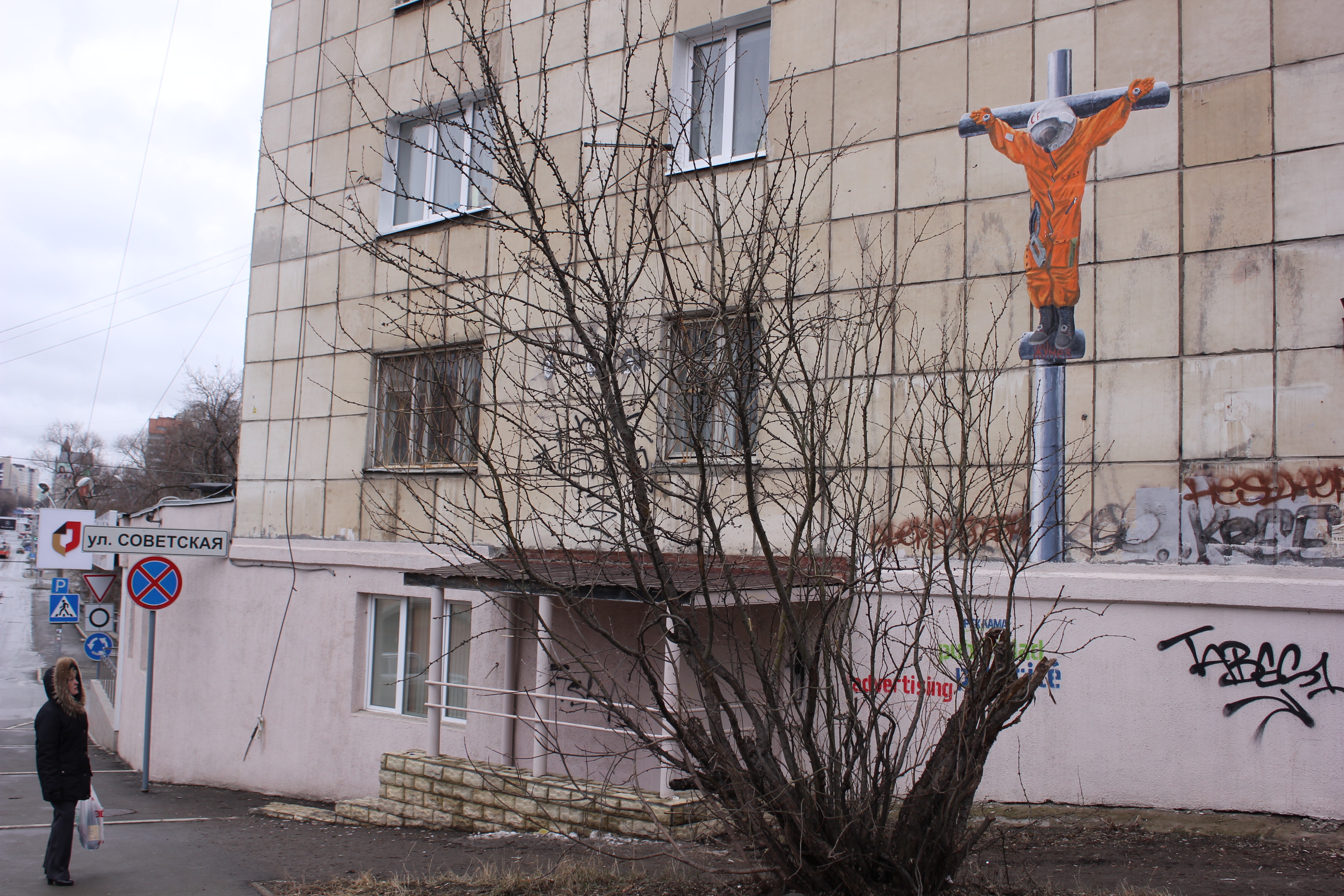
Alexander Zhunev, "Gagarin. Crucifix"
Describing his work, Zhunev says : “As of April 12, 2015, two large holidays immediately accounted for: the day of astronautics and Easter. The work“ Gagarin. Crucifixion ”is my attempt to talk about this centuries -old confrontation with the language of contemporary art.” Not only the topics raised in this work, but also the method of their artistic implementation continue the long -standing tradition in Russian art. It is enough to recall in this connection the “Crucifix” photo collage, created back in the mid-1980s Wagrich Bakhchanyan, where the Order of Lenin was “mounted” in the place of Jesus’s head, as well as the “myrrh-bearer” by Alexei Knedlyakovsky, created at the end of February 2012, depicting the crucified Pussy Riot activist. This system of images was also developed by Russian street art artists: the crucified woman poples and the inscription "Patriarchate kills-the Church approves" were applied by the ZOA Art group on the wall of the house near the Prince-Vladimir Cathedral in St. Petersburg in November 2011.
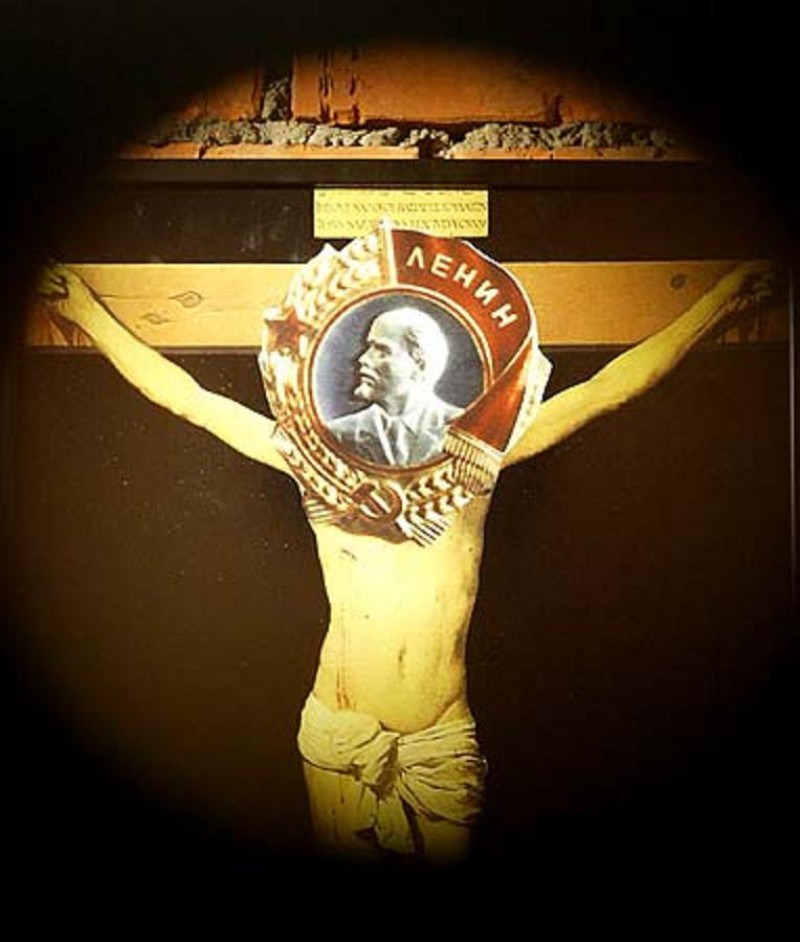
Vagrich Bakhchanyan, "Untitled"
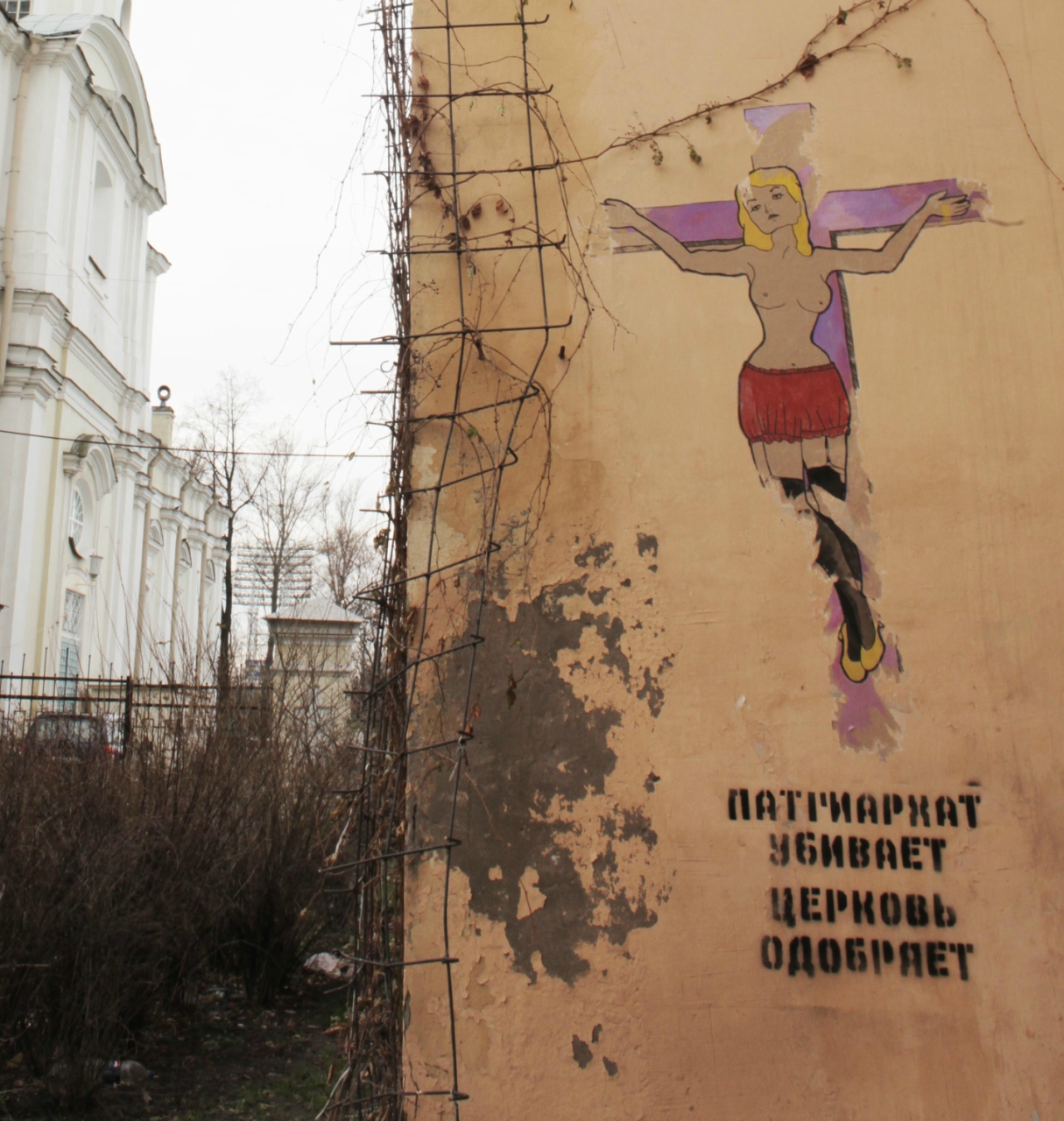
Zoa Art, "Patriarchate kills-the church approves", St. Petersburg, 2011
It is not unique to turn the artist to the image of the astronaut in a socio-political context-it is enough to recall in this connection the work of a talented graphic artist Alexei Jorsha "Happy Cosmonautics Day!", Awarded in 2013 of the Russian activist art alternative prize. The work of Jorsha, like the work of Zhunev, focuses on the changes that have occurred in the understanding of what role science and a thirst for knowledge in Russia play: once for imitation, admiring the heroism of millions of people, were “conquerors of space”, and now their names are almost unknown, while “astronauts” are called police officers who overcame protest rallies.
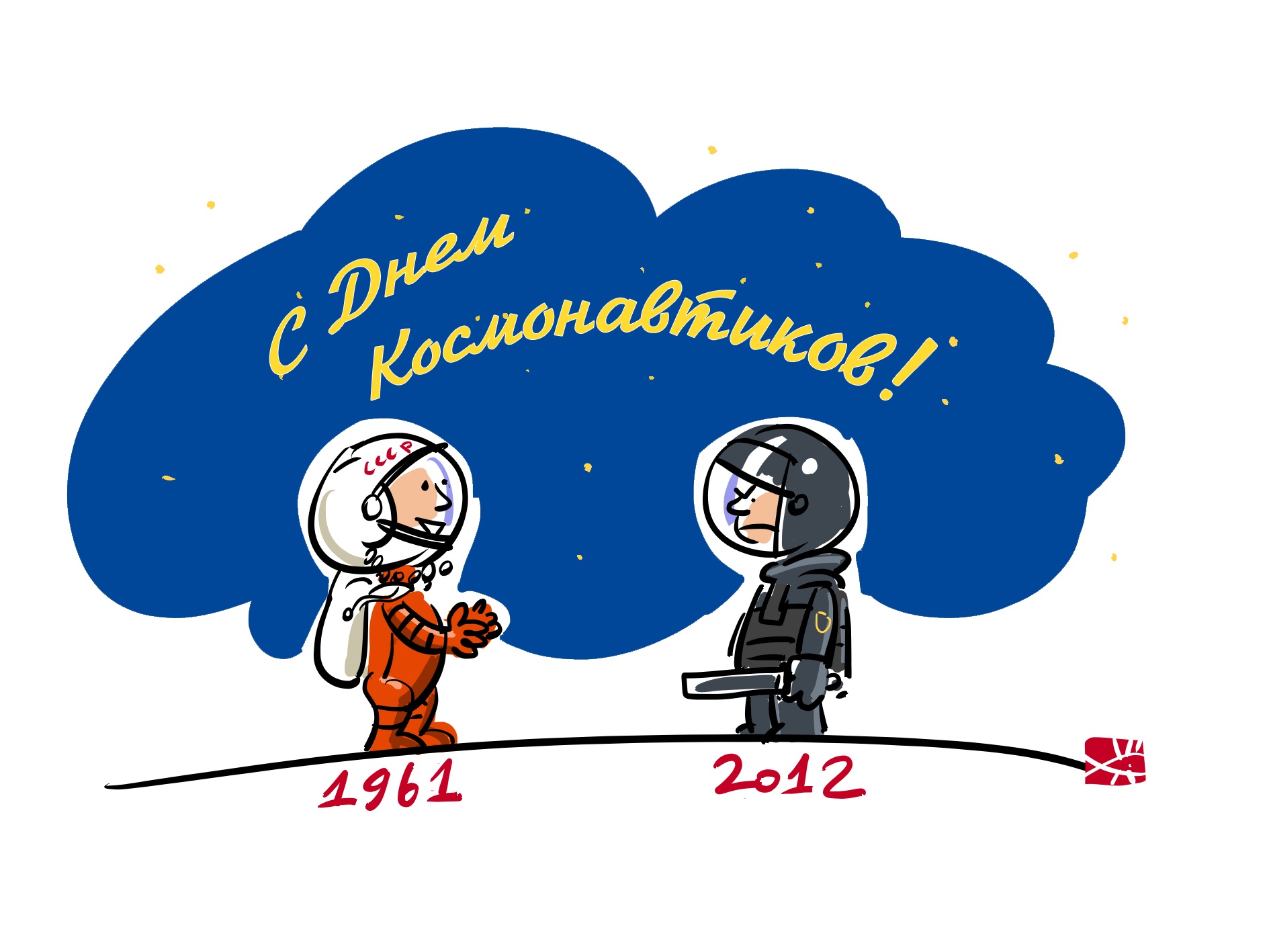
Alexey Jorsh, "Happy Cosmonautics Day!", 2012
The work of Zhunev also reminds of what: what used to be told by Gagarin’s life, and today the lives of Jesus and Christian saints are taught. By the way, the house on the wall of which Zhunev created his destroyed work is located next to the former missile school; In the same quarter there is a Holy Pre-General Cathedral, in which for many decades there have been a Perm art gallery, and in the neighboring bishop's house-a local history museum. In 2008, the Museum of Local Lore was evicted, in 2010 the cross was again hooked on the bell tower of the cathedral, the building of which was also returned to the Russian Orthodox Church, although the new place for a significant collection of the art museum was never chosen.
With his work on the wall of the Zhunev building, freely or involuntarily, he also reminded of the homeless Perm museums - from the building of the river station the Perm Museum of Contemporary Art was also evicted. The photograph of the destruction of the work of Zhunev, made by the Perm photographer Maxim Kimerling, looks doubly symbolic: the flight of Gagarin into Cosmos was the second, after the Great Victory, the basis of the Soviet heroic-patriotic ethos, but today from the wall of the house on Sovetskaya Street, the communal worker scraps the image of Gagarin and his helmet with the inscription "USSR". We still see the remnants of this inscription in the photograph - realizing that in a matter of minutes, if not a second, they will disappear irretrievably.
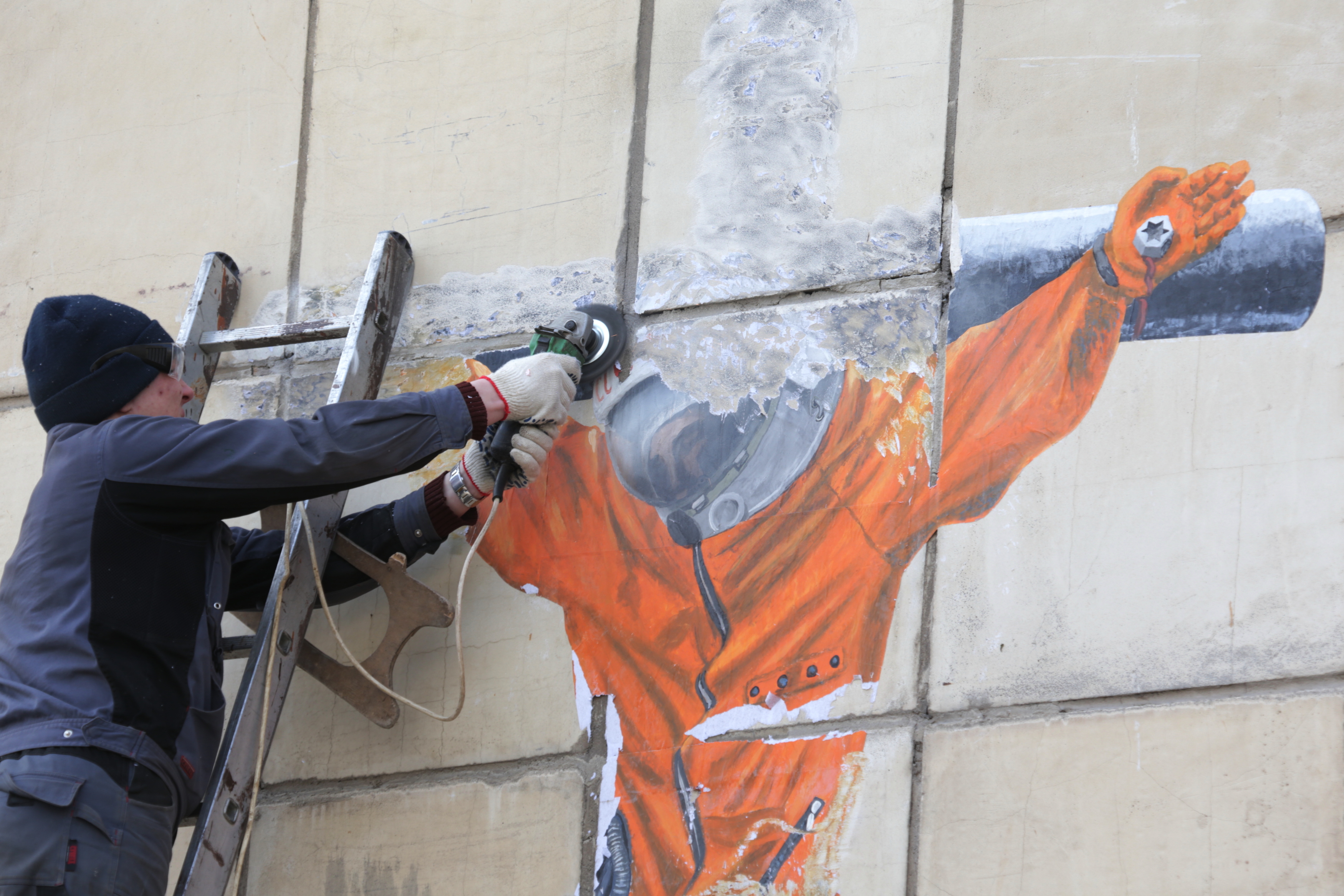
Destruction of the "crucified Gagarin". Photo by Maxim Kimerling
Either in a joke, or seriously, Zhunev notes the similarity in the methods of mastering space by church figures and street artists. Just as the cross established in a completely arbitrary cross immediately gives sacrificness to the “place of its deployment”, delicitimizing in this place any possibility of conducting an atheistic nature, and the work of street artists is largely aimed at “capture” of urban space, which, however, artists manage much worse than church hierarchs. The twelve -meter portrait of Yesenin, created by Zhunev, the owner of the building regularly hangs with advertising banners. Both businessmen and government representatives in our time rarely attempt on "church property"; It is hard to believe that someone would dare to smear the crucifix, draw him Junev on the same wall according to the adopted Christian canons. However, there is no one to protect independent art, especially raising civilian themes. Artistic officialdom-and dozens of "creative unions" in Russia today-with "these hooligans" does not want to have anything in common, but for officials, the development of actual art in the world is hardly at least anything knowledgeable, all this is just what needs to be "crushed and not letting in."
Countless times quoted the position of the Constitution, according to which Russia is a secular state. I am writing this column, being in France, for a century of serving as an exemplary example of a secular state, however, in this country, almost the entire calendar of official holidays is religious, and these days even in small cities and villages of the Church are filled to capacity. Today's world is complicated and contradictory, and, perhaps, you can’t call any country to the full extent of secular. The proportion of people who believe in one or another God or gods in all countries exceeds the number of atheists and agnostics. At the same time, it is extremely important that each of the spheres exist autonomously, without imposing its values and pictures of the world to the rest.
Moreover, practically no modern state is monoconfessional, and in the Russian Federation four religions are considered "traditional". Inside each religion, there are confessions and currents that sometimes adhere to very different doctrines, including on central issues. In this regard, it is completely incomprehensible why the issue of crucifixion is addressed to the Russian Orthodox Church, and, for example, Catholic or Protestant priests - it is obvious that no monopoly on religious feelings associated with the crucifixion of Christ, it is the Orthodox who could not. The fact that the number of adherents of Orthodox Christianity in the Perm Territory is obviously larger than the number of adherents of other Christian denominations cannot be of decisive importance in this regard, because religious feelings are not an indicator, measured quantitatively.
If the prosecutor’s office is so interested in the opinion of the work of Zhunev of the Perm Diocese of the Russian Orthodox Church, it is reasonable to expect both the same issue to representatives of other Christian faiths. Considering that in the art of the Western world, the rethinking of Christian symbols and plots is one of the constant motives, it is difficult to imagine that the adherents of Christianity of the Western rite in Russia can feel offended by the work of a similar plan. Since different believers in the same Jesus will come to various opinions regarding the admissibility of work similar to this, the situation is at a dead end. And this means: works of art created outside the sacred space of chapel houses should not in principle be convicted by criteria, exclusively for chapel houses suitable.
In the end, there is no reason to believe that the Orthodox Church would support - turn to it for advice - and Gagarin’s flight itself into space. As we recall from Soviet atheistic literature, the argument that "the astronauts who visited space did not find any God," was repeated repeatedly. But the priests, fortunately, did not ask to bless the flight of Gagarin. However, the picture in the center of which is depicted by Gagarin, it is they who should recognize either the permissible or “illegal” - yes, it was the legal plane that came into the legal plane after the adoption of the Federal Law “On Amendments to Article 148 of the Criminal Code of the Russian Federation and individual legislative acts of the Russian Federation in order to counteract the insulting religious beliefs and feelings of citizens”.
This is said many times, but this must be repeated again: a society that judges civilian artists as criminals and hooligans, has lost its way. The prosecutor, who announced the intention to forcibly deliver the artist Zhunev for interrogation, is fatally mistaken in terms of what public interests he is designed to protect. There is an absurd situation in which church figures are asked to be experts on issues that are obviously hostile to them, while considering these "examinations" in the literal sense of art critic in civilian clothes.
Alec Epstein - historian and sociologist
Opinions expressed under the heading "Law" may not reflect the point of view of the editorial office