
Translated material
New Union of the opposition
The non-playing opposition announced the new alliance: six parties are ready to operate a united front in the regional elections in September 2015 and in the elections to the State Duma in 2016. What are the chances of unification in the regions, does it make sense to participate in the elections and what the opposition offers the elites - the New Times sorted out
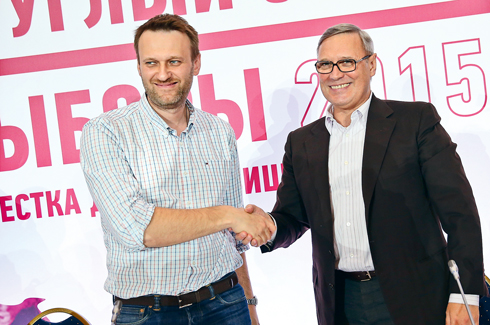
Alexey Navalny and Mikhail Kasyanov signed an agreement on the coalition, Moscow, April 18, 2015
We go to the State Duma, ”Aleksey Navalny announced in a briefing in a briefing on April 22. Together with the Party of Progress, this is a project of Navalny-the RPR-Parnas, “Democratic Choice”, “Civil Initiative”, “Party December 5” and “Libertarian Party” decided to enter the democratic coalition. “Open Russia” Mikhail Khodorkovsky also declared her support. The fund, not being a political organization, cannot directly participate in the coalition, but Khodorkovsky emphasized that he sees two tasks: providing honest elections and assistance to candidates in the formation of a political program. But the key structure here, of course, is the RPR-Parnas: due to the fact that the murdered Boris Nemtsov was a member of the Legislative Assembly of the Yaroslavl Region, the coalition will not need to collect signatures to nominate his candidates for the State Duma elections in 2016.
The declared goals
“We announce that we will organize (in September 2015. - NT ) six election campaigns in three areas - Novosibirsk, Kostroma and Kaluga, as well as elections in cities,” Navalny told reporters. According to him, the design of the coalition is simple: the promotion of "good" people in the field through party structures. As a filter mechanism - primary elections, primaries. According to their results, a “folk list” will be compiled, which will be able to receive support and political representation in the legislative bodies of the regions. “This should not be a list of Moscow politicians, these will be people in the field,” Leonid Volkov, a member of the Central Council of the Party of Progress, in a conversation with NT , emphasized. “We will invite and wait for a response from local activists who are ideologically close to the coalition.” Volkov emphasized that there will be no “steam locomotives” - politicians who are not going to work in the position for which they are elected in the lists.
Volkov, a well-known IT-shnik, in the past-a deputy of the City Duma of Yekaterinburg and the chief of staff of Navalny in the elections of the Moscow Mayor in the summer of 2013, gained federal fame after organizing electronic elections to the coordination council of the opposition in 2012. Here is exactly this experience - electronic voting - it proposes to use for primaries. Its plan is as follows: “Candidates will be presented on a special site. On the day of the primaries, online and offline voting will be held. On the eve of the elections, debate will be organized between candidates who will also be broadcast to the network, ”Volkov said to the magazine.
So far, the coalition resembles an umbrella structure: the federal center, headed by the Council, which includes representatives of several parties, and branches in the regions. There is no single program yet: it will be prepared together for the 2016 parliamentary elections, said Navalny at a briefing.
Elite menu
Many of those with whom NT spoke emphasized: the opposition were rallied by the tragic death of Boris Nemtsov. The new union is a serious application for access to the legal political field, to the transition from games to politics. The games ended when one of the most famous Russian oppositionists was killed a few hundred meters from the Kremlin. Alexei Navalny also said this at a briefing: "After the death of Boris, everything accelerated."
Of course, the participants of the alliance themselves, and observers realize that there are no special chances for passing into parliament - even if representatives of the non -systemic opposition will be allowed to the election, which is not obvious, then they will not allow you to win for sure. But the elections are always a critical moment, the period when the maximum number of people begins to be interested in politics, and in the power elites you can wait for surprises.
And it is no accident that Navalny refuses to talk about a single program so far. Now it is necessary to show cautious representatives of oppositional elites a spectrum of opportunities that critics of the authorities offer. And the faces here are more important than words. Navalny-the most popular of opposition politicians, deliberately sacrifices part of his popularity, entering into an alliance with Mikhail Kasyanov (RPR-Parnas), who in the eyes of many is an official who, for various reasons, fell into the disgrace of Putin.
But for the elites of Navalny, a not always understandable and potentially dangerous vault, promising to plant corrupt officials (that is, every second of the same elite), the leader of the rebel street, while Kasyanov is an experienced manager, the premiere of the most successful government of Putin’s era, obviously not configured to “take away and divide”. Andrei Nechaev (“Civil Initiative”) is a former Minister of Economics, then a banker who is deeply versed in the intricacies of the Russian economy. Vladimir Milov is a short -lived deputy minister of oil and gas, an expert in the field of the fuel and energy sector, but who supported the coalition Mikhail Khodorkovsky, not only the former owner of the country's largest oil company, who knows how to speak the same language, but also a person with an experience of 10 years in prison, whose courage is recognized even by his opponents. In addition, serious financial resources are behind him (according to various estimates, Khodorkovsky’s control may have about $ 2 billion). “This is an old story: in Russia, the opposition program is replaced by faces,” says political scientist Gleb Pavlovsky.
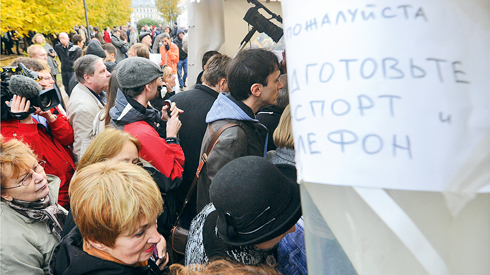
Elections to the Coordinating Council of Oppositions: Voter Registration, Moscow, October 21, 2012
Regional context
In 2015, local elections will be held in 16 regions. According to Leonid Volkov, each of these regions was considered on several points: an electoral history, the cost of conducting a campaign, the level of political culture, the statistics of falsifications, the presence of strong potential candidates and the percentage of the urban population. Based on the results of the study, Kaluga, Kostroma and Novosibirsk entered the TOP - this rationality determined the choice of the regions in which the United Opposition is going to participate. “From the point of view of electoral history and competition, this is the right choice. And Novosibirsk, and Kostroma, and Kaluga are regions with sufficient electoral potential, ”says a specialist in electoral behavior, political analyst Alexander Kynev. However, it is impossible to make forecasts, because much depends on how the elected campaigns are organized: the coalition has too few local activists, you will have to negotiate with promoted people in the regions, and what will come of it - no probabilistic schemes cannot be counted.
Prochrevsky political strategist Oleg Matveychev believes that the new opposition coalition has no resources in the field at all. “People who head the departments of these parties on the spot, or those who want to help them are absent as a class. They are somewhere, but they have nothing to do with the local elite, ”he told the NT correspondent. But Kynev believes that the primaries can help in solving this problem: “Two problems are solved here - to attract attention and attract new figures. As a mechanism for searching for primaries can work. ” Matveychev did not agree with him radically: “The primaries is an extra opportunity to accuse the party of all kinds of manipulations. This is a completely opaque story. And if they make primaries, then they themselves will seduce themselves with shit. ”
Parliament -2016
As for the elections to the State Duma in 2016, the opinions of experts coincide: the democratic coalition will have to seriously compete for their electorate with parties that declare similar democratic slogans. “15 % of the population are ready to vote for liberals now. This includes the “right business”, and “civilian platform”, and “Apple”. This is a serious problem, ”said Konstantin Kostin, chairman of the board of the civil society Development Fund, who in the past oversee the presidential administration issues of domestic policy.
The democratic coalition is not the first joint project of an unsystematic opposition. But this time, liberals set themselves more complex tasks: Navalny and his colleagues offer two -level elections in the field. The primaries will help the Alliance understand how wide the electoral capabilities in the regions are in principle. And the elections - how much support of oppositionists on social networks can be transformed into real votes in polling stations, said Konstantin Kostin.
Overboard
As always, the Yabloko party remained in a special status, which already habitually refused to enter the opposition coalition. The current party leader, Sergei Mitrokhin, explained his next “no” by the fact that the party that entered the coalition did not agree with the platform proposed by the “Yabloko”. Among the points named by Mitrokhin, “the complete rejection of nationalism and other human-naval ideologies, the rejection of the annexation of Crimea, and the failure of the economic reforms of the 90s” were marked.
In a conversation with NT, Mitrokhin, however, said that he did not want the alliance of the fate of the “Committee-2008”, “National Congress”, “United Committee” and other unsuccessful coalition projects of the opposition. “We ourselves will enter the polls in 2016. So we will meet in the new State Duma, where everyone will create his own faction, ”the politician, whose batch in the past parliamentary elections of 2011 received 3.43 %optimistically summed up.
The politician Ilya Yashin, who was expelled from Yabloko, who, together with the Movement of Solidarity, supported the new coalition of opposition forces, believes that “no” “Yabloko” is by no means the result of ideological disagreements. “The reason is in the relationship of the top of the party with the presidential administration. AP has enough formal and informal levers of pressure on the apple, ”says Yashin. According to him, the financing of Yabloko from the federal budget is a serious question: “Now this is being done by law, but one amendment to it, which United Russia can carry out, and there will be no financing.”
Despite all the disagreements, there is a potential for unification, according to another apple tree, Viktor Sheinis, a former long -term deputy of the State Duma. “Between the“ Yabloko ”and the rest of the democrats, the Mezha laid. But there are positions from which you can and should negotiate, ”he says.
Surprisingly, in the ranks of the new coalition there were no Gennady and Dmitry Gudkov expelled from Fair Russia. “We, in principle, support such a decision. But now there are meetings related to the direct formation of lists. And we do not participate in this meeting, apparently, the parties are invited there, and Dmitry and I (the son of Gennady Gudkov.- NT ) is not in the party, ”said Gudkov Sr. NT . Irina Prokhorova supports the association, until recently, one of the most striking leaders of the Civil Platform party: “I will be very glad if a new wave of such a political association ends in something good.” However, she categorically refused to build any forecasts. The current head of the party Rifat Shaikhutdinov, answering NT questions, said that "the coalition would not affect the distribution of votes in the upcoming federal elections."
Photo: Anton Novoderezhkin/TASS, Sergey Fadeichev/ITAR-TASS