
Translated material
They took it to kill him
Documents about the execution of the poet Federico Garcia Lorca are declassified
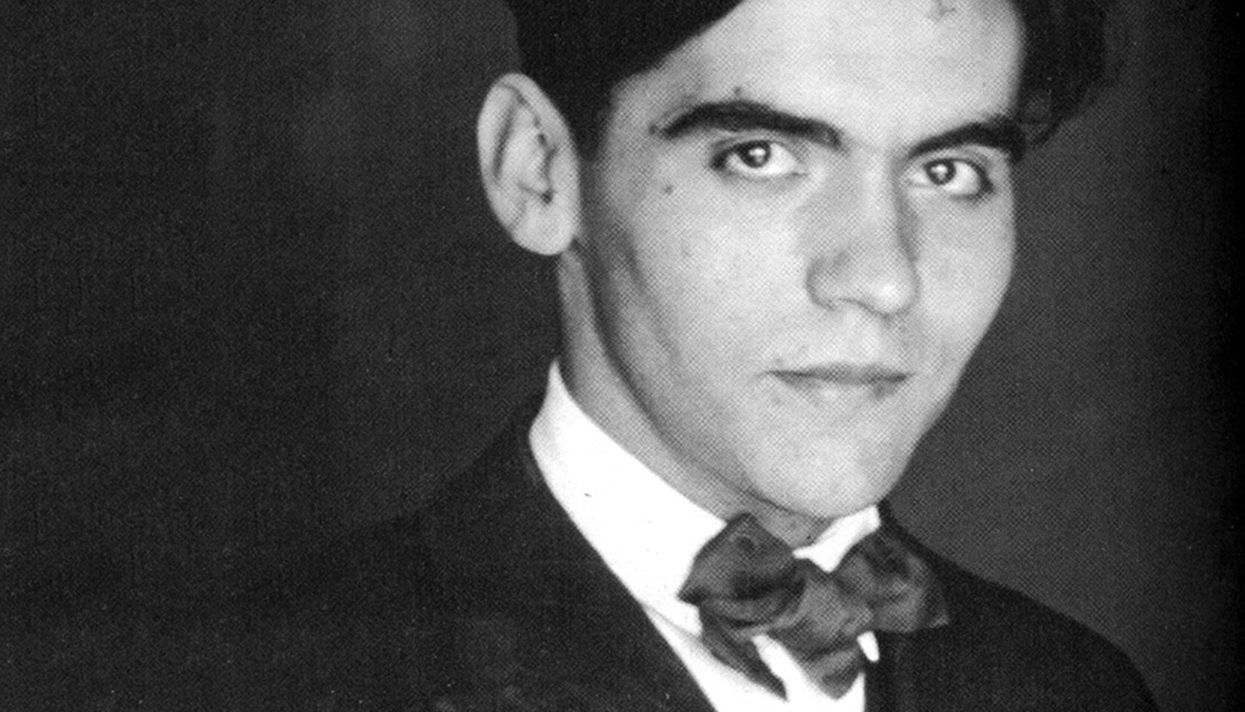
On April 22, the Spanish Broadcasting network of Cadena Broadcasting published previously unknown documents from the archives of the main police department of the Granada regarding the circumstances of the arrest and execution of the poet Federico Garcia Lorca in 1936. The published papers taken from the police officer in the Lorca case dates back to 1965 and are a response to the request of the French writer Marseille Halates made at the Spanish Embassy in Paris. The bar, which worked on the book “Life and Death of Garcia Lorca” (1968), did not receive a report from the embassy. These documents about the events of August 1936 were the first official confirmation of the military regime involvement in the execution of the poet. At the request of Medusa, the content of documents was studied by the Spanist philologist Irina Ershova (RSUSU).
The outstanding Spanish poet, playwright and prose writer Federico Garcia Lorca was one of the key figures of the second generation of Spanish intellectuals of the 20th century - the so -called "generation of 27 years." The writers, artists and composers belonging to him were united by liberal views, as well as similar cultural and literary guidelines. Lorca became famous early both in Spain and far beyond its borders; Among the friends and admirers of his talent were Pablo Nerud and Herbert Wells, Salvador Dali and Luis Bunuel, Manuel de Flya and Juan Ramon Himenes. The death of Lorca shocked the whole country - repression, first of all, affected the intelligentsia, and the death of the poet became a symbol of the spiritual catastrophe of the nation.
What was known about the death of Lorca
The scandal and indignation caused by the disappearance of Lorca after leaving Madrid to his native Granada immediately gave rise to many questions to the military authorities of Spain. At the same time, the newspapers loyal to the Francists in September-October 1936 published knowingly false information about the random death of Lorca in Madrid, Barcelona and, finally, Granade itself. The scandal did not subside and gradually acquired an international character. In an interview with the Mexican newspaper, La Prensa of November 26, 1937, Franco said the following: “Abroad, they talk a lot about one writer from Granada, whose genuine talent is not given to me how to judge how widely spread out of Spain about him, he remained alive, because the Reds used his name for his propaganda. However, the fact remains: at the first moments of the uprising in Granad, this writer died, as he contacted the rebels. These are ordinary accidents that are inevitable in the course of hostilities. Granada for a long time was in the siege, the crazy actions of the republican authorities, who distributed weapons to people, led to a number of skirmishes in the city, in one of which this granadian poet died ... So remember once and for all: we did not shoot any poet. "
The last month of Lorca’s last month of life looks as follows. In July 1936, just on the eve of the Civil War, a poet, concerned about growing tension, decided to go to the family in Andalusia in the Urta de San-Ventse estate. Literally three days later, a military rebellion began, and the power in Granad passed to the military and phalangists. Lorca, who sympathized with the Spanish left and republican authorities, had friends from the phalanx and among the monarchists. Alarmed by searches at home, he decided to hide with his friend, poet Luis Rosalez, whose two brothers were prominent phalangists. However, on August 16, Garcia Lorca was seized by gendarmes and, as they believe, were shot at dawn on August 18.
The political motives of the death of Lorca were obvious to many who wrote about his death, but the Irish researcher Yang Gibson “Granada of 1936: the murder of Federico Garcia Lorca” (1979) in his book (1979) in his book. Gibson came to Granada in 1965, interviewed many contemporaries of the events of August 1936 and compiled a detailed picture of the last days of the poet’s life. In particular, he outlined the alleged place of execution (near the town of Visnar) and wrote that Lorca was shot along with two Torero and old-teacher.

Request from the bar, the response of ministers
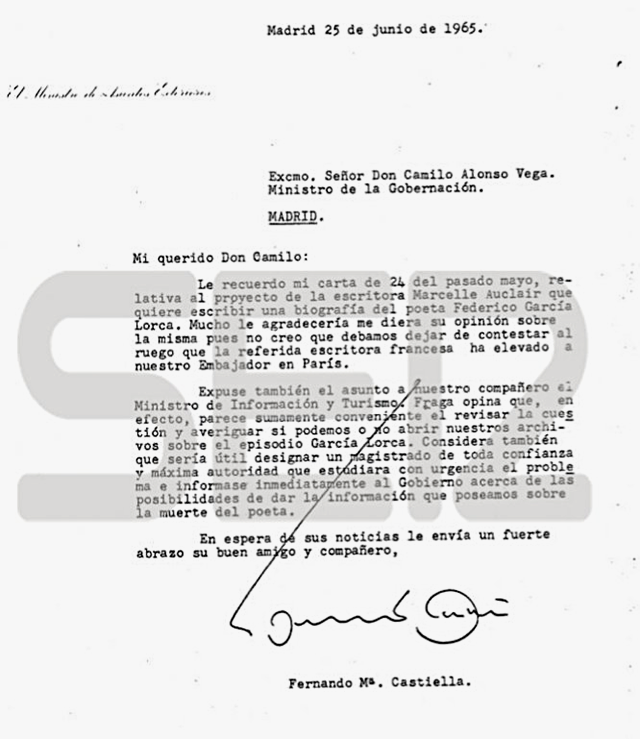
Marseille Haler (1899-1983)-a writer, a journalist and researcher of Spanish poetry-met Lorka in 1933 in the Toleled estate of the doctor Diego Maranenon “Villa sorrows”, where the poet read to his friends the “bloody wedding” just written. The impression of acquaintance with Lorca and his work later resulted in a desire to write a book and find out more about the circumstances of his death. Unsuccessful searches (while arriving in Spain in 1964) prompted her to apply to the Spanish embassy in Paris in the name of Foreign Minister Fernando Maria Kastieli. He, in turn, entrusted the case of the Minister of Internal Affairs Camilo Alonso Vega, having previously consulted with the Minister of Information and Tourism by Manuel Frag Irista.
Among the documents published in April 2015 there are letters from ministers. So, for example, Castelia wrote a note to the Minister of Internal Affairs, in which he conveyed the opinion of Manuel Fraga about the need to “appoint an official reliable and endowed with all powers” to clarify the circumstances of the death of the poet and a report about them to the government, as well as with a request “to clarify whether we can or not open the archives in the case of Garcia Lorca.” In a response letter, Alonso Vega expressed doubts about the need to dig a “Lorca case” and suggested that they “do not have the opportunity to give an official version of how this event happened.” The report was eventually made, but never transferred to the writer.
What is said in the police report
The police report published by Cadena SER consists of two pages of typewritten text and was compiled by employees of the 3rd regional department of the Main Police Department of Granada on July 9, 1965. The report says about the unreliability of Lorca, who was considered “a socialist because of the nature of his speeches and the connection with Fernando de Los Rios and other important persons of the same political affiliation”; It is also called “Mason, attributed to the bed of the 'Algamb and where he accepted the symbolic name Homer," although the degree of his participation in the bed is unknown. In addition, the report says that Lorca "was seen in the occupation of homosexuality, a deviation that has become well -known, although there is not a single particular case of accurate data."
The police report also sheds light on the sequence of events: frightened by two searches in his house, Lorca really sought shelters on the estate of his friend, poet Juan Rosalez and his brother. The house where Lorca was located was surrounded by “as a result of a large operation carried out by the police and the assault guard” (refers to the police of the Spanish phalanx). Lorca was arrested, and then “was taken out of the civil administration building and was taken by car in the Visnar district, where in the vicinity of the place known as Fuente Grande, along with the other detainees, whose personal circumstances were not known, was shot after he was recognized, and was buried - completely shallow, located in two kilometers from the right of the right from the right. Fuente Grande; It is very difficult to install a place more precisely. ”
Thus, if you believe the report, data on the number of people executed with Lorca, and an indication of the place of execution and burial of the body. In addition, it becomes clear that all the events essentially fit in one day and developed so rapidly that there was simply no time for the intercession of friends, family and a change in the situation.
In the 1965 report, all the actors of the arrest and execution of the poet are also called. Their names were known, but here they were first reflected in the official paper of the authorities. The report states that the CEDA Right Ramon Rumon Alonso, lawyer Juan Treskastro, Falangist Federico Martin Lagos, and still unknown - brought the poet’s arrest, and then, along with the gendarmes, went to detain him. Further from the report it follows that "he was taken to the civic administration of this province." The fate of Lorca immediately rushed to petition the head of the local department of the phalanges Jose Diaz, the Rosalez brothers, the police chief, as well as other friends and acquaintances of Lorki's families, who met with the civil governor of the province Huan Valdes Gusman (“Although they could not free him, they had nothing to threatens the lives of Federico”). The decision to shoot Lorca was made by Governor Valdeus Gusman, who supported the military - on the conscience of this particular person lies the destruction of hundreds of liberal opponents of the rebellion.

* * *
The words given in the police report confirmed the political background of the murder of Lorca and completely rejected the point of view of historians loyal to the Frankist regime about the personal causes of the poet’s death. The latter assumed that Lorca became a victim of clan contradictions between the landowning magnates of Andalusia.
In the Spanish newspaper El Pais, on April 23, Yana Gibson’s comment was published about declassified documents proving “that it was not a simple street murder, but his [Lorca] was taken out of the civil administration to kill him.” Gibson recalled that the report was mentioned, although not given, in the book of Eduardo Molina Fahardo “The Last Days of Garcia Lorca” (1983). Molina Fahardo saw these papers, but could not publish them. The phalangist on convictions, he tried to remove the accusations of the poet’s murder from the Francists.
Irina Ershova
Moscow