
Translated material
Diagnosis: sluggish crisis
About where the curve has yet taken out the Russian economy, why the ruble has become a currency of the dream and what are the chances of the future if Putin adheres to peaceful rhetoric
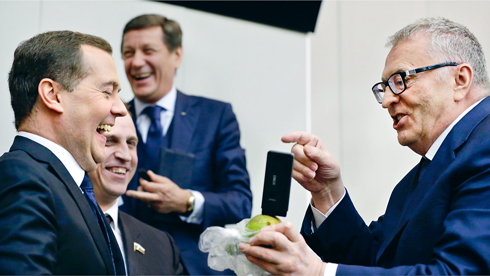
Prime Minister Dmitry Medvedev, after a report on the activities of the government in the State Duma with its vice-chairman Alexander Zhukov (in the center) and the leader of the LDPR Vladimir Zhirinovsky (right), Moscow, 2015
Only a month and a couple of reports of Rosstat were required for the mood in Moscow to change from murderous to excited ones. In mid-March, the subordinates of the Minister of Economics Alexei Ulyukaev, who brought a draft document from the proposals of the departments, entitled “The Main Areas of Government Activities” (ONDP), almost in desperation wrote about the “new growth model” of the Russian economy, which the government has to be implemented in the next two to three years, so that by 2018 it would somehow go out for a sustainable development path. Nothing fundamentally new, or at least, that the government has not known for the last ten years, has not been in the ONDP project, the “new model” required a sharp improvement in the quality of public administration, investment climate, respect for property rights, and reducing administrative barriers.
After a month, which went to coordinate this very ONDP in specialized departments, about the “new model of growth”, not to mention the inefficiency of the government, they forgot in the document - deleted. A little has changed in a month, but this was enough for the White House to decide: everything returns to the difficult but beautiful days of 2009, at the very moment when everyone understood, this is not a disaster.
And if this is not a disaster, then you can temporarily decide that this is a victory. Moreover, she is just in the yard.
Where the curve took out
In order for the government and the Kremlin to cancel continuous brainstormers with economists on the topic "How much more will we stretch?" And they took up the usual things - sowing under the leadership of the new Minister of Agriculture (a week ago - the heads of the Krasnodar Territory) Alexander Tkachev, bizarre Eurasian integration, toughening the fight against drug -defense and centenary of Konstantin Simonov - several components were needed.
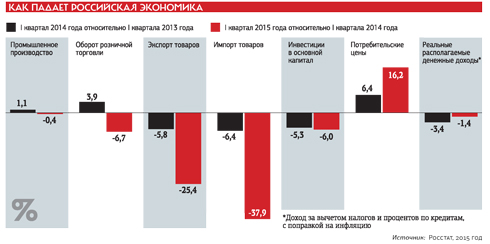
First of all, not so serious than expected, a decline in industrial production. The Rosstat report for the first quarter of 2015 is really quite interesting against the backdrop of the universal February-March expectation of immediate death. De facto for everything that took place in 2014-2015 in the real world-this is the Ukrainian war, sanctions, and international isolation-the economy actually responded with the collapse of investments at the level of up to 10 %, a moderate drop in private demand and real disposable income (mainly the consequences of the inflationary jump), a decrease in the revolution of retail trade and growth. savings. The latter can be interpreted as recognition by economic agents of the crisis as such. Although the hysterical wave of consumption in December-January lubricated this picture, both the population and private companies behaved in the first quarter as a whole as it is supposed to behave in the face of an inevitable decline: consumption is reduced, the norm of savings is growing.
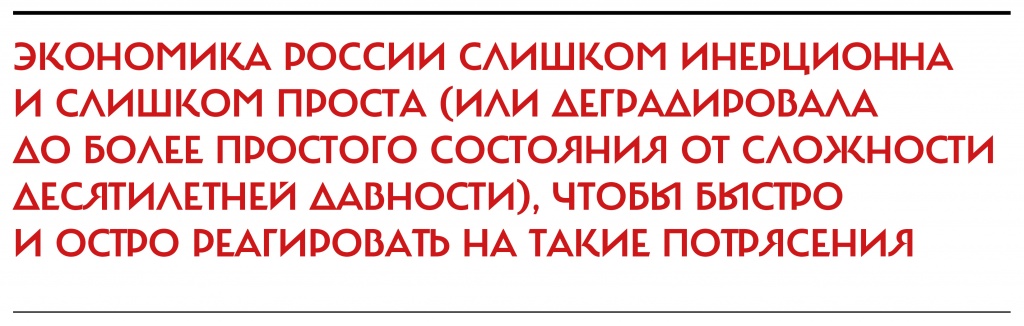
There are several explanations of how a country that has survived the strongest external shock over the past fifteen years, falling by tens of percent of export income, does not fail into an acute recession. All of them are more or less rational, but only post -facts are checked. The first and most obvious story: the Russian economy is too inertial and too simple (or degraded to a simpler state from the complexity of a decade ago) in order to quickly and sharply react to such shocks. In this case, the answer to the shock will be “smeared” in time, but it will take many years to get out of such a loss of growth rate. There are several more stories about how the government has found reserves for growth, but most of the resources that supported the economy since the beginning of the year are one -time.
In many ways, the prediction of the collapse of the Russian economy (including the author of these lines in the first numbers of NT for 2015) in the spring of 2015 were built on quite arbitrary assumptions that payments on a private external debt of $ 130 billion in 2014 and about $ 60 billion in 2015 are not able to take the means of refinancing, nor a financial system in the financial system in the Russian Federation Chapter with the Central Bank, who will not want to spend reserves on the salvation of industry.
Partly waiting for the disaster in the Russian economy were also caused by the fact that oil was cheaper. But then it stabilized about $ 60 per barrel. This scenario, as NT already wrote , was the most non -obvious scripts in the “bunch” with a different price of Brent, but it was he who was realized. It is difficult to predict oil prices, but so far it can be seen that, on the one hand, they are unlikely to grow strongly, and on the other hand, it is unlikely to fall much, because before the possible entry into the world market Iranian or American shale oil is still far - according to various estimates, on average about two years.
However, there is one circumstance that blocks all the boring and incomprehensible arguments of the pessimists, because it is clearly and irrefutable-the ruble is growing again.

A miracle about ruble
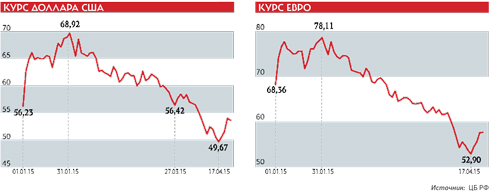
Strengthening the Russian ruble by 5-6 % in March looks like a miracle. However, for analysts of investment funds, the future correction of the ruble was predictable: for example, Bert Domen from Dohmen Capital openly wrote about this in Forbes back in September 2014, when the devaluation did not really unfold.
That Domen's note was devoted exactly to the fact that six months later it caused a splash in the Russian information market - an article by Bloomberg, which told about the Russian ruble as a potentially most profitable (as of the end of March) currency for Carry Trade. The name of this financial technology, which was most common in relation to the ruble after the 1998 crisis, was not transferred to Russian. In short: Carry Trade is when money is engaged in the currency of a country with low interest rates and invests in a country's bonds with high interest rates. In the case of Russia, it looks like dollar loans converted into rubles and spending on the purchase of OFZ (federal loan bonds) or ruble Eurobligations. From the point of view of the Carry Trade payment balance, it looks like a massive influx (if not, “raid”) of speculative capital, which forces the local Central Bank (in this case, the Bank of Russia) to fight the ruble strengthening and at the same time provide more ruble liquidity of the local banking system. Central Banks usually do not like Carry Trade-mainly due to the fact that it increases instability in the local financial system and contribute to greater than you could expect inflation. So, Carry Trade, and mainly carried out by Russian, and not foreign banks, is a completely understandable explanation for a stronger than forecasts, restoration of the ruble.
However, what is happening is the effect limited in time, especially since the same Bloomberg notes, in many ways it was provided with high banking rates of the Central Bank (the Bank of Russia was forced to raise rates in order to avoid the continuation of the devaluation in January, and the dependence of banks on the refinancing of the Central Bank does not make it possible to quickly reduce credit rates to customers) and - paradoxically - supporting Europe. After all, the second component of the “ruble miracle” - the program of the European Central Bank for the redemption of assets, which guaranteed for 2015 an abundance of almost free euros in the European banking system - they can be invested in rubles.
Finally, the second dollarization of the I quarter of 2015 nevertheless did not cancel either a sharp loss of profitability of almost any Russian business, not focused on export, or the collapse of the value of assets in Russia. It’s impossible to get out of Russian business without major losses, and in some cases it is impossible at all: there are simply no customers of ready -made businesses in the market, and for any money, state -owned banks are also not ready, unlike 2009, to engage in such charity. The "revolution" of companies, available to them at the junction of 2014 and 2015, was transferred to currency. Loans are expensive, but it is necessary to at least cover the current losses so that the business does not fall apart. Where to get rubles for this? It is known where: to convert a note of currency reserves.
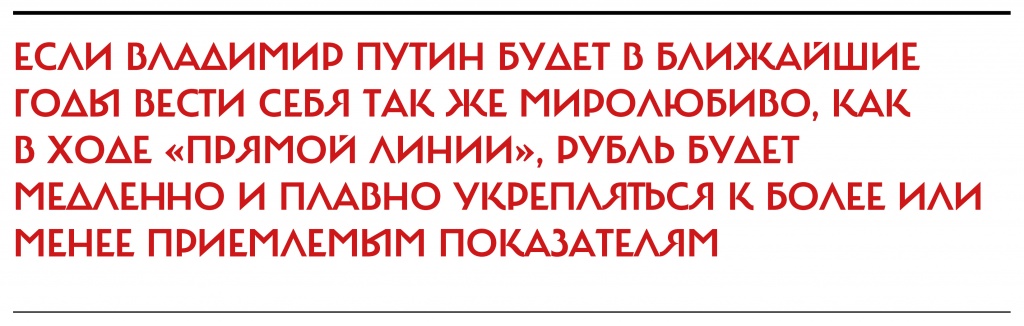
So against the background of a 5 percent reduction in retail turnover, the Russian ruble becomes a currency of a dream. At the same time, the answer to the question "How long?" - Uncertainly positive. The calculations of the Ministry of Economy show that if Vladimir Putin will behave as peacefully in the coming years as during the “direct line”, the ruble will slowly and smoothly strengthen to more or less acceptable indicators, although it will not reach pre -crisis hardness.
However, until that moment, the Russian economy should solve one problem - find investments.
Where did the money come from, Zin?
If we carefully consider the project of the “scenario conditions of socio-economic development of the Russian Federation” for 2015-2018-and this is the main budget forecast for the next three-year-old, then inconsistencies are obvious immediately.
On the one hand, the project says, it is necessary to spend money on “infrastructure projects” and other ways of maintaining state monopolies and private companies close to the state. On the other hand, due to a third of the budget revenues from raw materials exports and even taking into account the money of reserve and pension funds, as well as the national welfare fund and other near-budget reserves, the government will be able to carry out capital investments in the economy only at the 2014 budget level. The regions, which already in some horror survived the 2013 mini-crisis, are unlikely to support the current level of investment. The Ministry of Economy does not hide that in general, the state investment in 2016-2017 will be even less than in 2015.
Translated to public: there will be less money, but it needs more.
However, immediately the department states that next year, investments will recover from about the previous level and then begin to grow by 3 % per year. At the same time, not even fuel and energy Railways companies will be invested, but some private investors.

Moreover, these are AU, who are you? - Private investors will be mainly Russian, since both the forecasts of the Ministry of Economy and the calculations of the Ministry of Finance suggest: sanctions that impede these direct foreign investment in the Russian economy will not go anywhere in 2015-2018 - Russia still live with them. True, on April 23, the Ministry of Economy reported that the option is also calculated with partial cancellation of sanctions since 2016, but this is not the main, but an optimistic scenario. The large-scale investments of Iran, Venezuela, Cuba, or even our main European partners in the spiritual and economic revival-Greece and Hungary-there seems to be no reasons to wait, and China’s investment outside the TEK and border infrastructure projects are not yet observed in any significant volumes.
Therefore, investors planned by officials are all the same Russian businesses. That is, the people and companies, which in early March, looked at news feeds in amazement and quietly explained to everyone who wanted to hear that they did not understand what business in the current conditions can be discussed at all. The depreciated ruble and high credit rates are only part of their problems. They are also added to the final confidence that the government will not go to eliminate the unemployment hidden in the civilian (which means that the cheaper was the labor force will increase in price with a very limited proposal), will not solve the problem at customs, will not reduce taxes, will not have enough money to continue the necessary reforms.
All in the house
However, there is a version why the government is still waiting for the boat of private Russian investments in 2016. The government puts on the program of deofshorization, taxation of “controlled foreign companies” and “amnesty of capital”. The implementation of this complex of ideas will begin, in the second half of 2015. If the further aggravation of relations between Russia and the West is converted into limiting the possibilities of investing from Russia to the West (this is not a quick process, but it is inevitable - the capital, ready to conquer the whole world in words, are poorly accepted by the countries of a potential enemy), the flow of “repatriating” in Russia through various channels of Russian capital is quite possible. The only problem is that because of the same exacerbation of relations with the West, the return outflow of private capital from Russia may be even more.
As a result, instead of the combat restoration of the economy according to the model of the besieged fortress “Russia”, we are most likely to state in the end of 2015 in a long -term economic stagnation. The heroic and terrible I quarter of this year threatens to replace the series of others - calm, without incident, without transactions, without profit, without changes, without prospects - a pure waste of time and resources wasted.
Photo: Anna Isakova/Press Service of the State Duma of the Russian Federation/TASS