
Translated material
The process of Tsarnaev: the subtleties of the procedure
The insulting gesture of a 22-year-old terrorist who shot a prison video camera can decide his fate
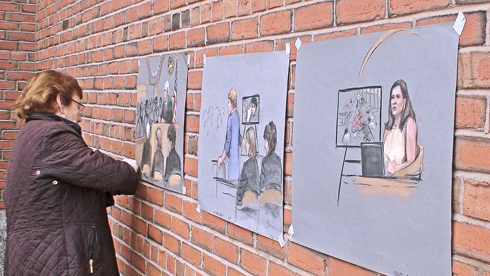
The author of the judicial sketch Jane Flevell Collins hangs his work on the wall of the court building.
The beginning of the second stage of the process over Johar Tsarnaev was postponed on April 21 by the decision of Judge George O'Tul - he went to meet the defense, which asked to postpone the court to have time to organize the arrival of all his witnesses to Boston.
The delay also meant that the beginning of the process would not coincide with the second anniversary of the attack, for which the jury condemned Tsarnaev (April 15), or with the Boston Marathon-2015 (April 20).
By announcing his decision to postpone the second stage, at which the same 12 Massachusetts jury and 6 spares will resolve the issue of punishment, O'Tul noted that in the past the indictments and the second stage of the process in the United States were often spaced in time. This stage, which is officially called the “phase of punishment”, greatly resembles the first (“phase of guilt”), although, as predict, it will be shorter than the first, lasting a month.
The accusation and defense made the introductory speeches in which the first asked for the death sentence, and the second - for life imprisonment. After that, the prosecution caused 17 witnesses and was rounded in the middle of the day on April 23.
The defense subjected the cross -interrogation of only one of the witnesses of the prosecution and will begin to call its own on April 27.
At the end of this, the mini-process, on which the norms of evidence, according to the law, are simplified compared to the “phase of guilt”, the parties will make the final speeches.
The prosecutors focused on the victims, and lawyers will call the friends of Tsarnaev, psychologists and other experts who will help them prove that their client was psychologically injured by their difficult childhood in Kyrgyzstan and Dagestan, and was drawn into the crime with his older brother Tamerlang, who died in a reserve with the police on April 18, 2013.
The factor of the place
Considering that the jury was scored from the inhabitants of the liberal Boston and the adjacent regions of Massachusetts, where the death sentence was last carried out in 1947, and in 1984 he was canceled completely, many predict that Tsarnaev would avoid meeting with the executioner.
Although the Bostonians were terribly injured by the terrorist attack on the marathon, the last survey of the local WBUR radio station showed that 61% of them would like to be sentenced to a life sentence. Only 26% prefer the death penalty.
The defense may now rejoice that all her attempts to transfer the process to another place were unsuccessful.
The law requires that the things that the defendant may threaten the highest measure to be considered only the jury, fundamentally not configured against such a punishment. Her convinced opponents are cut off. Therefore, the selection of jury in such cases is scrupulous and takes a lot of time. In the case of Tsarnaev, he took longer than the process itself.
The fact that his jury is not against the highest measure does not mean that they will necessarily vote for it. One, for example, noticed during the selection that "death sometimes looks like the easiest way out."
Observers do not exclude that he will want to say Tsarnaev not to death, but to decades of imprisonment in the federal prison of a super -strip regime in Colorado, where Viktor Butita Baron was almost exposed. At the last moment, he was saved by the liberal judge Shira Schendlin, who sentenced him to 25 years in prison.
Middle -aging jurk stated that she was in her youth against the death penalty, but over the years she began to find it more acceptable. The elderly jury spoke out on this subject completely vaguely and stated that her views on the highest measure were not completely settled.
It is not clear why the prosecutor’s office did not reject these three. These people inspire hope for the main defender of Chechen Judy Clark, who saved the life of all the fierce killers she represented.
She would be very happy if, in the main composition of the jury, there was a woman who stated that she was personally opposed to the highest measure, but will vote for her if the law demands this.
However, not even evening. This woman fell into the spare train and can still find herself mainly if the jury begins an epidemic.
Circumstances aggravating and mitigating
In their last word, the prosecutors will list aggravating circumstances, including the fact that Tsarnaev used weapons of mass defeat, committed a terrorist attack, previously prepared for it, deliberately killed or planned to kill more than one person, killed a particularly vulnerable victim (in this case, 8-year-old Martin Richard) and committed "especially terrible, cruel and immoral" Act.
Lawyers will list the mitigating and say that this is the first criminal record of Tsarnaev, that is, he is not a recidivist, that at the time of the attack he was only 19 years old, that he was mentally and emotionally unbalanced because of life's hardships, mentally underwriting, did not quite distinguish between good and evil and acted under “extraordinary and significant pressure”.
The latter is a stone in the garden of the brother of Tamerlan, on whom the protection will blame the main guilt for Johar entering the ranks of jihad.
“It is proven that Tamerlan made bombs that Tamerlan killed the police collier,” Clark said in her final speech at the first stage of the process, referring to the police, whom the brothers shot on April 18, 2013. “Tamerlan led, and Johar followed.”
“That day they considered themselves warriors,” said the prosecutor Alock Chakravarti. “They were Mujahides and moved their battle to Boston.”
Shocking evidence
The most important part of the work of prosecutors at the second stage of the process was the interrogation of the victims, who at the first repeatedly brought the jury to tears. They were also shocked by the performance of the last witness of the prosecution, the main patholoanatom of Henry Nields, who described in detail the wounds of 8-year-old Richard.
The boy’s stomach and spine were torn almost in half, the left hand was practically torn off, and the skin was covered with third degree burns. The juror was shown bloody snatches of his clothes and dumped a bunch of small nails, steel balls, pieces of wood and metal fragments extracted from the body of Richard, as well as a belt of one of the spectators of the marathon, from which the boy made a turnstile.
The jury had to survive similar indications again. The last was Steven Wolfenden, on April 23, who rolled a baby stroller in the video past the spectators of Johar in the crowd.
Soon after this, Wolfenden was on the sidewalk with his knee torn below and in vain tried to help his 3-year-old son Leo, who was lying nearby in a stroller with a bloodied head and flooded with a scream.
According to the witness, next to him Denise Richard, the mother of 8-year-old Martin, begged her son not to go into another world. Wolfenden looked at the quickly pale Martin and realized that he was not a tenant.
He took off his belt and dragged on his hip to stop bleeding. Another turnstile was imposed by a passerby who then took care of the screaming Leo. The boy had a crack in the skull, cuts, small burns and a bursting eardrum.
The first round - behind the prosecutor's office
According to the law, at the second stage, the judge gives the parties more will, however, it celebrates testimonies that, in his opinion, can excessively tighten the process, confuse the jury or mislead them.
At the end, the jury will say that they must decide which factors outweigh - aggravating or softening. With pharmacy accuracy, they did not come up with this way, so the solution is subjective.
The jury usually emphasizes that they are not obliged to say the convict to the highest extent. If they do this, the verdict will not necessarily be passed on the same day. This usually happens after two to three months. The death sentence should be disputed automatically, and the appeal can take several years, or even decades.
Federal death sentences are usually carried out in prison in the Terry-Hot town in Indiana through intravenous injection. In rare cases, judges manage that the suicide bomber is executed in some of the states in which there is a higher measure.
In the general opinion, the first round was now won by the prosecutor’s office, which showed a jury, in which Tsarnaev defiantly shows the middle finger of a prison video camera. This gesture is worse than Kukish and resembles a Russian slap on the bend of the elbow.
The media discussed him for a day in a row and noted that at the same time the prosecutor with the marvelous name of Nadine Pellegrini put on the review of the jurisdiction of large photographs of young people killed by the defendants.
“This is the whole Johar Tsarnaev! She remarked. “Not sympathetic, not repenting, not changing!”
Here, almost everyone decided that the jury, who sat all week in tears, unanimously sent Tsarnaev to acupuncture to Terry-Hot.
The exception was the left journalist Glenn Greenwold, to whom Edward Snowden merged a fair part of the secret documents stolen by him. Greenwoland writes on The Intercept that Tsarnaev’s face exposed at that moment not hatred and contempt, as the prosecutor said, but an ordinary boredom of a teenager from a long sitting alone.
Photo by Jane Flevell Collins