
Translated material
Sleep about the white ribbon
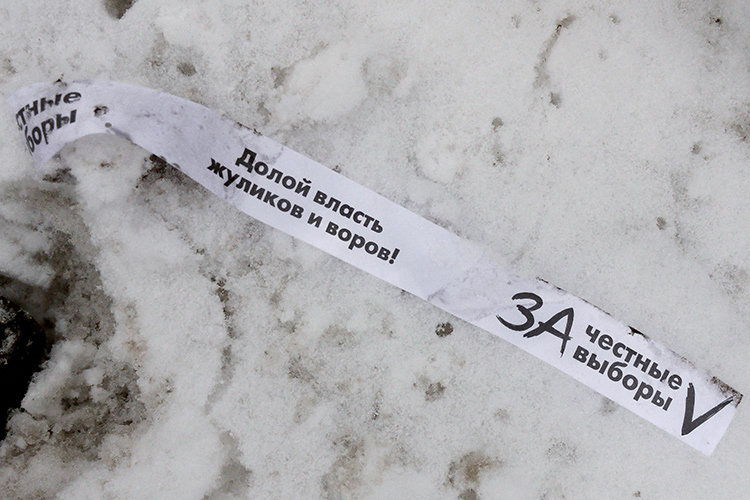
Come tomorrow, April 29, to show the first version of the film, Student Marina Razbuzhkina Masha Pavlova “Dear Uncle Vova”, about the prisoner of Bolotnaya Leonid Kovyazin and his family (as part of the Sinema Belief project ). We will continue the conversation about protest and its influence on society and individuals. You can get to the show at this link .
In 2012-2013, at least 15 times large contingents of citizens - from 30 to 50 thousand - in Moscow went to mass processions, and an attempt was made to create a protest camp on clean -up boulevard. May 6, 2012 - on the eve of Vladimir Putin’s entry into his next, “third”, presidential term - a mass protest rally took place, which led to the clash of demonstrators with the police. During this period, a rare situation of interaction between left, right -wing, environmentalists, municipal social activists, avant -garde artists, etc. arose. The coordination council of this new movement arose.
Although the media controlled by the Kremlin told the population that this COP is unpopular, the presidential administration knew that sociological surveys show an increase in influence. The Kremlin made a choice in favor of suppressing this movement, and not to include it in the political field. Despite the fact that all of 2013 the Kremlin took various measures of intimidation, in September 2013, one of the most popular leaders of this movement - Alexei Navalny - received more than 27% of the vote in the Moscow Mayor.
Now that this public climb in the past, the question arises: what was it at all? The answer to this question depends on the "side of participation." Let's start with the Kremlin. The Kremlin did not immediately decide in its assessment of the movement. At first, the Kremlin interpret the appearance of movement as a positive factor - “angry townspeople”, “new angry” were revealed. The "creative class" expressed its public aspirations. The Kremlin at that moment did not decide on the understanding of the movement that the head of the Just Russia Parliamentary Party Sergei Mironov appeared at a meeting of the parliament with a white ribbon on the lapel of a jacket. For some part of the establishment, the mass exit of the townspeople into the street was perceived as a result of the Medvedev “thaw”. It was assumed that this activity can be used by the reform system itself. The movement was conceived as a “thaw”, reformist. It remained a mystery that the “Staro -Ultsin” played in this movement, which Surkov, which is “Friedman and the oligarchs”. But all of them were publicly suspected of supporting this renovation public movement.
The institutions of "public reflection" made negligible content that comprehend the movement of the "white tape".
The line of Kremlin fluctuations regarding the “white tape” became May 6 - 12,000 policemen and fighters of the internal troops were pulled into Moscow to arrange a clash on the eve of the inauguration of Putin and rigidly show the Protestants the barrenness of their public efforts. After May 6, the active formation of a unambiguous Kremlin position began: the movement was entirely subversive, inspired by the West, and its participants were “enemies of the state”.
What did the movement itself think about itself? Attempts of self -description began immediately, in December 2011. It was evident that it contains two distinct large topics: dissatisfaction with the elections and dissatisfaction with the duration of Putin's reign. This was its main fuel between December 2011 and May 2012. Belarusians arose from the massive participation of citizens in the movement of observers in the elections and as a response to the “voluntarist” Putin decision to return to the presidency. That is, it was a movement for the “democratization of the system” and for the inclusion of “new dissatisfied” in the policy. This means that in the event of a victory, it would lead to more transparent elections and some change in the system of party representation in the State Duma and regional parliaments.
Now, after the Crimea, after the radical turn of Putin’s policy, many vectors of the then movement require a new understanding. Let's say there was an important dispute between the participants - whether it was necessary to go to Bolotnaya (behind Nemtsov and Parkhomenko) or to the area of the revolution (behind Limonov). It seemed to many then that the consent to go to Bolotnaya was a rejection of radical protest. Meanwhile, after Crimea, Limonov became the Podputin columnist of the Izvestia newspaper. While many protest participants are sitting, fled from the country, and Nemtsov was killed at all.
The 86 percent “postcrymist consensus” makes it possible to look at the events of 2011-2012. Many political historians believe that the Kremlin adventure in Ukraine is a direct consequence of the “swamp protest”: a small victorious war is arranged by the Kremlin in order to completely get rid of the consequences of protest, which threatened the system of personalist power by V. Putin.
Now that this public climb in the past, the question arises: what was it at all?
An interesting circumstance, the meaning of which is completely unclear: the institutions of "public reflection" made a negligible content that comprehend the movement of the "white tape". In Russia, even the final description of the entire history of movement did not appear. That is, there was not even a book like the journalistic chronicle of Sophia Koshkina about the Kiev Maidan. None of the leaders of protest wrote large memoirs applying for the creation of dominant discourse. Not a single research group published a large monograph about these events (with a few rare exceptions: collections of “Apolitical Politics” , “City Movements of Russia in 2009-2012” , “We are not NOM” . - Ed. ). Even artistic - both traditional and avant -garde - forms of rethinking protest were insignificant: neither a large exhibition, nor large -scale documentary films, nor attempts to artistic heroization of this resistance . As a result, there are several spot and chamber reflexive events - an album of protest slogans collected and published by V. Lurie (“ABC of Protest”), documentary films “Winter, leave!” and “term”, monograph by the sociologist M. Gabovich, working in Berlin (written and published in German). Of the best texts of Russian sociologists and philosophers, analyzing the protest of 2011-2013, not even a significant book was collected. An attempt was not made to make feature cinema, there is neither a script nor a novel written about these events.
The Kremlin won, the reformist movement was defeated, at the expense of the war in Ukraine a new patriotic consensus was created - and only journalists Konstantin Semin and Arkady Mamontov write the history of white -open protest. Their history is not much different from the criminal case of attempted on the foundations of the state system of the Russian Federation and an attempt to overthrow our “Caesar” by order of the United States.
The movement of the “White Ribbon” is undoubtedly one of the three or four most important events of the post-Soviet history of the Russian Federation, which generally determined the course of this history, led to the reduction of the political system and the vector of the entire society. Such events require great discursive efforts. They reveal whether society has generally reflective opportunities distributed in various formal and informal institutions - universities, scientific groups, publishers, art groups, etc. It turned out that Russian society has almost no such opportunities. Maybe they will appear later?