
Translated material
A magnificent eyewitness
An exhibition of the favorite of Nepman Moscow, Dandy Georges - George Yakulov opened in the Tretyakov Gallery
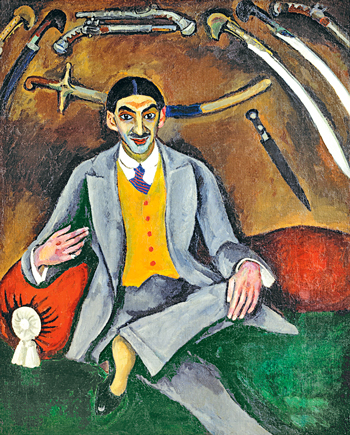
Portrait of Georges - George Yakulov’s brush Peter Konchalovsky,
State Tretyakovskaya Gallery, 1910
The brighter and more unusual the character, the more legends, rumors and gossip go about him. Only gossip remains from someone, from George Yakulov there were legends, and amazing, bright, emotional paintings. The exhibition was first collected 130 works by the artist from the collection of Tretyakov Gallery, the National Gallery of Armenia, the theater museum named after A.A. Bakhrushin, the Bolshoi Theater, the Literary Museum and private collections. The previous exhibition of Yakulov was forty years ago, that is, even in the days of the USSR.
On the attack with the cane and in white gloves
Georges Yakulov - exactly, Georges, they called him in the French manner in Moscow - was a man of outstanding energy and talent. In Moscow, an eternal festive booth was spinning around him, where representatives of art bohemia walked. There are many stories. When the young Yakulov was excluded from the Moscow School of Painting, Sculpture and Architecture (and excluded it because he simply ignored the exams), he was drafted into the army - then the imperial. At first he served in the Caucasus, but he was soon sent to the Far East, where the Russian-Japanese war began. In battle, he was injured and returned to Moscow. But soon the First World War began - where is she without Georges?
His friend and poet Vadim Shershenevich, in his memoirs, “magnificent eyewitness” recalls: “When the war began, Georges, who had already done the Japanese campaign, put on white gloves and promised to enter Berlin in these gloves. He took a tiny suitcase and two shifts of linen: “I will buy myself a new linen in two weeks in Berlin! .. Georges has always been a dandy ...” Another poet - Anatoly Mariengof - in the “Roman without a lie” recalls how Sergey Yesenin and he (and both, recall, belonged to the Imazhinists group) met Yakulov in the cafe: “It was a purple on it. French from old drapari. He hits the yellow cuts with a thin cane. A chic person. With the same cane, in white gloves, he took his company to attack the Germans. And then he rang the St. George Crosses. Yakulov looks at us, mysteriously squinting one olive. The other is generously politically by Provencal oil. “Do you want Duncan to introduce Izadora?”
The legend says that when in the fourteenth year the soldiers of his company refused to go on the offensive, the Yakulov, whom the soldiers adored, stood in full height - in a tailcoat, with a butterfly, in the hands of stack - and went to the enemy. The soldiers followed him. The explosive bullet of Yakulov then pierced the lungs.
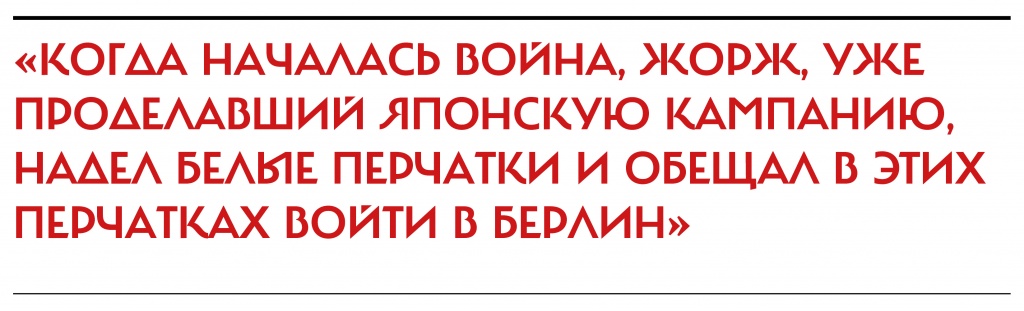
Color sun
“My childhood passed in Tbilisi, in my homeland ...” - wrote Yakulov in his memoirs. The death field of her father George took three sons and moved with them to Moscow, where the boy was given to the famous Lazarevsky Institute of Oriental Languages. However, soon he had to leave the institute "for the inability to obey the conditions of gymnasium life." But he already dreamed of art, so that such a turn of events only delighted him. Preparing for admission to the art school, he was engaged in the workshop of Konstantin Yuon for two months (perhaps hence the love of juicy and bright tones). Later, after serving in the army, Yakulov carried out of the war not only fighting wounds, but also his own artistic experience, which formulated in the theory of “multi -colored suns”. The Sun of Moscow is white, the sun of Georgia is pink, in the Far East it is blue, and in India yellow. Yakulov was carried away by this idea and even began to build a theory under it - about how the movement of lines and colors correlates with a national character.
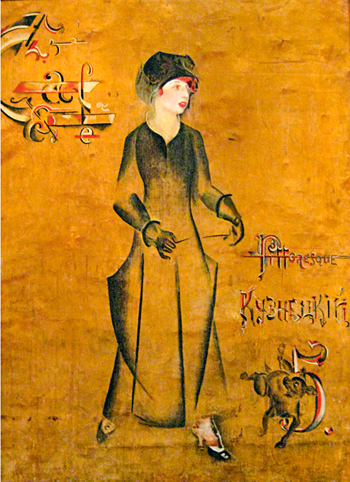
At the poster of the Cafe "Pittoresk", the wife of Georges - Natalya Shif, the State Tretyakov Gallery, 1917
The first picturesque work that he wrote after the Russo-Japanese War was shown at the Moscow Partnership exhibition in 1906 and immediately made the author known. The picture was called “jumps”, and it already laid the elements of the composition that became the hallmark of Yakulov - a spiral and staircase. “Having got into Moscow on the races,” Yakulov wrote, “I noticed the movement of the crowd, overwhelmed by the excitement, reminding me of the Manchu typhoon ... I built the composition of the races in the vortex (baroque) movement with Chinese linear graphic and watercolor transparency of the wet spectrum of China ...”
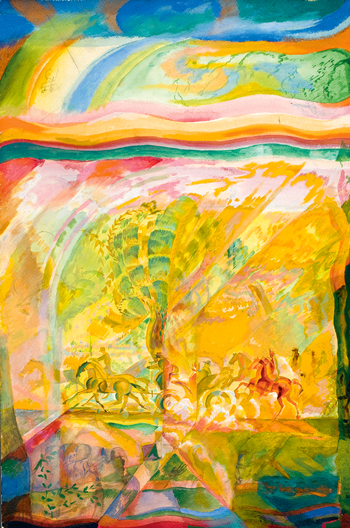
Georgy Yakulov, "Spring Walk",
State Tretyakov Gallery, 1915
Indeed, Yakulov tried to combine the art of the East with the European tradition that delighted him-the result was something completely new, bewitching and fabulous. Since that time, Yakulov was actively exhibited at numerous Moscow exhibitions, then he drove around Europe and conquered Paris, where he carried away his theory of French artist Robert Delune. By the way, in Paris he talked a lot with Picasso, about which he then wrote an article.
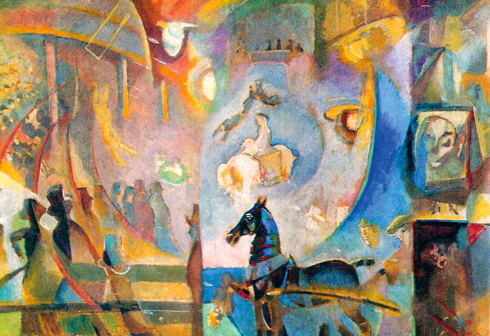
Yakulov made the scenery for Tairov’s play “Girofle -Zhirofle”, turning the scene into a circus. Back in 1910, he wrote a “circus”, which is stored in the Art Museum of Uzbekistan
Girofle -fat
When the NEP reigned in the USSR ( a new economic policy proclaimed in 1921 and legally banned in 1931, when the law on the ban on private trade was adopted in the USSR.- NT ) and as mushrooms after the rain, numerous cooperative cafes and restaurants began to arise and theaters were revived, the talent of Georges Yakulov turned out to be possible. Back in 1909, he issued a cabaret “Corpfold of the Caucasus”, then a hunting club on the topic “China”, the Moscow merchant club turned into “Night in Spain”. The most famous was the Pittoresk cafe formed in the 1918th cafe. The artist Valentina Khodasevich recalled: “Great and quickly he painted the glass frantically bright transparent colors (it turned out like stained glass). I remembered huge multi-colored, somewhere racing horses and, it seems, still roosters. Why? For what? Doesn't matter! It was very beautiful ... ”By the way, then on an advertising poster he in the same style depicted his future wife Natalia Shif.
On January 25, 1919, together with Yesenin, Mariengof, Shershenevich, Georges Yakulov signed up under the declaration of the creation of the Order of Imazhinists. At that time, a large number of literary groups arose - from futurists to nickels, however, the Imazhinists, led by Yesenin, turned out to be one of the most active, scandalous and demanded groups. Yakulov illustrated the books of his friends and made their graphic portraits. In parallel, he designed performances, many of which, thanks to his scenery, became a sensation. First of all, this is the legendary performance “Girofle -Zhirofle” in the production of Alexander Tairov. Yakulov turned the scene of the performance into a circus, some new surfaces were advanced from everywhere, stairs descended. The result was a kind of mechanical box. This work brought Yakulov in 1925 the honorary diploma of the World Artistic Exhibition in Paris, and Sergei Diaghilev, having looked at these scenery, persuaded Yakulov to draw up the ballet Steel Skok (1927) to the music of Sergei Prokofiev.
Actress Alisa Konen recalled “Girofle -Zhirophle”: “Yakulov was very passionate about the intention of the performance, but when he found out that the design should be done urgently ... He protested. It ended in the fact that Tairov made him a rather extravagant sentence: - Steel completely for two weeks to the theater. The conditions are luxurious: there is a room near the mock -up, we will equip it quite comfortably for you, Alice will take care of food, and we will drink the wine carefully with you, according to the glass at dinner and dinner. After your crazy life on Sadovaya, you will rest, sleep and easily make the design in the right time. And so that you do not run away, do not might, I will locate you with a key ... "

Zoikina apartment
“Life on Sadovaya”, which Konen writes about, is the famous salon held by Yakulov’s wife and who became the prototype of “Zoikina’s apartment” by Mikhail Bulgakov: in the play it was about how thirty -five -year -old Zoya under the cover of a sewing workshop in her apartment arranged a dating house. Of course, the Salon of Yakulov was not a house of dates, but it was here around the clock that Nepmanskaya Moscow was Kurolesil. The salon arose after the marriage of Yakulov on a disgrace, but unusually attractive Natalia Shif. Contemporaries recalled: “When she walked or drove up there, there is always a crowd of men behind her. She ... dressed a dress right on a naked body, or a coat, and the hat is huge. And always a stream of very good spirits from her. ” It was in this salon that Iceedora Duncan and Sergey Yesenin met, his guests were Vsevolod Meyerhold, Alexander Tairov, Alisa Konen, Anatoly Mariengof, Anatoly Lunacharsky and many others. There was no food in this house - wine, chocolate, canned food. Parties lasted all night. In the end, in 1927, when Yakulov was just in Paris, his wife was arrested and only thanks to the intercession of friends was not imprisoned, but sent to Kislovodsk. She returned to Moscow after the death of the artist.
In 1928, Yakulov went to his native places, to Dilizhan, to Armenia. All letters that came to him from Moscow were dedicated to his upcoming anniversary-the 25th anniversary of creative activity. The anniversary committee included the widely known people-Lunacharsky, Stanislavsky, Eliava (chairman of the Council of People's Commissars of the Transcaucasian IFSR), Ter-Gabrielyan (Chairman of the Council of People's Commissars of the Armenian SSR), Semashko, Tairov, Picasso, Liege, Stravinsky ... However, Yakulov did not have the opportunity to see the holiday: in December twenty-eighth he died of Tuberculosis. His wires were Yakulov’s magnificent and theatrical-the body was carried on a sleigh in which white horses were harnessed, covered with black blankets, embroidered silver. On both sides were conducted by conductors in white redingings with metal buttons and in white cylinders.
They say that Yakulov smiled all his life and even at the moment of death on his face a smile froze: the posthumous mask confirms this.