
Translated material
Lukashenko changes the sight
The President of Belarus will not be on May 9 on Red Square. On this day, he himself will take a parade - at home, in Minsk. But his shadow will be invisibly soaring over the paving stones, which will go Russian military equipment: wheeled chassis, sights and other optics, electronics and radars - almost all of this Belarusian production
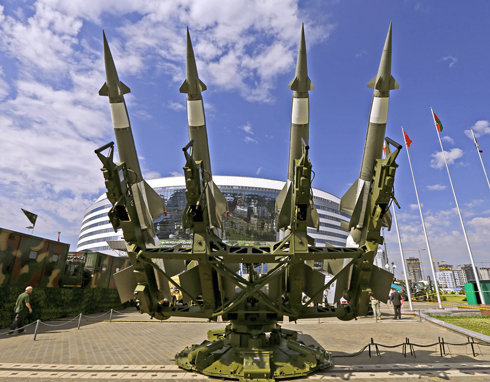
This mobile anti-aircraft complex is one of the exhibits of the Milex-2014 exhibition, Minsk, July 2014
There was no special intrigue that refused to come to Moscow on May 9 on May 9 on May 9 on May 9. The Belarusian leader, as he himself made it clear, will come to Moscow on the 8th-“demonstrate unity with the Russian people and others” and participate in the informal CIS summit. But on the night of the 9th he will return home. “In 2010, Lukashenko acted exactly the same-he went to Moscow on the 8th, not the 9th,” the political scientist Yuri Draghroust recalled NT . “May 9 is one of the main public holidays in Belarus, with a parade and other celebrations, and the president always meets him at home.” But the truth is that in the current conditions Lukashenko’s behavior looks ambiguous: “On the one hand, he goes to Moscow to Moscow, so Afront is, as it were, and not. There, Angel Merkel also rides, even if not on the 8th, but on the 10th. On the other hand, it will not be on the rostrum on the rostrum, again, like Merkel and many others. ”
But Belarus in any case will be present at the parade. Most likely, the T-72B3 tanks will be held along the Kremlin paving stones, and they have a multi-channel sight “Sosna-U” of the Belarusian production. However, on the T-90-the same sight. Russian combat vehicles of infantry and landing are equipped with other sight of the Belarusian production - "COO". In addition, all Russian missiles, electronic control systems, military control and guidance, military computers and avionics in aircraft, radars, etc., are stuffed with Belarusian components - electronics and optics. In total, for the Russian defense industry of the Belarusian military-industrial complex (military-industrial complex), according to the deputy head of the military-industrial commission under the Government of the Russian Federation Oleg Bochkarev, "close more than 1.5 thousand positions on components." And since 2014, when the war of sanctions began and Russia has lost the opportunity to purchase an electronic-component base for weapons in the West, the Belarusian role in the Russian military-industrial complex has increased even more: without the help of the neighbors of the import substitution program, they would hardly earn money.
But at the beginning of this year, Alexander Lukashenko made it clear to the entire Russian military -industrial complex: the former format of cooperation is no longer satisfied with him. Belarusians have their own pride and far -reaching ambitions.
Presidential turn
On March 16, Lukashenko unexpectedly stated that the state -owned enterprise of the Minsk Plant of Wheel tractors (MZKT) would not change the owner. The uninitiated this was absolutely not said. The initiates were shocked.
MZKT is the only manufacturer of wheel chassis for Russian missile systems, starting with Topolya-M to the S-300, which Moscow is going to put Iran, and the Iskanders, located in the Kaliningrad region to intimidate NATO. In the same place, on the MZKT, the chassis for the mobile coastal missile anti-ship complex "Bastion" and the Ball-E coastal missile system-and this is another pride of the Russian defense industry, which will be shown at the parade on May 9.
For the past 5 years, a rumor wandered around Minsk: the MZKT is about to go under the control of Russians. The transaction options were called a variety of - from the transfer for debts to the capital entering the capital of the Russian investor - the Rostekhnology Group of Companies. Moreover, the last option was considered the most likely. The Minsk enterprise regularly visited the Deputy Prime Ministers of the Russian Federation Arkady Dvorkovich and Dmitry Rogozin. But Lukashenko eventually decided in his own way. Presidential argument: "This (MZKT) is a good enterprise, which many are of interest in which many people show."
Who exactly “shows interest”, experts in Minsk understood instantly. At the very beginning of 2015, many enterprises of the Russian military-industrial complex refused to purchase components in Belarusian plants in their previous volumes-due to the crisis. However, the Belarusians were not too upset: by that time they had already found new customers, partners and investors in Ukraine.
Helicopter, but not the same
On July 10, 2014, the Minsk-Arena complex on the outskirts of the city of Burlil-was the second day of the arms exhibition Milex-2014. Not far from the entrance, in an open area, there was a huge and sparkling with a whiteness Mi-8 helicopter. At him, squinting from the sun, he watched a Russian military in the form of a colonel for a long time. At some point, a colleague approached him:
- Well, how do you like the car?
- Bastards! Kneading all these bulbas with crests! ..
Spitting, the colonel turned and resolutely walked to the covered pavilion.
Military specialists are understandable to the military equipment. The Russians are used to considering Mi-8 by their helicopter. But the one who stood here, at Milex-2014, was not at all from Russia. This modification-the Mi-8MSB-now begins to be produced in Belarus together with the Ukrainian JSC Motor Sich (Zaporozhye) and the Belarusian OJSC Orsansky Avia repair Plant (OAZ). Especially for the issue of the Mi-8MSB (and then-other helicopter models), the Ukrainian company redeemed the control package of OAZ shares from the Belarusian government. To create the production of the full cycle, the production of the most important components is established in the Orsha. The key element of the new machine is an engine that allows the helicopters to save up to 20 % of the fuel and increase the flight range to 600 km. Not to mention the maximum flight height of 9150 m against 4500 m of the Russian Mi-8T.
"The moment is normal ..."
Back in March 2014, Ukraine introduced a ban on the supply of weapons, military equipment and components for enterprises of the Russian military-industrial complex to Russia. “... Customs have already accumulated by goods, in most cases paid and provenced up to 80 %, which we cannot get,” complained Borisov, Deputy Minister of Defense of the Russian Federation, complained on the air of the Russian News Service. In Minsk, they instantly sensed the opportunity to earn in the conflict of Moscow and Kyiv.
During the summer of 2014, the Government of Belarus has developed two concepts for the development of the VPK. The first involves the creation of a joint venture in Belarus with Russia and Ukraine for the assembly of weapons and military equipment. “We do not just play the role of an intermediary here-we give the opportunity to save tens of thousands of jobs in Ukraine and actually save neighbors, especially the southeastern regions, where the enterprises of the Ukrainian military-industrial complex are concentrated, from a social explosion,” a high-ranking government official in Minsk remarked self-propelled in a conversation with NT . The idea of creating the joint venture quickly gave the result: today, specialists of the Ukrainian military -industrial complex, Belarusian colleagues invite whole families to move to Belarus.
The second concept reflects Lukashenko’s desire to finally establish his own production of weapons and military equipment. On September 23, 2014, at a meeting in Minsk, he stated: “No one will give and sell even for a lot of money what we need today-promising types of weapons ...” At the same time, Lukashenko clarified that he had in mind primarily the production of tactical and cruise missiles. Russia is not going to supply such equipment to its formally the closest ally. It is clear that Minsk is looking for other sources of technology to establish its own production of weapons, including for export purposes, and do not depend on external suppliers.
The catch, however, is not so easy to create a production cycle of this kind from scratch-it will be necessary to establish the production of missile gunpowder and learn to conduct technical tests, while there are no missile training grounds in Belarus. How to be? Lukashenko saw the optimal way out of the situation in a closer cooperation with Kiev: “Let's try to work with the Ukrainians together so that intellectual, engineering centers, designers in Ukraine do not disappear. The moment is normal ... This moment must be used not only for yourself, but also for the external market. ”
Moreover, Minsk is ready for direct purchases of weapons from Ukraine. At the end of September 2014, the delegation of the military-industrial complex of Belarus consisting of 22 people visited military enterprises in Kyiv, Lviv, Chernigov and Dnepropetrovsk. Belarusians were primarily interested in plants and organizations (KB, Research Institute) associated with the production of missiles or their components (homing heads, missile engines, control systems).
“For Belarus, the Russian-Ukrainian conflict is nothing more than a background for increasing its own technological potential,” said Andrey Porotnikov, head of the Belrus Security Blog analytical project. “Official Minsk seeks to use the situation to tug around the flagships of the Ukrainian military -industrial complex with its unique technologies, which neither Belarus nor in Russia.”
Photo: Vasily Fedosenko/Reuters