
Translated material
Investigation in the case of the Moon
In April, a group of scientists from Israel and France published a sensation in the respectable journal Nature: the results of computer modeling confirmed the hypothesis that the moon was born as a result of a powerful cosmic cataclysm
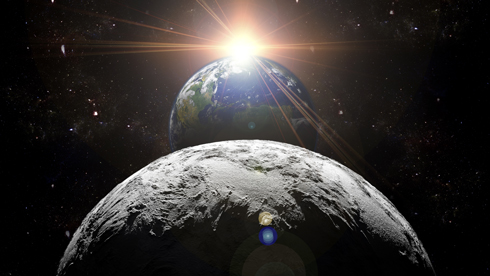
Esotericists of all time attributed to the moon mystical properties, many peoples of the world considered it a deity. For astronomers, the Earth - the Moon was also a mystery for a long time. Now that dozens of automatic devices were investigated by the moon, astronauts visited, it seems that scientists know everything about it. But there is still no main answer: where did she come from, so similar and at the same time not like the ground.
Versions of the great
The investigation of the moon began in the XVIII century, when the first scientific hypothesis of the origin of the solar system was formulated. Back in 1734, Mistik Emanuel Swedenborg described the origin of planets and stars from a substance emanating from the sun. And in 1755, the philosopher Immanuel Kant in his cosmogonic theory suggested that the foggy discs that are visible in the telescope can be planetary systems in the formation stage.
Forty years later, the mathematician, physicist and astronomer Pierre-Simon Laplace gave the idea of Kant a scientific appearance. The primary nebula should, according to Laplace, first have the shape of a spherical dust ball. As the rotation was accelerated, it became disco -shaped, stripes appeared, and then planets formed from them. He cited the rings of Saturn as a visible illustration of this process.
XVIII century - the time of guesses and insights. But the question of where the moon came from was left unanswered. 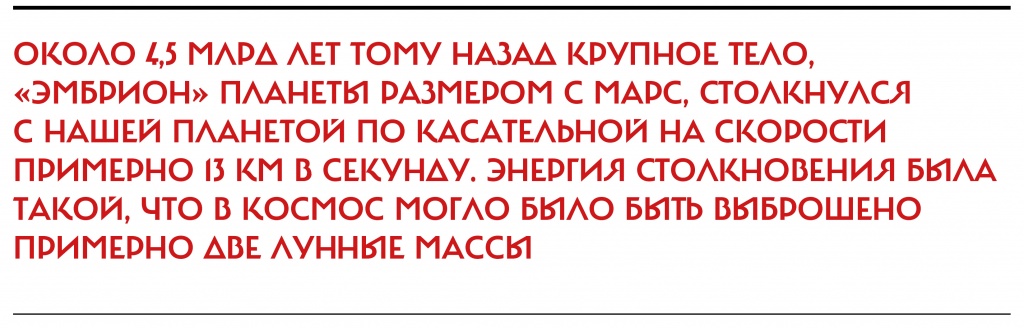
For the first time at the end of the 19th century, George Howard Darwin, an astronomer and a mathematician, son of Charles Darwin, tried to answer him at the end of the 19th century.
Darwin Jr. believed that immediately after his birth, the earth rotated very quickly. The day lasted about three to four hours. At the same time, the period of oscillations caused by a tidal (gravitational) effect of the Sun was very close to this rapid rotation. The joint action of the gravity of the Sun and the high speed of rotation of the Earth could be resonant. As a result, Darwin believed, a giant hump grew on earth, it became like a pear. In the end, the top of the pear came off and became the moon. Later, in 1892, the British priest and geologist Osmond Fisher suggested that the giant cavity of the Pacific Ocean was the place of separation of the moon.
In 1930, the mathematician Harold Jeffris proved that during the formation of the gravitational “hump”, the speed of rotation of our planet was automatically reduced and there could not be any separation. But until 1936, in children's, for example, educational radio programs in the United States, they said that the Moon is a lumpy torn from the body. 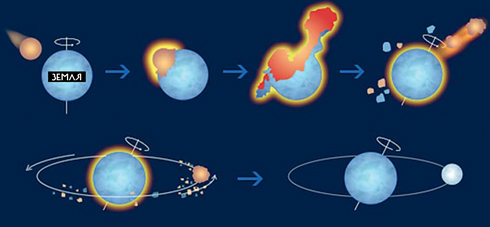
Capture theory
For a quarter century, in the development of hypotheses about the origin of the moon, a lull reigned. Only in the 1950s, the “Steal Theory” was replaced by a “capture theory”. The idea of "capture" was quickly accepted in scientific circles. Its authors, Harold Yuri and Horst Herstencorn-suggested that the moon was formed independently, somewhere in another area of the solar system. And only then was captured by the attraction of the earth.
This theory looked much more thorough than the previous ones. It was assumed that the moon is a kind of space relic - the primary body remaining from the earliest stages of the formation of the solar system. But the authors of the theory did not manage to explain the almost circular shape of the lunar orbit: scientific postulates claimed that the captured body of the orbit should be like an ellipse. Critics of the “capture” also said that the likely outcome of the rapprochement of cosmic bodies is not the capture of the weak strong, but either a clash or a change in the orbit. And in order to get into orbit around our planet, the moon needed to aim very accurately.
The German geologist Alfred Vegener, the author of the idea of the movement of mainland tectonic plates, and the American geologist of the Gray Dzhilbert, proposed their version of the “capture”. They believed that there were actually several “luna” grabbed by the land, and later they all “blinded” into one. Numerous craters on the surface of the moon are traces of the last stages of this cataclysm.
And so it continued until the beginning of the new era - when the moon began to be explored with the help of automatic devices: almost half of the experts professed the “capture theory”.
Morning sun never lasts a day
The Apollo program and the ability to explore the real lunar soil gave rise to new hopes. Everything would be simple (as far as possible with cosmic bodies), if the moon were like asteroids. That is, to some primary pieces of universal matter. However, the substance of "mature" planets is sharply different from this primary substance. This became clear from the samples received from the moon. Their composition - in comparison with the composition, for example, the Chelyabinsk meteorite - is greatly changed. How the composition of Martian planetary meteorites has been changed, since both lunar and Martian matter, apparently, survived the processes of geological processing, “re -melting” in the bowels of the planet.
In short, this stage of the investigation in the case of the Moon did not justify hopes. The study of lunar samples, seismic sounding, mapping of the gravitational field of the moon, the shooting of its reverse side (which, as it turned out, is very different from its apparent side) - all this gave rise to new issues. It turned out, for example, that the chemical composition of lunar soil is very similar to the composition of the earth's breeds. It looks so much that the hypothesis of the birth of the moon somewhere far from the ground should be discarded. But it was embarrassed that the amount of lunar iron is much less than the earth - only 3 % of its mass. 
In 1975, American scientists William Hartmann and Donald Davis, relying on the work of the Soviet scientist Viktor Safronov from the Earth Physics Institute, offered a new hypothesis of a “giant impact” or “giant impact”, which is now considered almost generally accepted.
It consisted in the fact that about 4.5 billion years ago a large body, the “embryo” of the planet the size of Mars, collided with our planet in a touching speed of about 13 km per second. The energy of the collision was such that about two lunar macs could be thrown into space. This happened at the moment when an iron core was already formed at the ground, so a substance devoid of iron was released into space. Flying elements began to quickly leave the substance - they dissolved in outer space. And what remains was the moon, the way we know her.
“This model has an important philosophical aspect,” wrote Hartmann and Davis. - There have always been difficulties during attempts to explain the whole variety of properties of the systems of the planets satellites within the framework of a single evolutionary theory. Jupiter and Saturn have their own “miniature” solar systems. The Earth is a “double” planet, Mars has only two tiny companions, Venus and Mercury have no companions ... ”According to Hartmann and Davis, it is difficult to explain such heterogeneity with the consequences of evolution, most likely it is the result of“ rare events ”, which belongs to the“ blow ”. Simply - the result of the space revolution.
The objections to the idea of a giant blow arose, of course, immediately. The opponents were interested in: where did the own substance of the impactor go, that is, the drummer? For example, Russian scientists led by academician Eric Galimov from the Institute of Geochemistry and Analytical Chemistry named after Vernadsky believes that the theory of “Impact” only multiplies entities: Galimov insists that the process of forming the moon and earth from the common gas -fluid cloud went about the same as the process of formation of double stars - they arose simultaneously from one initial substance. The differences in the amount of iron as part of the earth and lunar substance are the result of the fact that the large body (the embryo of the Earth) attracted more matter from the mother-eyed, the smaller in volume (the germ of the moon).
But supporters of the shock hypothesis began to further “unwind” the chain of the probable space revolution. In particular, Edward Belbruno and Richard Gott from Princeton tried to calculate where the cosmic body that inflicted a “blow” could appear.
And here the imagination of scientists studying the secrets of the Universe can envy any science fiction writer. The hypothetical “shock” was dubbed Teye - named Mythical Titanida, who gave rise to the goddess of the moon - Selena. The calculations of scientists have shown that Teya was formed in the earth's orbit at the points of Lagrange - the so -called points where the gravity of the earth and the Sun forms gravitational “wells”. There are only five such points and there at the beginning of the formation of the solar system, such as spring water in the lowlands, small planetary bodies, the “building blocks” of future planets gathered. These bodies joined the hypothetical Teye. And again the question: if the hypothesis is true, then the “wells” of the moon, who did not have time to join the ancestor, had to remain in the gravitational “wells”. Where are they?
The chances of finding them are very ghostly. In the meantime, scientists, using the methods of mathematical modeling, are trying to choose this option for a clash of a certain cosmic body with the ground, which would explain why the moon still consists mainly of earthly matter. And here is a new scientific sensation. In April of this year, a article by scientists from Israel and France was published in Nature (the group is headed by Sean Raymond from the Laboratory of Astrophysics to Bordeaux): they tried to simulate such Tayi formation options so that its isotopic and chemical composition was very close to the composition of the land. They tracked the growth zones of planets using computer modeling and found that potential “drummers” (impactors) are very close in composition to their potential “victims”. This confirms the idea of the birth of the moon as a result of a cosmic cataclysm.
The Nature article has been delighted in the camp of supporters of the theory of the clash of the cosmic body with the ground. But there is no doubt - now new objections will be sprinkled. It is clear that the case of the origin of the moon is still not closed.
Photo: Shutterstock.com, Moon-formation Bussle.com