
Translated material
Armata is a holiday
The parade on May 9, by the 70th anniversary of Victory, should become the largest in the latest history of Russia. What are going to hit the “probable enemy” primarily - the New Times found out. Armata tank, Bastion missile system and Pak Fa plane - possible events and disappointments of the Victory Parade
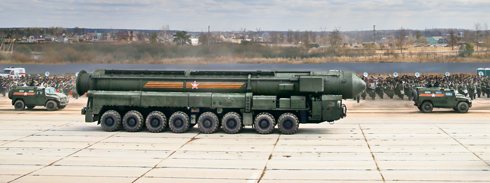
Yars surrounded by armored vehicles "Tiger", Moscow Region, Alabino, April 22, 2015
On May 9, a small army will actually pass through the cowardice of the country's main square, whose weapons quite allows you to unleash a local conflict. Or maybe not only local.
The army’s command plans to “roll out” to show 7 new models of military equipment: T-14 T-14 T-14 “Armata”, Coalition-SV SAU, Armata BMP, Kurganets-25 BTR-MDM, Boomerang, Bal-E and Bastion Coastal Coastes.
“During each parade, they promise to show something new, but only this time, it seems, there will be fundamentally new samples,” said Alexander Khramchikhin, deputy director of the Institute of Political and Military Analysis, in an interview with NT . The participants in the parade in Moscow set the task of demonstrating the best from the arsenal of Russian weapons, and the military observer Alexander Golts agrees. The army command promises to deliver 10 Armata tanks to the parade and 10 BMPs on the same chassis.
But both experts emphasize: participation in the parade does not mean that innovative equipment will go into the army tomorrow. Perhaps there are only small series released for the holiday.
"Armata"
The program of the program is the T-14 mysterious tank on the heavy tracked platform "Armata". The name of the platform was a reference to the “scrapers”: the so -called iron artillery guns that existed in Rus' from the second half of the XIV century (the source - the Great Soviet Encyclopedia), although the word itself has a Latin root: Arma - weapons. Now Russian combat vehicles are not only tanks, but also BMP (infantry fighting), BMD and self-propelled guns (self-propelled artillery installations) use a variety of caterpillar chassis, which creates a logistic nightmare for manufacturers-a single platform is designed to solve this problem, and the T-14 itself may become the main combat tank of the Russian army.
On the eve of the holiday, the Ministry of Defense published a photograph of the T-14 with a sheathed upper part. The fact is that the most important feature of this Uralvagonzavod production machine is precisely the armored capsule of the crew hidden in the bowels of the Armata (in previous models the crew was stirred in the tower). From this capsule, the gunner remotely controls the uninhabited tower of the tank. This is an important technical achievement, which is also promised to implement the Coalition-SV SAU and the Kurganets-25 BMP. True, not all experts believe that the uninhabited tower is an impeccable design solution. According to the British armored vehicle expert Christopher Foss, such a modification was tested in the English intelligence machine and refused it after the tests - they put a tower with two crew members inside.

For the price we will not stand
When the serial production of miracle technology begins, they are unlikely to know even in the main automobile-bronational administration, ironizes Khramchikhin. According to him - at best in two years. Golts, in turn, recalls how in 2011 the Ministry of Defense was going to completely abandon the purchase of new armored vehicles. At the famous “direct line” with then Prime Minister Putin, the workers of the Uralvagonzavod were promised to come to Moscow and deal with the “loafers” protesting against the authorities. In exchange for such hot support, they asked only to purchase their tanks.
It seems that Putin heard his Ural fans - two weeks later in the Rossiyskaya Gazeta a program article by President Putin appeared, in which the order of Uralvagonzavod was voiced by a separate line - 2300 tanks until 2020.
Experts evaluate the costs of developing "Armata" in tens of billions of rubles.
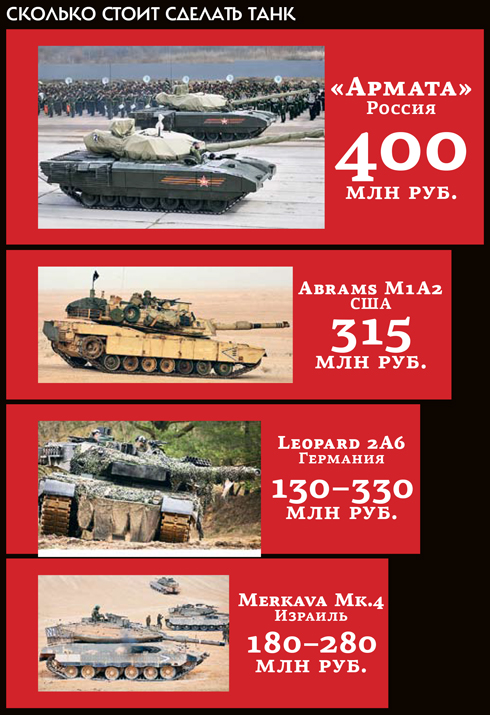
“Then there was a crisis, and it became clear that the production of a tank, one unit of which costs 400 million rubles, is very consisted with the state. When we are now told that a limited series is made, and then it will take tests in the troops for two years - we understand that the decision on serial production has not been made or at least postponed to more grain times, ”summarizes Golts. For comparison: the last modification of the German Leopard 2A6 is now in recounting to rubles from 130 to 330 million rubles. ($ 2.5–6.5 million). One of the best tanks in the world is Israeli Merkava Mk.4 - in the region of 180–225 million rubles. ($ 3.7-5 million). The American Abrams M1A2, depending on the configuration, is estimated at about 315 million rubles. ($ 6.21 million), however, in 2014, Saudi Arabia purchased them at $ 1.9 million per piece, that is, almost four times cheaper than the Armata will cost.
Actually, in March 2011, Alexander Postnikov, the then commander of the Ground Forces, was very sharply talked about in March 2011. In his opinion, samples of domestic armored vehicles are worse than NATO, but also Chinese analogues, but expensive-the new T-90 tank cost 118 million rubles. per unit. “It would be easier to buy three“ leopards ”for this money,” the media quoted.
The shackles of the West will fall
The T-14 may well become a "front" tank released by a limited series for spectacular rentals in front of the public. And the reason is not only in the huge cost of its production and the inability to assess the degree of completeness. Although representatives of the military -industrial complex cheerfully reported on successful import substitution, this is not entirely true. The Russian military-industrial complex will fully pull the manufacture of multilayer armor of steel and ceramic and composite layers and a powerful 125 mm caliber smooth-bore for T-14, but the main “chip” of the modern tank is still not armor and gun, but electronic filling.
According to stingy data, the tank is literally stuffed with laser sensors, cameras and thermal imagers. However, it is electronics in Russian armored vehicles that often have a foreign origin - even official representatives of the industry recognize this reluctantly. Back in 2008, Rosoboronexport agreed on the licensed production of thermal imagers with the French from Thales Optronics. At Armat, they are planned to be replaced by Russian counterparts, which are still in development and, apparently, completely “raw”.
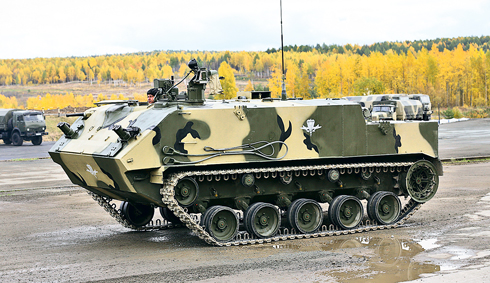
BTR-MDM "Broke"
"Shells" and "boomerang"
For the first time, a significant number of new armored personnel carriers and infantry combat vehicles will appear on Red Square. 10 BTR-MDM shells, 10 armored personnel carriers and 10 BMP Kurganets-25 and 3 BTR boomerang will pass by the Kremlin’s towers. They will be complemented by eight units of self-propelled artillery installations "Coalition-SV" and a certain number of mobile coastal complexes "Bastion" and "Ball-E".
Each of these models has interesting features. It is only known about the promising SAU “Coalition-SV” on the basis of “Armata” that the developers refused to try to create a cannon “double-barreled” and returned to classical design with one barrel.
But data on the caterpillar “shell” are available: its armor is made of lightweight alloy, and the speed is not particularly inferior to the wheel armored personnel carrier and equal to 70 km/h along the highway and 10 km/h when moving swimming. The machine, designed to transfer landing, is able to take on board two crew and 13 fighters. For comparison: BTR-80 and BTR-90 allow you to transport only 7 soldiers.
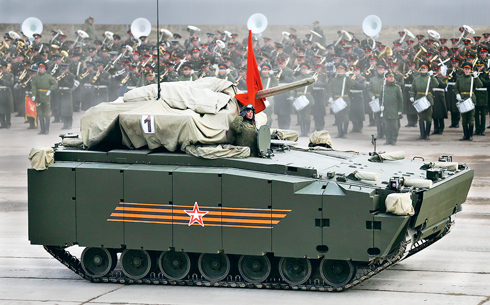
BMP "Kurganets-25"
The Kurganets-25 BMP is also capable of transporting no more than 8 paratroopers, but equipped with an era module with a machine gun, an automatic gun of a 30 mm caliber and two dual launchers of the Kornet PTRK. The module is robotic and controlled by a combat computer that can detect the target and fire until completely destroyed. It is this machine that should replace the BMP in service with the Russian army. On the basis of its caterpillar platform, it is planned to design a whole family of armored vehicles.
Based on the Boomerang wheeled platform, they were also going to create a number of military vehicles, but the reality of these plans is extremely doubtful: only three “boomerangs” would enter the parade, although earlier the command of the ground forces promised to provide mass supplies this year.
Bastion missile systems are able to “cover” up to 600 km of the coast from enemy airborne operations and hit even the largest ships like aircraft carriers. It was these complexes, according to President Putin, were defiantly deployed in Crimea in March 2014.
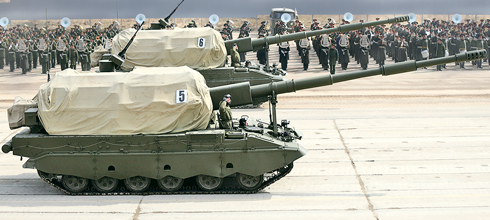
SAU "Coalition-SV"
In 2011, it was expected that the “bastions” would be deployed in the Kuril Islands, but this plan was never implemented. This may be due to the export policy of Russia: from the moment it was put up in service, two “bastions” were put in Syria and Vietnam, while the own army received only three complexes - though with a large number of launches.
The same situation with the Ball-E, whose labeling speaks of the export version. It was supplied to Vietnam and Venezuela and today is rather an element of successful Russian business weapons than a significant value in the coastal defense system.
Aviation
“For the first time, spectators will see the latest fourth-generation plus fighters of the Su-30 and“ fourth generation plus plus ”Su-35 over the Red Square, the modernized Mi-35M shock helicopters and the Ansat-U training helicopters,” the Ministry of Defense said on the official website of the Ministry of Defense.
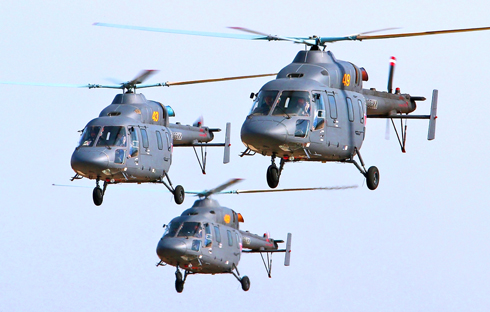
Ansat-U helicopter
Indeed, the Su-35 will fly over Red Square for the first time. But the Chinese spectators have already managed to enjoy the show with their participation at the Aircraft Engineering exhibition in the city of Zhuhai in November 2014. At the same time, there were negotiations on the possible sale of 24 new PRC fighters.
“Su-35 is not a fundamentally new aircraft. This is a further endless development of the Su-27 fighter, albeit very deep, ”said Khramchikhin.
On the eve of the parade, it became known about the ban on the use of the first Russian fifth-generation T-50, also known as PAK FA (promising aircraft complex of front-line aviation) in the flight part of the festival of the first Russian festival.
The source of Gazeta.Ru in the Ministry of Defense reported an informal ban on an informal ban. According to him, he is related to security issues - the plane has not yet completed state consulting. The Armata also did not go through the tests, but, as the interlocutor of the publication said, "tanks do not fly over the heads of people." It is worth recalling that the demonstration flight of the T-50 prototype in June 2014 in Zhukovsky near Moscow ended in an accident-one of the power plants refused the fighter.
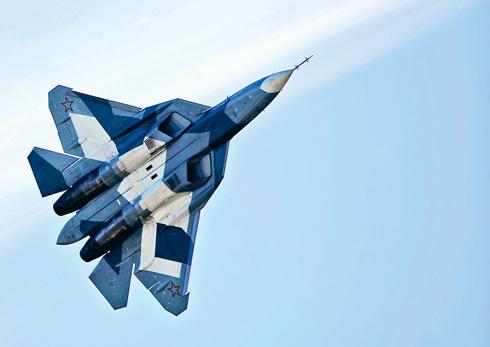
Fifth generation fighter T-50
The multi-purpose “stealth”-fighter T-50 is perhaps the most ambitious project of Russian aircraft manufacturers. One of its main differences will be the opportunity to reach supersonic speeds without turning on the frying, which will reduce the visibility of the aircraft for radars, optical and thermal detection, and will also reduce fuel consumption. The inconsistency of the T-50 is achieved due to the special shape of the aircraft body, which reduces the ability to detect it visually or radar.
The development of Park FA was not without the participation of foreigners - the fifth generation fighter creates in conjunction with India. Local military expert Monica Cansoria announced in the press the figure of $ 295 million invested by Indian partners in the T-50. She also noted the desire of New Delhi to get more access to the project and its technologies.
Photo: Sergey Savostyanov/TASS, Mate 1st Class Ted Banks/US Navy Photo, Luxfon.com, Tankolet.ru, Wikipedia.org, Alazan RussianPlanes.net, Sergey Bobylev/ITAR-TASS