
Translated material
Mom and dad and their war
Family portrait against the background of hostilities
Dad went to the front on July 6, 1941, mom-August 31. He is in intelligence, military unit 1080, she is in the 3rd front-line theater brigade. He became Grigory Grigoryevich Basil and was to him until October 42, when he, already without fingers on his leg, was commissioned. Mom is a girl from the vaudeville “Poor Grandmother”, an old rabbi from the sketch “Nose with a hump”, a juggler in a dress from black taffeta with a pink organus and a nurse, nicknamed “German Shepherd” from the play “Memorable Meetings”. And they were at the age of 21
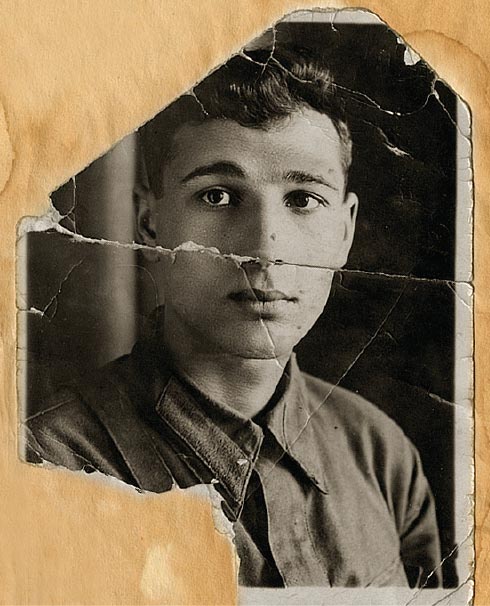 |
| Mark Albats in a reconnaissance school. August 1941 (from personal archive) |
I saw dad who crying twice in my life. The second-when he was dying, the first-when on TV on May 9 in the early 70s showed the "Belarusian station". When Nina Urgant took the guitar and sang: “Here the birds do not sing, the trees do not grow and only we shoulder to shoulder ...” - the father began to rub his eyes. “Mark, you can't,” said mom. The pope had already had two heart attacks by that time, and the third was on the way, and the war finally got it in the eighty.
May 9 was a special day. A large creaky table was extended in the kitchen, potatoes were fried, and scarce sprats and even more scarce Bulgarian “tomatoes in their own juice” were fried to it. Well, a doctoral sausage from the order. Mom and dad drank a glass. Vodka. Both drank well - they studied at the front: a mother in the swamps of the Volkhov Front (“under Budogosch” - she remembered this and in her 86) was treated with hot vodka (“It was such muck!”), So with a tear from the refrigerator went well. Then we, the children, cleaned the table, and everyone watched the TV collected by his father. Once they showed theatrical film stakes of the war - there we saw a mother that we never knew.
Cold autumn of the 41st
When the war, father, Mark Albats, was a 3rd year student of the Moscow Electrotechnical Institute of Communications, but he was also an athlete-butter-witch, because he was not wrapped in the military registration and enlistment office (the students had a reservation)-so he ended up in the military unit 1080 of the Southern Front, to which, according to the military ticket, was assigned on July 6, 1941. In fact, this same military unit was in Moscow and the main intelligence department of the Workers 'and Peasants' Red Army (Red Army) was called. Mom, Elena (Lyalya-I was called in the theater) Izmailovskaya, on June 21, played a diploma performance-“Late Love” by Ostrovsky in the Shchukinsky Theater School at the Vakhtangov Theater, then at night she caught lighters on the roof of the theater-until the bomb entered it (the theater was evacuated to Omsk), and the 3rd front-line brigade was prepared in the afternoon. The program: Yuri Zavadsky, the artistic director of the brigade, set it. In that military collection that they showed on TV in my childhood, my mother played in the vaudeville "Black Grandmother". "Mom, what is this vaudeville about?" . “Very funny old vaudeville. There, the old man with an old woman sings: "And since we will not have children, so we will have dogs." I played a girl there. ” The most amazing thing is that this is “we will have a dog” exhausted, wrapped up soldiers - that in Moscow, that on Volkhovsky, that on the Stalingrad fronts where my mother played, we met with enthusiasm: “We gave 3-4 concerts a day. And people were so hungry for civilians, in talking about Moscow, about the house, that when we gathered in another part, they sometimes shot at the wheels - so that they would not leave, ”my mother said.
However, this was already in the 42nd. In the fall of the forty-first 3rd front-line brigade, she played in Smolensk, then after the retreating troops closer and closer to Moscow. We drove a truck with a wooden top - it was all shot. They played hastily made hospitals, where the wounded lay on straw, drove past the ground houses, saw wells, full of corpses of children ... “My mother (Lidia Mikhailovna Savitskaya) told me:“ Where are you going? You will see the first corpse and cannot stand it. ” But how psychology changes depending on the situation. I remember how I was traveling on our truck, I sat near the side and ate soldiers' crackers: they were large, square, very thick, hard and very tasty, and there were corpses folded by stacks around ... ”Mom had to interrogate the captivated German in Smolensk (she brilliantly knew German):“ He said that he would still pass along Red Square. But I was not scared. It became terrible on October 16: in Moscow there was a panic, smoke stood, everyone was afraid, burned their party documents ... I then firmly decided: if the Germans entered Moscow, I will take a backpack and leave the city. ”
And Mark Albats at the same time moved in the exact opposite direction: if mom is from the Germans, then dad - to the Germans: 600 kilometers in occupied Ukraine, on foot and on the crossing, from the place of landing to the turnout, where the coherent and walkie -talkie awaited him.
Father
“/ .../ I report that according to the archival materials we have Albats Mark Efremovich, in 1941, was prepared for the radio operator under the GSS of the Red Army and on the night of September 4-5 of the same year was parachute in the area of Nikolaev. At this time, Albats M.E. He was transferred to the disposal of the intelligence department of the headquarters of the Southern Front and acted on his assignment. In the city of Nikolaev, Albats lived in a conspiratorial apartment at the address: st. Pushkinskaya, house 4, apt. 11 according to the documents for Basil Grigory Grigoryevich / ... / In October 1942, Albats M.E. He was in the hospital, where he was treated for frostbite and was then expelled from intelligence authorities. ” Signature: Colonel A. Zhollo.
The author, after long and persistent requests, received this document from the Main Intelligence Department in June 1994, when her father was not alive for 14 years. He told us something himself, but a little (dad worked in a terribly secret Research Institute of 10, developed radio systems for ballistic missiles launched from submarines, and therefore used to be extremely restrained), I learned much more from his sister, Lydia Efremovna Matveeva-Aunt Lida, which was recorded shortly before her departure. 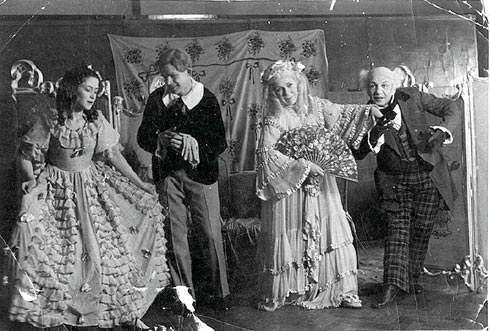
Vaudeville "Bad Grandmother". Elena Izmailovskaya (extreme on the left) as a girl. Volkhov Front. 1942 (from personal archive)
The father’s legend was elementary - such were held only at the beginning of the war. Grigory Grigoryevich Basil is the son of a Georgian manufacturer from whom they took the case and sent to the camps. The son was waiting for the Germans to come, but how they came - so immediately came to the occupied territory. Where, how - is unknown. In Georgian, my father knew exactly one word “ara”-“no”. It saved him when once, in Nikolaev, when he was sitting in a restaurant in the company with Romanian officers, a “fellow countryman” approached him, spoke on Georgian, his father pretended to be dead and answered everything - “ara”. Why - Georgians? The Albats-Sephardic Jews, once left Morocco (was there in the 16th century Rabbi Albaz-translated from the Arabic "Falcon"), there were black-haners and, compared with Europeans-dark-skinned. In short, the father fit into a certain stereotype of the “Caucasian”-in any case, for the Fritz of the 41st-42nd year. They recognized their own right away: “You are true that of these, well ... Jew,” the partisan was a guards, who met him on the other side, when his father once again crossed the front line in order to convey the report. The fact that he was Mark Albats was known only in Moscow and at the headquarters of the Southern Front. As the Germans did not recognize the Jew - one god knows: when the Father was already working in Ukraine, almost the entire Jewish population of Kyiv was shot in Babi Yar - 33 thousand 771 people, in October - another 17 thousand ...
The Father met the New Year's Eve of the 42nd year in a funnel, where he was hidden a walkie-talkie. According to this radio, he heard the Germans' message that Moscow was taken. “I wanted to shoot myself,” he said later, “Moscow was taken, it's over. And I also thought about my mother - how she would survive. "
Grandmother, Evgenia Samoilovna Grebelskaya, in those days she was evacuated in Chkalov-she was a psychiatrist, worked in the hospital, together with her grandfather they shot a kitchen, Aunt Lida and her husband (he was an oil industry, and he had a reservation)-near Orsk, where there was a large petrochemical plant. A telegram came to Baba to his wife: "Both legs were amputated." This, fortunately, was not true.
January night, in a wild cold, father with a partner - the aunt remembered that his name was Nikolai - the front had to cross. We got under mortar shelling. Nicholas killed, his father leaned in the snow, and when he got up at night to go, he could no longer go. But he crawled. “He was mistaken for a scout, but he said some words that need to be called,” Aunt Lida recalled the story of her father, “and he was taken to the headquarters.” 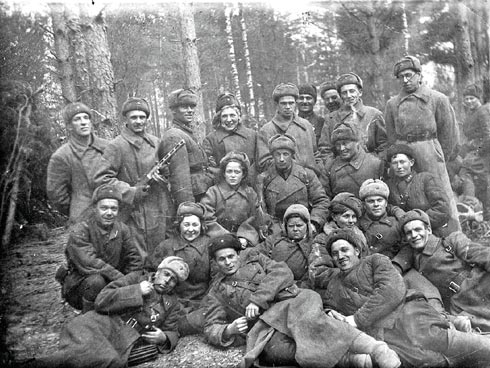
Actors of the 3rd front-line theater brigade and their spectators. Volkhov Front. 1942 (from personal archive)
Then there was the Kislovodsk group of hospitals and gangrene. The surgeon said to this 21-year-old boy: “The pilot lies in the next room-he does not have both legs, but you will not have only one.” “It’s not easier for me,” the father answered. And he didn’t let it cut. “He wrote to me:“ Do not worry, my fingers are amputated, ”Aunt said. - And our entire shift walked, raising your fingers on your feet: can you walk without fingers or not? ”
Then the Germans approached Kislovodsk and the hospital evacuated: they put the lying on some carts, the father was on crutches and walked into Guryev. In early November of the 42nd, at night in Chkalov, in the house where the Albats lived, there was a knock on the door. Evgenia Samoilovna gasped: "Mark arrived." I ran to open. “Mark stood in the doorway. Terrible Mark. But alive, ”said grandmother to aunt Lida.
Mother
"Mom, weren't you afraid?" - “Well, I was probably afraid, I just don’t remember now. There, on the Volkhov front, it was ridiculous: I came out of the dugout, I hear - the birds whistle. And suddenly our political instructor to curse me - and to the ground. I say: "What do you allow yourself?" And he: “There is a“ cuckoo ”sitting, German sniper, he is a whistle-foaming ...”
"Was it cried?" - “It happened. We crossed the mined field - we went to the front line. I'm on a horse. The Germans spotted us, and I crawled under the belly: I was engaged in a lot of voltage when I was in the (Vakhtangovsky) school, and gymnastics on a horse - she transferred me through a clearing. Crossed. I sat on the tubercle. The mouse fled by: one of the actors threw the earth at him and slammed him. And here I cried. "
"I was sick?" - “Well, yes, my scurvy on the Volkhov front began, my teeth just fell. We played right on the ground, the snow was lying, March month: and I'm in the dress ... ”jumps:“ Spus, swamps. And tiny huts were built on the aspen. And now I am somehow sitting I write a letter to my mother: the door opens, several officers come in and hold out a bouquet of bluish primroses to me. And they collected him waist -deep in ice water ... ”And then the next frame:“ And we were given white short fur coats and white hats. And when I arrived in Moscow for several days, I walked along Gorky Street, everyone shouted to me: "Aunt, are you from the movie?" 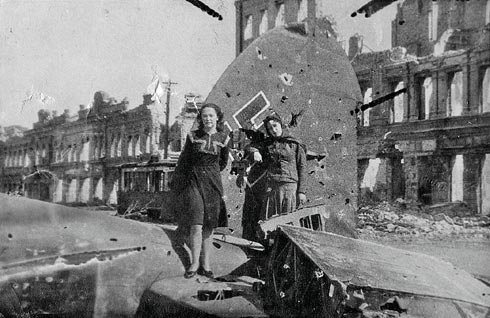
Portrait against the background of war. Stalingrad. March 1943. (Elena Izmailovskaya - right) (from personal archive)
Mom played not only vodvili and sketches - juggled with burning mounds, danced, read poetry: “You know how they (soldiers) loved these poems!”
Its strongest impression is Stalingrad: the theater brigade entered the city with the troops: "I was shocked: we are going, and on the fence it is written:" Mom look for us alive. "
The concert was given on the street, where they captured Field Marshal Paulus. They set the truck, threw back the sides, she went to this impromptu scene and saw a sea of soldiers and officers in front of her - not a single civilian person. “They were on broken balconies, in the remains of window openings, sat right on the asphalt. There were houses around - facades of houses: there was nothing inside them. I stood in my long velvet dress with a bare back and roared. I could not start a concert ... "
* * *
In the 43rd, his father returned to Moscow-graduated from the institute. At the end of the 43rd, my mother also returned-she came to the theater to the then famous director Gorchakov. I took off my overcoat, hat. Gorchakov made a firmware and said: “There is a man whom you love more than life. And he dies before your eyes. Play ".
They met after 8 years. Further there was life.