
Translated material
Chernobyl nuclear power plant will be covered with a centenary sarcophagus
Developed countries have introduced their share of the creation of a new shelter over the Chernobyl nuclear power plant, and Russia is not yet
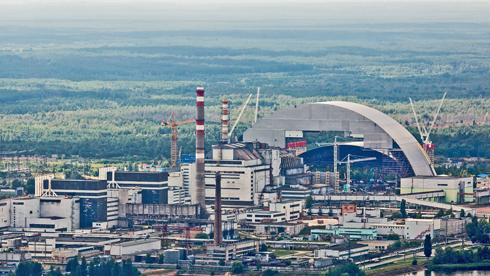
The European Bank for Reconstruction and Development (EBRD) announced that almost the entire amount was collected in order to finish work on cover over the Chernobyl sarcophagus by November 2017. At the International Conference of Donor countries of this project, held in London on April 29, € 530 million out of € 615 million necessary for the full completion of construction was collected.
“Now I am completely calm,” said the state-secretary of the Federal Ministry of Environment, the Protection of Nature, Construction and Safety of Germany's nuclear reactors, Johen Flosbart, at the press conference (Germany presides in the G7 this year). “There is no doubt that we will have enough funds to complete the construction on time.”
He announced that € 360 million of the € 530 million collected now is the contribution of the EBRD, € 165 million is given together by the Big Seven countries and the European Commission, and € 15 million-the contribution of individual donor countries, including Austria, Brazil, Denmark, Kazakhstan, Türkiye and Kuwait. Russia and China, as well as some other countries that took part in the meeting of “donors” financing the Chernobyl shelter, promised to make contributions, but were not ready to name specific amounts. Among the donors of the project there is Ukraine, but there is no Belarus, which did not send its representative to the conference. It is expected that some of the missing are still € 85 million will be covered with donors, who, like Russia, have announced their readiness to participate, but could not yet name specific amounts, and the rest will contribute to the EBRD.
The explosion in the fourth reactor of the Chernobyl nuclear power plant occurred on April 26, 1986 and was accompanied by the release of a large number of radioactive substances. This accident is still regarded as the largest atomic energy in the history of atomic energy both in the alleged number of people who died and suffered from it, and in economic and environmental damage. Radioactive materials were spaced for the most part of Europe, but the territories of Belarus and Ukraine were most affected, on the border of which the Chernobyl nuclear power plant was located.
In July-November 1986, a temporary concrete sarcophagus was built over the exploding fourth reactor, which was supposed to isolate the scene of the accident and restrain the spread of radiation as much as possible. Modern tests show that the release of radioactive substances during the accident amounted to only 5% of what is under the sarcophagus. The shelter is designed for 25-30 years, 29 of which have already passed.
In 1987, the EBRD began collecting money for the shelter project, which is now entering the final stage. The total cost of shelter, which will cover the existing sarcophagus from above-€ 2.15 billion, of which the cost of the design itself is € 1.5 billion. Sometimes, in order to distinguish a new shelter from the old, the object that Europeans now collect money, call “shelter-2”. Now that the last spaces of financing is practically closed, “there is no doubt that the construction will be completed on time and under the budget,” Igor Shevchenko, Minister of Ecology and Natural Resources of Ukraine, said at a press conference. Participants in the press conference emphasized several times that compliance with the construction time of shelter is extremely important, because each delay significantly applies the project.
The shelter is also not the final solution to the Chernobyl problem. Experts say that its life will be at least 100 years, but then you will have to make some kind of decision again.
“The first sarcophagus was built hastily, the main thing was to quickly isolate the scene of the accident. The shelter project was developed by engineers, architects, and other specialists using modern technologies ... We do not know what technologies and materials we will have in 100 years. Perhaps then it will be possible to find an even longer, perhaps the final solution. Today, everything that is under the sarcophagus, and the sarcophagus itself is, in fact, radioactive garbage, which needs to be disposed of, but we cannot do this yet. Perhaps in 100 years we will understand - how? We all learn to eliminate the consequences of this disaster, ”Flosbart said, answering the question NT . He added that partially the technologies used by builders in Chernobyl were used in Japan in the elimination of the consequences of the accident at the Fukushima-1 NPP.
Shelter is the largest mobile ground design that has ever been built. Its height is 110 meters, a length of 165 meters, a flight between supports is 260 meters, weight is more than 30 thousand tons. Construction began in 2010. It installed a complex system of fans, which avoids corrosion of materials throughout the construction of the structure, under the ceiling - two powerful taps, which can subsequently make sarcophagus and utilize radioactive garbage and other auxiliary mechanisms. Shelter can withstand high humidity, radiation, heat and even a hurricane.
Funds for the “shelter” project were allocated by 43 countries. Most of the money was given by the EBRD, who simultaneously acted as the money collection manager.
The Minister of Ecology and Natural Resources of Ukraine Shevchenko added that the forest fire, which occurred this week in the Chernobyl alienation zone, did not affect the course of the construction of the shelter, since the fire boundary was 20 kilometers from the place of work, and the fire spread in the other direction. According to the minister, by the evening of Wednesday the fire was localized and almost extinguished.
The construction of shelter is not the only task in Chernobyl. The three other reactors of the Chernobyl nuclear power plant, which, after the accident in the fourth continued to work until 2000, should also be disassembled, and the exhaust fuel and radioactive garbage are disposed of.
Photo: Shutterstock.com