
Translated material
Why omen is lying
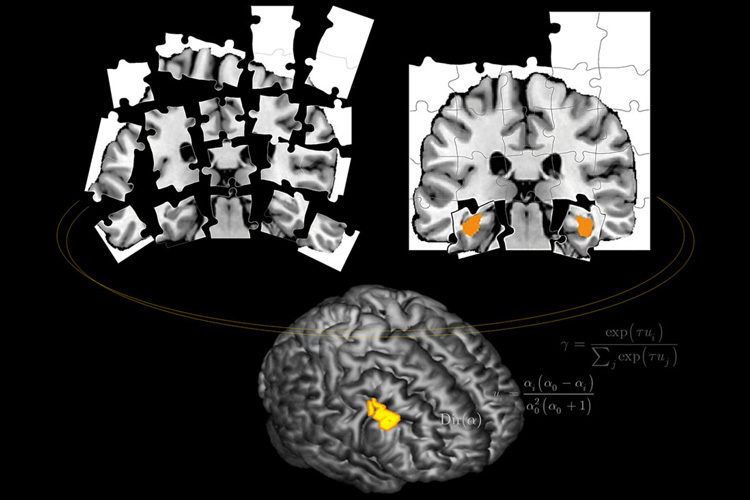
What happens in the head of a person who believes in bad signs and good omen? This problem was interested in the California Technological Institute. Kaltech is primarily known as the reserve of physicists, astronomers and generally scientists involved in the exact sciences. It was here that Richard Feynman gave his famous course of lectures in physics , and most of the Nobel Prizes, employees and graduates of Kaltha received for research of elementary particles. Famous biologists also worked here - for example, the discoverer of the DNA structure James Watson. And now the employees of this institute have undertook to deal with the systems for the search for causal relationships working in the brain of superstitious people-and not only them alone.
The experiment itself resembled a game with a one -armed bandit. Usually this happens like this: you pull the lever of the slot machine - and three pictures appear on the screen. Three cherries, three seven and different other combinations (known in advance - this is important!) Means that you won. Now coins are sprinkled from the machine.
Scientists from Kaltech turned this scheme inside out. Roughly speaking, coins are pouring out of time from time to time - and you need to guess what winning combinations are generally. In other words, find a pattern in particular cases.
True, in reality, everything looked a little more boring than an underground casino in laboratory interiors. Pictures (not three pieces, but as many as five at-a star-star leaf-star leaf, for example), was simply shown on the display to a person lying inside a magnetic resonance tomograph. There were no ringing coins either - but the experimental ones fought for a real gain in dollars.
In the course of the game, each subject studied - and here it should be noted that by the term “training” scientists understand not sitting at the desk, but the ability to build hypotheses based on their experience. For example, from the game to the game, the experimental experimental is more and more sure that if a picture with an asterisk appeared, he will certainly win this round (and because of the picture with a leaf, on the contrary, he will lose). If such a stable confidence that a certain picture would give a win or loss, the participant arose after the first round, in which the image met, it means that he instantly concluded about its significance. It was such training on the only example that scientists were most interested in. Here are two events occur simultaneously (for example, “Asterisk fell out” and “I won a lot of money”). In which case will the brain draw far -reaching conclusions based on this single example?
The ability to remember the relationship between events the first time for extreme situations, when each next meeting with an incomprehensible is unjustifiably expensive. An example is the knowledge that the finger should not be poked into the fire, and the scissors in the outlet.
From time to time, coins are pouring out of time from time to time - and your business is to guess what winning combinations are generally.
But usually we do not need to rush with conclusions, and we can afford to leisurely accumulate examples of the coincidence of two events, until they are gained enough to write down “yes, there really is a connection”. For example, if we liked the food in the restaurant, but did not really like the waiter, the idea of a “bad restaurant” will not immediately be printed in memory.
However, if we come to a restaurant over and over again and over and over again we see gross waiters there, it comes time to be wary and stop visiting it. So the usual gradual training works - it carefully accumulates the facts before drawing conclusions. But for extraordinary circumstances, we have a special system of instant learning, for which it is not necessary to repeat twice. For example, if we are poisoned by food, then the first time we remember that it is dangerous in this restaurant, and we will not want to return there. But how does our brain understand when it needs to use a quick memorization system, and when is ordinary and more reliable?
Of course, by default, collecting a sufficient number of facts is more profitable, so we need to look for what should change in the environment, so that we decide to judge on the basis of the only example. It can be assumed that we need to immediately decide on the cause of the incident, if it is new for us (“before I have never smelled of burning at home - probably because I had never prepared before”). Another opportunity - that we quickly draw conclusions only when the consequences of the event are quite serious for us (“I sometimes lost a small amount of money, but yesterday I stole an annual salary; apparently, I should not take it with me to a bar”).
In fact, it is even more interesting: the conclusion that there is a connection between events, we make the fastest in a situation where there are no reasonable grounds for such conclusions.
In some rounds, scientists specially set up everything so that the participants did not have reliable data for any forecast for the future (imagine, for example, that a “one -armed bandit” has gone crazy and spits out the coins without depending on what is on the screen).
But the less the participants had a chance to deal with the real influence of the picture on the outcome of the game, the faster they began to associate it with a win or loss. Sometimes they were enough for one combination “Picture-Vygrysh” in order to firmly assure, as if these two events were connected. And such training took place on the fly only when the situation was actually as vague as possible.
It can be assumed that if there is a lot of money to the stake, then we approach the search for patterns more responsible. But the conclusions were equally hasty (plus or minus), regardless of the size of the rate. And if, for example, some amount of winning was displayed on the display for the first time, this also did not change anything.
The typical reaction of this brain zone is the signal "All the Enjoy and Strange."
It turns out that the main task of the quick training system is to save us from the oppressive feeling of uncertainty, and the novelty of the situation and our risks are secondary to it.
Here one could recall the “fast brain subsystem” and “slow brain subsystem” described by the Nobel laureate on economics Daniel Kaneman in the book “Think quickly, decide slowly”. The idea is: “Slow subsystem” (it is also a rational mind) - dear to use, requires a lot of glucose, and the brain exploits it except for extreme necessity, and by default, is content with the “quick system” (roughly speaking, intuition).
But in the classical experiments of Kaneman, no tomographs were used, and in an experiment with the players it became clear that the Nobel Laureate scheme describes the events not quite correctly in this situation. The team from Kaltha claims: this fast system is not a default regime, but a spare parachute in case we do not own the situation.
What exactly did scientists see on the tomograms of subjects? First of all, they discovered the area of the brain, which - not a lot - monitors the predictability of what is happening. Her typical reaction is the very “all worse and stranger” from Alice in Wonderland.
This area-the ventral-lane prefrontal bark-was the more active, the less defined the causal relationships between the pictures and the results of the game were. Sometimes this area began to work in a coordinated brain, with a hippocampus. Hippocampus is a structure that is responsible for the episodic memory (that is, a memory that concerns the events that took place personally with us, and not abstract facts like the fact that the Volga flows into the Caspian Sea). It was this part of the subject of the subjects that became active during instant training, when they concluded from the connection of the picture and the results of the game from one time. At the same time, the hippocampus at such moments worked consistently with the ventral -lane prefrontal bark, as if responding to her "still weird and stranger."
In this case, the subjects quickly remembered that the resulting result was associated with the incentive, about the effect of which they actually did not know anything.
And during ordinary training, when the results of the game corresponded to expectations, the ventral -lane prefrontal bark and hippocampus worked at a different way.
It is useful to be able to study on the only mistake or to identify the danger by meeting with it only once. True, our instant learning system also has a side effect. The system begins to work with any unpredictable events, but it may be mistaken in which of them are important. After all, uncertainty is annoying, and I want to reduce it at all costs, even if it does not threaten our life and health. If the situation becomes too incomprehensible, we assign the cause of the mysterious phenomenon a fact that is in no way connected with it. So there is a faith in a black cat, which brings troubles, in the need to put a textbook under the pillow on the night before the exam or in a happy shirt, which will help us pass an interview.
The fear of uncertainty is what makes our logic limp when it would be especially useful to us. Logic allows you to say “Stop, I don’t really know anything”, and sometimes the most useful - not to draw conclusions ahead of time.